How to Get Roofing Leads: All Channels & Costs Reviewed
By Makayla Schultheis
Most roofing companies rely on the same handful of channels to bring in new customers: referrals, lead aggregators like Angi and HomeAdvisor, Google Ads, and maybe some paid social. And while those channels can work, we consistently hear the same frustrations from roofers:
They’re expensive. Most roofers pay between $150 and $300 per lead. Google Ads for roofing averages about $187 per lead — among the highest costs in home services. Even “cheaper” options like Angi come with hidden costs once you factor in the close rate, which is typically below 20%.
You have no control. Referrals are hit-or-miss. Paid ads sit right next to your competitors. Lead aggregators sell the same lead to four or five contractors at once, so you're competing on price before you've even introduced yourself. Your pipeline is totally dependent on other people and platforms.
There's a ceiling. The deeper problem with all of these channels is that they only reach homeowners who are already looking. That's a fixed pool — and every roofing contractor in your market is fishing in the same one. Spending more doesn't grow the pool. It just makes the competition more expensive.
We put together this guide covering every major roofing lead generation channel, including what each costs, how exclusive the leads are, and which options give you the most control over your pipeline.
We start with our solution, GlassHouse, because it’s the most proactive, exclusive, and cost-effective approach. Then, we’ll explore some of the other popular lead gen methods.
How to evaluate channelsBefore getting into each channel, it helps to have a framework for comparing them. Most roofers optimize on one dimension — cost per lead — and ignore the other two that matter just as much. The three things worth measuring on every lead channel:
With that frame in mind, here's how each major roofing lead-generation channel stacks up. |
Digital door knocking with GlassHouse
Digital door knocking is the equivalent of door-to-door canvassing, but on a much larger scale. Instead of sending a crew to knock on doors physically, you're reaching hundreds of homeowners right on their phones via SMS and email.
GlassHouse finds homeowners in your service areas so you can reach out to them directly. You own the message and the relationship. You're not competing with four other contractors for the same response.
And we’re the only platform that does this. For roofing companies that want to stop renting their pipeline from Google and Angi and start owning the neighborhoods they work in, it's a faster, more predictable way to grow.
Why the roofing industry is uniquely well-suited for this
There are two types of roofers, and digital door knocking works powerfully for both.
For storm chasers, it's all about timing.
When a hailstorm hits an area, most homeowners haven't started searching yet — they haven't even called their insurance company. The night before your crew rolls out, you get into GlassHouse, draw shapes around the affected neighborhoods, and schedule your texts to go out at 9 a.m. By the time your door knockers arrive, homeowners have already heard from you. You're not a stranger anymore — and that changes everything about how that conversation goes.
For retail roofers, it's the "around existing jobs" angle.
Every job you complete is a credibility signal for the surrounding neighborhood. A message like "We just finished a roof on Elm Street and noticed several homes nearby with similar shingle aging — we'd love to stop by for a free inspection while we're in the area" lands completely differently than a cold ad from a company the homeowner has never heard of. Proximity equals trust. And your crew is already there — present, visible, (sometimes loud) for days. GlassHouse lets you capitalize on that before you pack up and leave.
This is the key insight that applies to both: it's no longer a cold touch. When your team shows up after a GlassHouse campaign has already gone out, that homeowner already knows your name. The conversation starts warm.
And unlike buying leads from aggregators, when a homeowner replies, they're replying to you.
Complete Roofing in Woodstock, Georgia, called GlassHouse a "no-brainer." In just 2.5 months, they hit a 75x ROI. After four months: 26 qualified appointments, $150K in won revenue, and 1 to 2 booked appointments per day during their busy season.
How digital door Knocking works in GlassHouse
Here's what the actual workflow looks like:
Log in and open the territory map. Your existing customers are plotted as green pins — a visual of where you've already worked and which neighborhoods you're known in.
Draw a shape on the map around the neighborhood where your current or upcoming job is located. Switch to satellite view to confirm you've captured the right streets.

Apply property filters to get hyper-targeted results before you reveal any contacts. Filter by home age (older roofs are more likely to need replacement), home value, home size — whatever criteria make sense for your services. You only spend credits on contacts that actually match your target.
Reveal the neighborhood. We pull homeowner contact data — mobile, email, and property details — for everyone who fits your search criteria. Our data is sourced from multiple providers, scrubbed and enriched, with a 76% accuracy rate and less than 1% opt-out rate across campaigns.
Build your campaign. Our system includes proven templates pre-loaded in accounts, and our onboarding team can help get your messaging dialed in and set up. A typical opener: "Hi [Name], a storm recently moved through your area, and we're already inspecting roofs on [Street] this week. We'd love to stop by and check yours out at no cost. Just reply YES if you're interested."

Launch. Schedule your messages to send to your selected contacts.
Note: We handle all 10DLC registration and TCPA compliance automatically, so you’re always covered. We exclude anyone on the DNC and TCPA litigator lists from our contacts, so you never accidentally reach out to them (and anyone who opts out of your messages is permanently removed from your contacts). Your messages go out from a local 10-digit number registered to your business, and sending hours are enforced automatically.Hot leads surface in your sales board, with real-time text and email alerts. You can respond manually or let our AI autoresponder, Ask Jackie, carry the conversation through to a booked appointment.
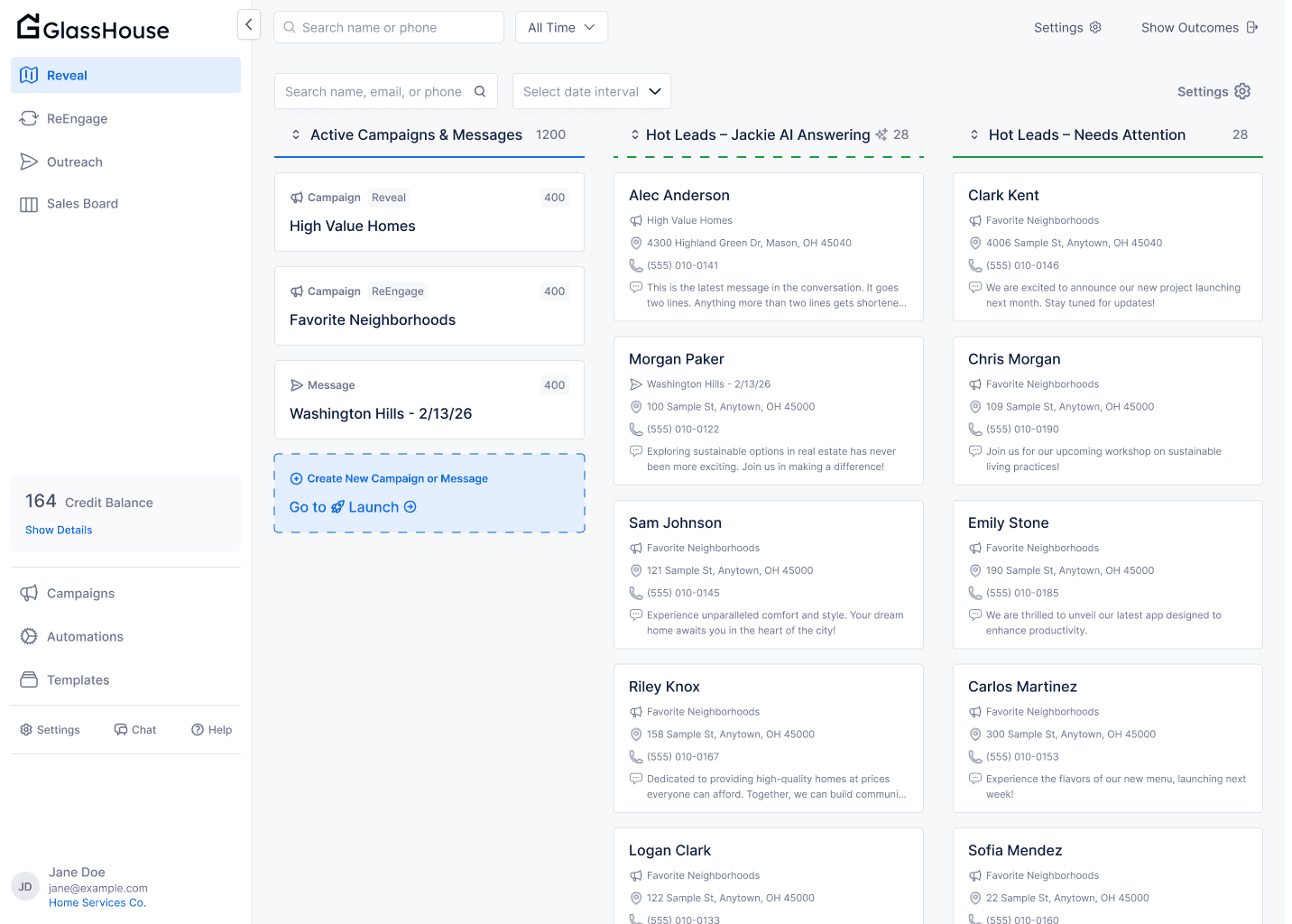
Once a homeowner engages, their contact information is pushed to your CRM via a webhook — Jobber, FieldRoutes, HubSpot, and others are all supported.
Pro tip: A lot of our roofing companies pair GlassHouse with their drone operations. Text the neighborhood, generate interest, then send the drone crew out to inspect and close on the spot. It's a complete outbound motion from first touch to signed contract.
All in all, managing this workflow only takes 1 or 2 hours per week. The platform is super straightforward, designed to streamline the entire outbound process, so you can learn the ropes quickly and get moving. But if you’d rather have us handle it for you, our team can take the reins. We’ll find the best contacts and build your campaigns, so you can focus on the hot leads that come your way.
What it costs
GlassHouse is structured around a platform fee plus credits. One credit reveals a homeowner's contact data; three credits sends an outbound SMS. At typical usage levels, you're reaching around 3k homeowners per month at $35 to $75 per lead.
At a 0.35% SMS conversion rate — the benchmark for higher-ticket services like roofing — that's roughly 10 hot leads per month. For a roofing company with average job sizes in the $8k to $12k range, a single closed job covers the full annual platform cost. Most customers see that happen within the first two months.
GlassHouse at a glance
|
See what Digital Door Knocking can do for your business
Enter a few details and see the leads, revenue, and return on investment GlassHouse can drive for you.
What industry are you in?
We'll use this to set your benchmarks for conversion rate, deal size, and close rate.
Select your vertical:
Ready to see how digital door knocking works for your market? Book a free demo of our system.
Traditional outbound (direct mail, door knocking & local events)
Outbound — whether through GlassHouse or traditional methods — flips the reactive approach. Instead of waiting for homeowners to find you, you're going directly to them, in the neighborhoods you want to work in.
The most common modes of attack here are door-to-door canvassing, attending local events, and sending out direct mailers.
Door-to-door canvassing
Physical canvassing is still one of the most effective tactics in roofing — especially after storms or in neighborhoods with aging roofs. A good canvasser can usually convert 1 in ~10 to 15 homes into inspection appointments under normal conditions. In post-storm situations, it can jump to 30% or 50%.
The cost per lead is low (mainly labor), but it doesn't scale without adding people. Most roofing companies pair canvassing with a territory mapping app like SalesRabbit or Spotio to keep track of where they’ve been and avoid re-knocking the same doors.
Local events & sponsorships
Home shows and community sponsorships build brand recognition in a way digital channels can't fully replicate. A homeowner who's seen your truck at their kid's Little League game or your booth at the neighborhood home show will be more familiar with your brand and more likely to trust your ads when they see them. It's not a direct lead-generation channel — it's what makes your other channels work better.
Some specific opportunities worth prioritizing here:
Home shows: These give you direct interaction with homeowners who are actively thinking about home improvement.
Neighborhood community events and HOA gatherings: These are high-trust environments where word-of-mouth spreads quickly.
Community and sports sponsorships (Little League, school events, local 5Ks): These keep your brand visible in the neighborhoods you serve.
Networking groups like BNI or the Chamber of Commerce: These let you create referral relationships with other home service providers and local businesses.
Direct mail
Direct mail is less common in roofing than door-knocking, but it's worth knowing about. For a typical postcard campaign targeting homes in your service area, you’ll see:
50¢ to 70¢ cost per piece (design, printing, postage)
1% to 3% typical response rate
$20 to $70 cost per lead, depending on response
Strategic targeting makes a big difference. Homes built 15+ years ago, neighborhoods you've recently worked in, and areas with visible storm damage are all higher-probability targets than a blanket zip code mailing.
The limitation is timing. USPS turnaround times mean you can't move as quickly as with digital outreach (particularly after a storm, when timing is everything).
While all these methods are pretty straightforward, inexpensive, exclusive, and controllable, they only scale as far as your boots on the ground will take you. (That's where GlassHouse comes in.)
Traditional outbound at a glance
|
Referrals
Referrals remain the highest-converting lead source for roofing companies — and the one with the lowest CPL.
Industry benchmarks put referral close rates above 50%, compared to 10% to 20% for third-party leads. And unlike every other channel on this list, the CPL is essentially zero (excluding any referral incentives you offer).
The downside here is that referrals don't scale predictably. You can't turn them on when the pipeline is thin, and volume depends almost entirely on how many jobs you're doing, how strong your customer base is, and how happy your customers are. That makes referrals an important part of the mix, but not a growth strategy on their own.
To systematize referral generation:
Ask for them at job completion and in your follow-up communications — most contractors don't ask at all.
Offer incentives such as gift cards or discounts on future work for successful referrals.
Build relationships with insurance adjusters, real estate agents, home inspectors, and property managers for cross-referrals. Insurance adjusters are especially valuable for storm-driven roof repairs — they're seeing damaged homes before homeowners have even picked up the phone.
Stay in touch with past customers — a periodic check-in keeps you top of mind when a neighbor asks for a recommendation.
Referral programs at a glance
|
Lead aggregators (Angi, HomeAdvisor, Thumbtack, Networx)
Angi, HomeAdvisor, and Thumbtack are probably the most well-known names in roofing lead generation, and for good reason. They have massive consumer audiences, and the promise is simple: homeowners come to them looking for contractors, and you get connected. Seems like a pretty fail-proof system.
But the catch is baked into the model. When a homeowner submits a request, the platform sells that lead to multiple contractors — often four or five simultaneously. By the time you call, they've already heard from your competitors. At that point, you're competing purely on price and availability, which drives margins down even if you do close the job.
On that note, we can't forget about the close rates here. Most contractors are only winning a fraction of the leads they're paying for, which means they have to keep spending just to maintain (somewhat of) a steady pipeline. The spending compounds fast.
It is worth mentioning, though, that some services, like Service Direct, offer exclusive roofing leads — sold to only one contractor. It's a step up from the shared model, but you're still dependent on someone else's platform to generate them.
All in all, lead aggregators don’t make sense as a long-term growth strategy. You have to spend so much here to see any type of results, and every dollar you spend on shared leads is a dollar that isn’t building a channel you own.
That said, lead aggregators can make sense in some cases:
When you're a new company and need volume to get going.
During slow seasons, when you need to fill gaps.
As a small slice of a diversified lead mix — not as a primary channel.
Lead aggregators at a glance
|
Local SEO & Google Business Profile
Organic search is the best long-term investment in roofing lead generation — in theory. Once you're ranking, leads come in without ongoing spend, and your cost per lead is very low.
The problem is getting there.
Search engine optimization (SEO) isn't something most roofing business owners can just figure out on their own. It requires technical knowledge, consistent content, and an understanding of how Google's algorithm works — none of which are skills you picked up swinging a hammer. Which means if you want to do it right, you're typically hiring an agency.
Roofing-specific marketing agencies like Roofer Elite and Hook Agency charge between $1.5k and $5k+ per month. And you're looking at 3 to 6 months (at least) before you see meaningful results.
That doesn't mean SEO isn't worth it. For established roofing companies with the budget and patience, it compounds beautifully over time. But it's not a tap you can just turn on, and it's not cheap to do well.
If you're going to invest here, the two highest-leverage pieces are your Google Business Profile and your website.
Google Business Profile (GBP)
Your GBP is what gets you into the "local pack" — the map results that show up at the top of Google for searches like "roofers near me" or "new roof installation [city]." This is the one piece of local SEO you can manage yourself without much technical knowledge. To optimize it:
Make sure your business name, address, and phone number are accurate and consistent across every directory.
Add high-quality photos of completed projects and your team.
Actively request reviews and testimonials from every satisfied customer — star rating is one of the most visible trust signals a homeowner sees.
Respond to all online reviews, positive and negative.
Your website
Beyond GBP, your website needs to be built to rank for the right searches — and this is where most roofing companies need outside help. The basics an agency would handle:
Dedicated service pages for each offering (repair, replacement, inspections, emergency services, commercial roofing).
Location pages for each area you serve — "roofing contractor [city]" terms are often lower competition than broader keywords.
Fast load times and mobile optimization. If your site takes more than 3 seconds to load on mobile, you're losing leads before they even see your content.
Clear calls-to-action on every page.
Another option worth mentioning: Google Local Services Ads (LSAs). These sit above standard search results, and you only pay when a verified lead contacts you directly — typically $40 to $100 per lead for roofing. If you're not ranking organically yet, LSAs are worth testing while your SEO builds.
Local SEO at a glance
|
Google Ads & paid social
Paid advertising can deliver quick results because it puts you in front of homeowners who are actively searching for roofers and looking to hire someone right here, right now. The intent is so high.
But, of course, nothing that good comes without some tradeoffs.
Paid advertising can be an expensive road to go down (re: roofing is one of the most competitive categories in paid search).
And running them effectively isn't simple. As with SEO, most roofing business owners don't have the expertise to set up and manage campaigns on their own, which means hiring an agency or dedicated specialist — adding even more to the overall cost.
Google Search Ads
With a well-optimized Google Ads campaign, you'll typically see:
~$11 average cost per click
~5.6% average conversion rate (clicks to leads)
~$187 cost per lead — this doesn't factor in what you're paying an agency or specialist to manage it
Our best practices to get the most out of Google Ads:
Target high-intent, specific keywords — for example, "roof replacement estimate" converts better than "roofing services."
Use dedicated landing pages for each service, not your homepage.
Track phone calls, not just form fills — most roofing leads call rather than submit a form.
Consider LSAs — see above — alongside or instead of standard pay-per-click (PPC).
Social Ads
Ads on social media platforms like Facebook and Instagram are cheaper per lead — between $20 to $80 for roofing — but have lower intent. The homeowner wasn't searching for you; you just showed up in their feed.
These are best for retargeting people who've already visited your site or for running awareness campaigns in specific zip codes (like after a storm, when folks may need roofers to remedy the damage).
For most roofing companies, paid ads work best as a complement to other channels rather than a primary source of new leads. If you're working with a limited budget, start with search where the intent is higher, and add social retargeting once that's dialed in.
Paid ads at a glance
|
Roofing lead generation companies
There are a handful of well-known companies in the roofing lead generation space — some sell leads, some build your marketing infrastructure, and one lets you generate your own. Here are some quick details about the most common options.
Angi & HomeAdvisor
Angi and HomeAdvisor both operate on the shared-lead model we covered earlier. Leads start flowing quickly, but you're competing with multiple contractors for every response. Worth knowing about, but approach with realistic expectations on close rates and true cost per customer.
Service Direct

Service Direct generates leads and sells them exclusively to one contractor, so you're not racing four other roofers to the same homeowner. Pricing runs higher ($50 to $150+ per lead for roofing), but the exclusivity makes it a legitimate step up from Angi. Worth testing if shared leads haven't been converting well for you.
Roofer Elite

Roofer Elite is a roofing-specific marketing agency focused on local SEO, reputation management, and content. Rather than selling leads directly, they build out your online presence to generate inbound over time. Better fit for established businesses with the budget and patience for a longer-term play.
Hook Agency

Like Roofer Elite, Hook Agency specializes in digital marketing strategies for roofing companies and has a strong reputation in the industry. They tend to work with larger operations ($1M+ revenue) given their pricing and scope. Worth considering if you're at that scale and looking for a dedicated agency.
GlassHouse

GlassHouse operates on an entirely different model. Rather than buying leads from someone else — shared or exclusive — we give you the tools to generate your own. You choose the neighborhoods, we pull the contact data, and you own every conversation that comes from it.
Every option above puts you in a reactive position, waiting for leads to come through someone else's platform. We're the only one built for proactive outreach — the only one where you create the opportunity.
Best practices for roofing lead generation
Use a mix of channels
No single channel is reliable enough to build a business on. The roofing companies with the most predictable pipelines typically layer three or four sources into their lead-generation strategies: referrals as a base, SEO for long-term volume, paid ads for on-demand fill, and at least one active outbound channel, so they're not entirely dependent on homeowners finding them first.
As a rough benchmark, top roofing companies tend to distribute their leads something like this:
~30% referrals
~20% organic / SEO
~20% paid advertising (Google Ads, LSAs)
~20% outbound methods (including digital door knocking)
~10% repeat clients
The specific split will vary based on your market and how established your business is — but if any single channel accounts for more than 50% of your leads, that's a concentration risk worth addressing.
When developing your strategy:
Separate lead types before channels. Insurance/storm and retail replacement are different businesses. Different tickets, cycles, and what drives them. The right channel for one is wrong for the other.
Run three postures, not two. Baseline demand capture (SEO, LSAs, GBP) catches people already shopping. Storm response (canvassing, geo-social, adjuster outreach) activates within hours of an event. The third — and most underused — is sustained neighborhood saturation around your best completed roofing jobs, because neighbors notice new roofs nearby. This only works on low-cost channels you can run year-round.
Judge channels by contribution, not cost per lead. Close rate matters, but so does volume. Measure cost per signed contract and total contracts each channel produces, then weight the mix accordingly.
Protect the channels that compound. Reviews, referrals, and neighborhood density are owned; paid is rented. Keep a floor on the compounding channels even when paid looks cheaper.
Match cadence to what you're reviewing. Channels monthly, lead mix quarterly, posture shifts within 48 hours of weather, strategy once a year before spring.
Track your cost per lead by channel
If you don't know what you're paying per lead — and what's happening to those leads — you can't figure out what’s working for you and where to pull back.
There are three metrics worth tracking for every channel:
1. Cost Per Lead (CPL)
Here's roughly what to expect:
Referrals: ~$0 (excluding any incentives)
SEO/Organic: under $50 once established
Google LSAs: $40 to $100 per verified lead
Google PPC: ~$187 average for roofing
Facebook/Instagram: $20 to $80, but lower intent
Direct mail: $20 to $70, depending on response rate
Lead aggregators: $50 to $200+ per shared lead
GlassHouse: $35 to $75 per lead
2. Close Rate by Channel
CPL only tells half the story. Remember, a $50 lead that closes at 10% costs more per job than a $150 lead that closes at 40%. Track the close rate separately for every source:
Referrals: Over 50% is the gold standard
Inbound (your own website & SEO): 20% to 40%
Third-party & shared leads: 10% to 20% — the homeowner is shopping around
Outbound (homeowner responded directly to your message): Closer to inbound rates — because the relationship starts with you
3. Customer Acquisition Cost (CAC)
CAC is the full picture: total marketing spend divided by the number of new customers acquired. The construction industry average is around $610 per customer — use that as your benchmark.
The point of tracking CAC alongside CPL and close rate is to catch situations where a channel looks cheap on CPL but expensive on CAC. This happens when close rates are low, follow-up is slow, or you're paying for leads that were never a real fit.
Don't just rely on inbound
The roofing companies growing fastest right now aren't just waiting for the phone to ring. They have an active outbound motion running in parallel — reaching neighborhoods near their jobs and staying ahead of homeowners before a need becomes urgent.
That matters especially in a storm-driven business. When bad weather hits your market, the contractors who are already active in those neighborhoods — who homeowners have already heard from — are the ones who fill their calendars first. Outbound isn't a replacement for inbound. It's what makes your inbound more effective, because you're already a known name.
Common mistakes to avoid
Slow follow-up on high-quality leads. Speed matters more in roofing than in almost any other vertical. A homeowner who responds to an outreach message or submits a form is also likely talking to your competitors. Contacting a lead within the first five minutes makes them dramatically more likely to book — if you wait an hour or more, you might miss your window.
Ignoring the neighborhood opportunity around existing jobs. Your crew is on-site for days, almost impossible to miss. That alone helps build trust with other homes on the street. Most contractors pack up and leave without ever capitalizing on it.
Treating outbound as a one-time blast. Whether it's direct mail or SMS, a single touch rarely converts. Multi-step sequences and consistent follow-up are what actually move potential customers from "I got a message" to "I booked a roof inspection."
Relying on only one channel. Google algorithm updates, rising ad costs, and lead aggregator quality shifts — these things happen without warning. The roofing companies that weather those disruptions best are the ones that aren't dependent on any single source to keep their pipeline full.
Paying for shared leads without measuring close rates. Most roofers know what they're spending on Angi — they don't know what they're actually closing from it. Before you double down on or write off a channel, know your close rate. A higher CPL channel with a much better close rate can be a better investment.
Not tracking analytics. If you don’t dig into which channels are producing qualified leads and at what cost, you can’t improve your strategies and optimize your marketing spend. CPL and close rate tell you what's working. CAC tells you what it actually costs to win a customer. Without all three, you're making budget decisions based on gut feeling instead of data.
How top roofers are winning more business
Every channel in this article can generate roofing leads. But if you're asking which one gives you the most control, the lowest cost per lead, and the ability to reach homeowners before your competitors — GlassHouse is the answer.
It's the only channel where you can lean into proactively reaching new potential leads. That matters because intent at that stage is different: you're not competing on who shows up first in Google results or who calls back fastest after a shared lead. You're the first contractor they've heard from, with a message that says you're literally down the street.
Here’s why our customers choose GlassHouse:
It’s way more cost-effective, with lower CPLs. GlassHouse delivers leads at a fraction of what Google Ads costs for roofing. A single closed job covers the full annual platform cost for most contractors.
You're not competing with anyone for the same lead. When a homeowner responds to your GlassHouse campaign, they're responding to you — not to a form that's been sold to four other contractors at the same time.
The leads you reach are already warm. You're not interrupting a homeowner with a random ad — you're reaching out in a neighborhood where you're already working, with a message that references work you've done nearby. That context means the conversation starts from a place of familiarity, not cold outreach.
It builds your brand beyond the immediate job. Not every homeowner you reach needs a roof this week. But the ones who've seen your name, heard you were working on their neighbor's house, and received a personalized message from you are far more likely to call when they do — or pass your name along when a neighbor asks.
It scales without adding headcount. Traditional canvassing requires people on the ground. Digital door knocking lets one person — even a part-time admin — run outbound campaigns across an entire service area, with automation handling much of the follow-up work.
Want to see how GlassHouse works for your market and crew size? Book a free demo.