How to Get Leads Without Paying for Angi & HomeAdvisor
By Nicole Kurrasch

Any contractor who’s bought leads from Angi or HomeAdvisor knows the pain of dealing with these sites. The cost per lead is expensive, and you're competing against 5 (plus) other contractors. Whoever calls first or bids lowest wins — and close rates stay low because of it. You spend a lot to win very little.
But the shared-lead model is only half the issue. Shared leads are inbound at its worst: the homeowner has no interest in you or your brand, and four or five contractors are pitching them the same service at the same time. There's nothing to compete on but price.
It's essentially commodity price-shopping — and you're paying for the privilege of racing to the bottom. The way out isn't a better lead vendor. It's reaching homeowners directly yourself, so you're the only one in the conversation and competing on more than just a number.
This guide is about how to do that: building your own way to reach homeowners instead of buying shared introductions. The most direct version is going straight to the neighborhoods you want and putting your brand in front of your whole market — which is where we'll start.
To see firsthand how GlassHouse lets you do that, schedule a free demo after reading.
Build Your Own Pipeline with Digital Door Knocking
Plenty of home service companies already know that door knocking works. You can choose the neighborhoods you want to work in, get reps out there knocking on doors, make introductions, and have a real shot at winning the job. Getting in front of homeowners directly lets you build relationships and trust.
Anyone who’s managed door knocking campaigns knows this approach has real limits.
You only have so many crew members who can knock on doors, and you’re stuck working around when homeowners happen to be available. That’s usually in the evenings after work, when people are trying to get dinner on the table and aren’t always receptive to a stranger at the door.
More towns are giving homeowners a way to opt out before you ever reach the porch. Smyrna, TN already has 2,200+ addresses on its No Solicitation list, with fines and lost permits for crews that ignore it. Nashville runs a Do Not Knock list of its own. And as of April, Castle Rock, CO scrapped registration entirely — now a homeowner just needs a sign on the door. This makes door-to-door riskier, more complex, and wastes more time.
Where it is still permitted, door knocking often results in a pipeline that ebbs and flows based on how many boots you can get on the ground and how many homeowners are actually up for a conversation.
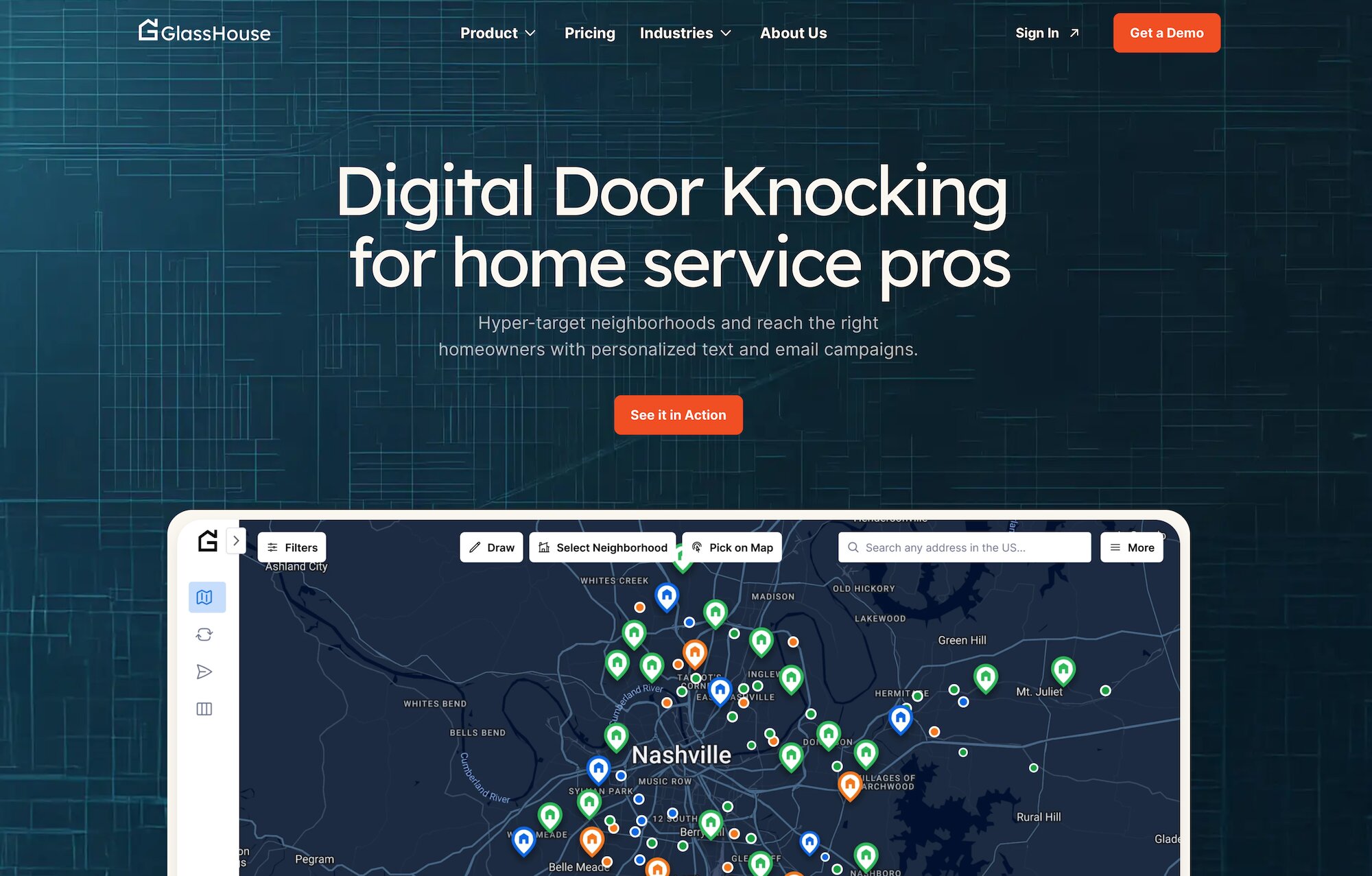
We created GlassHouse to put you in direct contact with homeowners, the same way door knocking does — without any of the constraints that limit how much ground you can actually cover. We call this approach digital door knocking.
Instead of a crew walking the block, you reach homeowners where they already are: on their phones, with a quick text. They respond on their own schedule instead of yours, which means the conversations you do have tend to be more convenient for them — easier to get time scheduled to show up and close the sale.
You still own every one of the relationships with the people you speak to. Nobody's brokering your introduction but you — you choose the neighborhoods to target and send the outreach. And when you win jobs, those homeowners are your customers. So when they need something else down the line, or mention you to a neighbor, that's still your relationship to work.
This approach also gives you a ton of control over managing your pipeline. You can run campaigns anytime you need to keep your book full — feeding it strategically instead of hoping the timing lines up on its own.
Now let’s get into how GlassHouse actually works.
How Our System Works
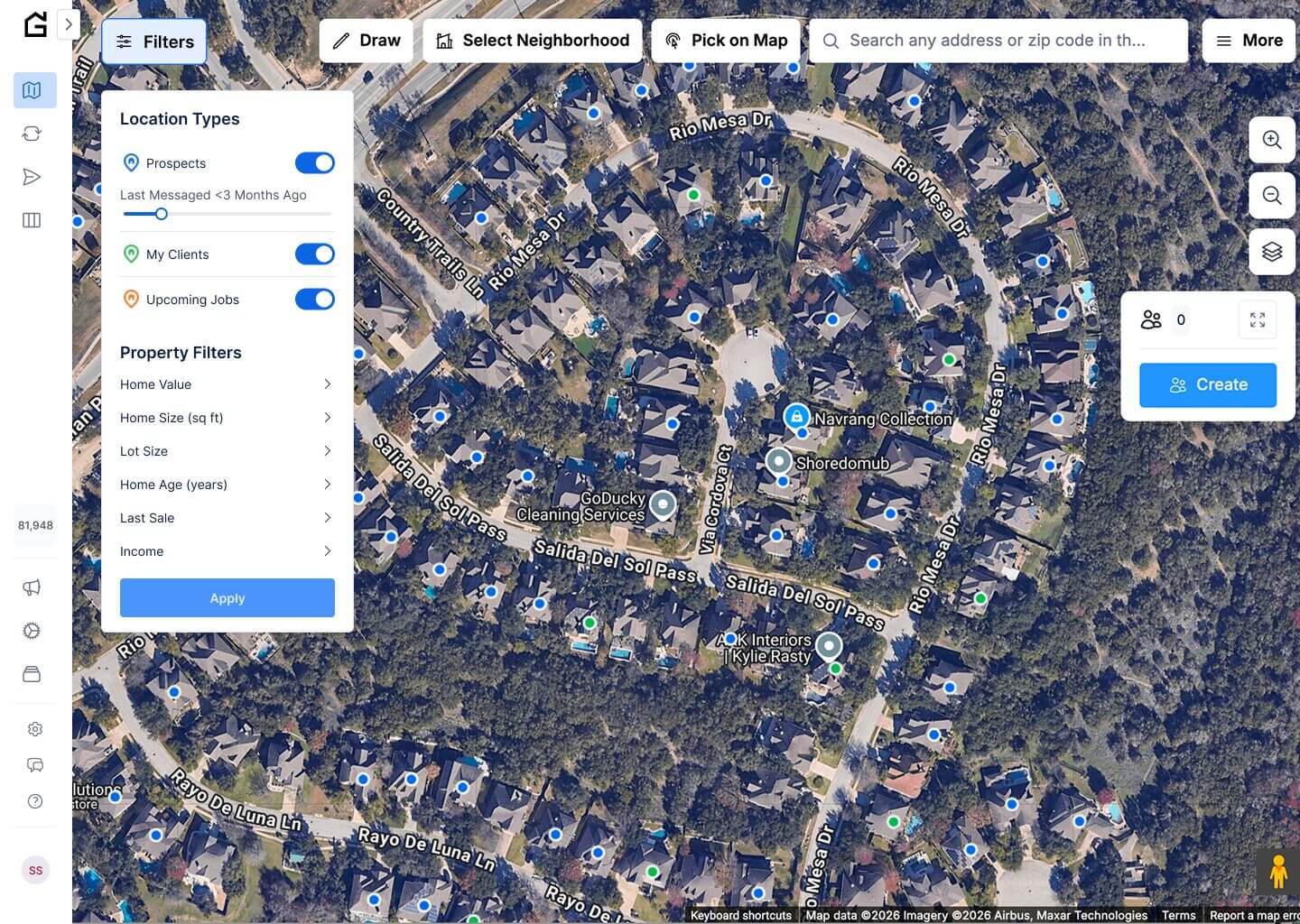
The workflow here is built around a map, so it's super straightforward. We provide a ton of filtering options so you can reach homeowners who make sense for your business, giving you a level of precision in your outreach.
You can reach hundreds (even thousands) of homeowners at once with a single campaign. Our system comes with templates for a range of services — all conversion-optimized, designed to get homeowners responding — so you can quickly build your messaging.
Here's how it works:
Open the map and pull your target areas. Green pins mark your existing customers, so you can see where you've built a presence and expand around it. From there, draw a shape around specific neighborhoods or streets you want to target — any custom shape works, not just a preset radius. Switch to satellite view for a closer look at homes you're targeting: their size, upkeep, and what's around, like nearby wooded lots or newer developments.
Filter for homeowners you want to reach. Search by home value, size, lot size, age, and last sale date in the right neighborhoods. You'll see how many homeowners match your criteria, which tells you whether that neighborhood's worth sending outreach to or whether you should look in other areas in your market.
Click Reveal to see the properties and homeowners that match. All that filtering means you're building a list of qualified prospects instead of sweeping an entire zip code. You're not spending platform credits on homeowners who were never going to be qualified.
Build your SMS campaign. Again, we provide a lot of templates here so you can choose the ones you like best. Our team will also help you hone your messaging for your brand or services.
Schedule and send. Messages go out to everyone on your list at once.
Also worth noting: compliance is handled automatically on our end throughout this process. GlassHouse manages all 10DLC registration and TCPA compliance, scrubs DNC and litigator lists automatically so you're never reaching out to someone you shouldn't. We also enforce compliant sending windows. Every message is sent from a local 10-digit number registered to your business.
Then our system helps you manage all the replies to your messages.
Positive responses become hot leads and land in your sales dashboard, ready for you to pick up the conversation and get an appointment booked. You can also use our AI autoresponder (Jackie) to respond to and qualify new leads for you. This improves speed-to-lead and helps you schedule appointments, so you only have to jump in to win the job.
(Anything negative, including a "STOP" reply, gets filtered out automatically, and that homeowner comes off your contact list so you're not spending time filtering through opt-outs.)
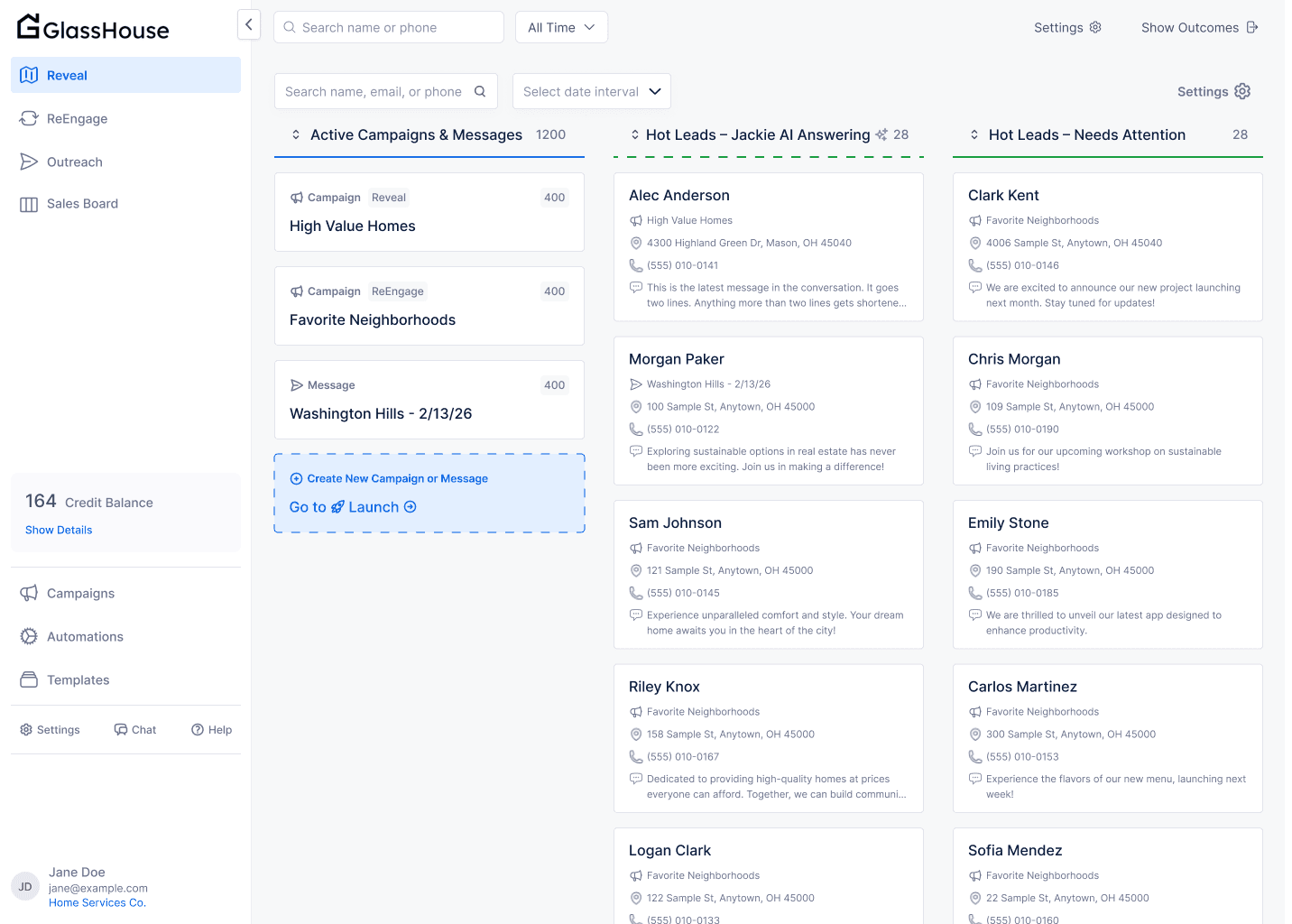
Any hot lead can also automatically get pushed straight to your CRM or FSM. Once a homeowner is in your CRM, you can continue to nurture the relationship, look back on past jobs, and reach out for upsell and cross-sell opportunities.
That CRM integration passes data both ways, too. You can push your customer list to GlassHouse, which allows you to target around upcoming jobs, exclude current customers from outreach, and even retarget them right in our system with our ReEngage feature. It also fills in missing customer details like home size, age, and value from our database. You can build retargeting campaigns for seasonal check-ins, referral requests, or new services you didn't offer previously.
Direct integrations also help keep your data clean. Any lead from GlassHouse is always accessible in your CRM, and you can easily track attribution. Revenue-booked jobs and appointments generated through GlassHouse are all visible right in your analytics dashboard. We even show revenue influenced, meaning customers you’ve won that were at some point touched through a GlassHouse text or email. Matching that activity back against your CRM shows you how much business your outreach is actually driving, allowing you to make better business decisions.
Conversion Rates & Results
Every trade converts differently over SMS, but we generally see conversion rates run inversely to ticket size: that means lower-cost services have higher conversion rates, and higher-ticket trades have lower conversion rates.
Across the board, most of our customers see an average ROI of 5-7x, paying off their investment in our software in just a few closed jobs. A few painting jobs or one solar install covers the cost of our platform (and then some).
Check the full breakdown of conversion rates by business type below:
Carpet Cleaning: 0.60%
Window Coverings: 0.60%
Pest & Lawn: 0.55%
Dryer Vent Cleaning: 0.50%
Exterior Clean: 0.50%
Home Cleaning: 0.50%
Junk Removal: 0.50%
Tree Care: 0.50%
Concrete: 0.40%
Lighting: 0.40%
Water Services: 0.40%
Painting: 0.35%
Fence & Gate: 0.30%
Roofing: 0.30%
Garage: 0.25%
Kitchen & Bath: 0.20%
Mechanical: 0.20%
Solar: 0.20%
Pool Construction: 0.10%
Remodel: 0.10%
We also created an ROI calculator so you can plug in your details — industry, average job or contract rate, SMS conversion rate, and close rate — to see what type of return you can expect for your business:
See what Digital Door Knocking can do for your business
Enter a few details and see the leads, revenue, and return on investment GlassHouse can drive for you.
What industry are you in?
We'll use this to set your benchmarks for conversion rate, deal size, and close rate.
Select your vertical:
CJ Welsh, owner of WOW 1 Day Painting of Nashville, sees an 8x to 10x return from GlassHouse: “It's a direct way to reach customers and stay present in the communities we serve — in a way our competitors aren't."
Learn more about his story and read more case studies here.
How to Get Started
The first step to get started in GlassHouse is with a free demo, so you can see exactly how it works for your business. Our team will walk you through the software and even pull real prospects in your market. We’ll map out the best package suited to your business, and run the numbers on what kind of ROI you could expect.
Our pricing includes a flat platform fee ($3,500/year), and then you purchase credit bundles (3¢ per credit). Credit bundles are based on the volume of campaigns you plan to send in GlassHouse.
You can also add email to your plan to run email marketing and SMS campaigns in parallel. This is $250/month and includes managed domain sending, 7,500 monthly emails, drip campaigns, email copy creation, inbox alerts, and more.
And if you’re interested in having our team manage your campaigns, we also offer a Done-For-You service for $400/month. You’ll get a dedicated account manager who will build your lead channel, create campaigns and manage copywriting, and provide monthly performance reports.
See how our system lets you build a pipeline on your own terms by scheduling your free demo.
Test Additional Outreach Methods — Physical Door Knocking, Door Hangers, & Mailers
We already talked a bit about door knocking above, and that’s something we still encourage you to do. We’ve actually seen it boost conversion rates after sending out campaigns.
We also see teams experiment with:
Yard signs: You can place these in homeowners’ yards after jobs (with their permission, of course), and they serve as an ad for everybody who walks by.
Door hangers: Your teams can place these in the surrounding houses after jobs to let folks know you’re working in their area.
Mailers: You can send these to targeted neighborhoods to put a physical advertisement in front of homeowners.
These ways to get your name out directly to homeowners. But it’s worth mentioning you need volume here to get significant results. For example, with 10k door hangers, you could see around 180 new leads.
We typically recommend that anyone investing in GlassHouse also invest in other channels like these so you're reaching homeowners multiple ways.
Yard signs, door hangers, and mailers put your name in front of a homeowner, but none of them give that homeowner as convenient a way to respond as a GlassHouse text does. If they've already seen your name, the text is what often gets them to become a lead.
For teams still door knocking, GlassHouse lets you target your efforts more strategically. Run digital outreach first to temp check neighborhoods and see which homeowners are most interested, then send reps to the areas where people are responsive and open to a conversation. Reps show up to doors that are already warmed up, instead of working every block cold.
Some tools to assist in your efforts here:
VistaPrint or Zazzle to create door hangers and yard signs
Mail Shark, USPS EDDM (Every Door Direct Mail), and PostcardMania to send targeted mailers
SalesRabbit, SPOTIO, and Knockbase to manage physical door knocking routes — you can also check out our guide on the best door knocking software for more options
Establish a Well-Rounded Referral Network
Referrals and partnerships convert higher than anything you buy — 30% to 50%, compared to 8% to 15% from an online marketplace like Angi. That’s because your name is being recommended by a trusted source. A friend or neighbor talking about you can speak to your quality of work firsthand and can win you more business than you might even be aware of.
The downside of referrals is that you can’t really control how often they happen.
But what you can do here is put more people in a position to refer you. The more people who know your work and can recommend you, the more referrals come in, so it's worth building out a network:
First, of course, you have your customers. You should have a process for asking for referrals after jobs. You can do this in person and send a follow-up text or email that includes both a review request and a referral nudge. It’s also commonplace to offer a referral incentive to thank customers for sending business your way. Gift cards or bill credits work, but double-sided incentives, like a discount for both the referrer and the new customer, tend to land better.
You can also partner with businesses or professionals in your area who regularly work with homeowners. Real estate agents, property managers, home inspectors, insurance adjusters, and so on. These are usually the people folks go to when they need someone like you — a home inspection turns up an issue, an agent's closing on a house that needs work done. General contractors, handymen, and other complementary, non-competing home service businesses are worth the same effort. For example, landscapers and fence installers run into each other's customers all the time. Joining a local BNI chapter or your Chamber of Commerce is another way to plug into a group of businesses already set up to refer each other.
Then, you can join Nextdoor and other neighborhood apps. Homeowners go here to ask their neighbors for contractor recommendations, so it's worth having a presence. Claim your business profile, engage in the threads where people often ask for recommendations, and land the job directly. Staying active here pays off even when you're not in the comments — homeowners who become familiar with your name are more likely to bring you up when someone else asks.
It also helps to build general brand awareness in your community. Attending home shows or HOA meetings, sponsoring local events or youth sports teams, and showing up consistently at things like farmers markets all put your name in front of the people who might need or refer you later.
Turn Your Website Into a Lead-Gen Channel
You can also get leads directly from your website. If you’re set up with contact forms, booking widgets, or click-to-call buttons, homeowners can more easily get in touch with you.
However, those easy contact elements only help you win business from those who are already looking up your specific business. If you want to reach a wider audience, you need to improve your website's visibility, and the best way to do that is by optimizing your website for search engines.
Search engine optimization (SEO) is the art of getting your website to appear in search results when people Google “roofers near me,” “lawn care,” or “[insert your vertical here]”. The people doing those searches are actively looking for a business like yours — they’re seeing who’s in the area and are ready to hire somebody. You want to be part of that conversation.
An extra perk worth mentioning here: top-ranking, high-quality sites also get pulled and cited in AI engines. So if you set yourself up right, AI tools like ChatGPT, Gemini, and Claude may mention your name when homeowners ask them for recommendations.
Some simple strategies here:
Your home page should be visually appealing and should include your business name, what you do, customer testimonials, and links to your social pages. Booking forms or click-to-call buttons need to be easy to spot here, too.
Create a contact page that lists your phone number, email, and service area(s).
Build service pages for each job type so you’re more likely to appear when people search for specific services or treatments.
Have location pages for each area you serve — same logic as above, but to cover those location-specific and "near me" searches. This is a big part of local SEO, making sure Google connects your business to the areas you work in.
You should also include FAQs on your service pages to answer the common questions you hear during appointments. Something like "what's the best time of year to repaint the outside of your house?" for a painting business, or the equivalent question for your trade.
On that last one, you can also create blog content that covers common topics related to your industry and services, so you’ll appear when people are researching those.
For example, a pest control business might have content on natural ways to get rid of mosquitoes or ants, signs of termite infestations, and whether different types of treatments are safe for pets. In the copy, you want to lean into what makes your advice or services unique and why your solution is the best. These “originality nuggets” set you apart from other general advice blogs and make your brand more memorable.
Giving free advice like that gets you in front of homeowners while they’re still figuring out what kind of problem they have and the severity of it. Then, when they decide they need to hire someone, they already know your name.
After you’ve built out your site, there are a few technical things to check.
Make sure your website works on desktop and mobile devices. Pull it up on your laptop, phone, and tablet if you have one, to ensure it looks and functions right across each device. Most website builders make it easy to optimize for all screen sizes, and you can go back to your website builder to make changes if you notice something is off.
Another thing to pay attention to while checking your site is page load speeds. Large images and videos are common culprits for slowing a site down, so click through your main pages and see how quickly each one loads. You can also use Google PageSpeed Insights, a free tool that scores your site's speed and flags specific fixes if something's dragging.
Once you’re up and running, you can use Google’s other free tools, Analytics and Search Console, to keep an eye on how your site performs. You can see the keywords you rank for, how many visitors you get, the pages the majority of your traffic is landing on, and more. You can use this data to keep fine-tuning your site and your strategy.
Get Your Name on Google & Test Other Online Directories
Beyond your website, you can make your business more visible online by creating profiles on Google, Bing, Yelp, and Apple Maps. These platforms all have free programs built for businesses, designed to put your name in front of people when they search for what you offer.
For example, let’s look at Google’s directory. When we search “roofing businesses near me,” the very top of the results shows a list of businesses and where they are on the map. (You can also see Yelp right below.)
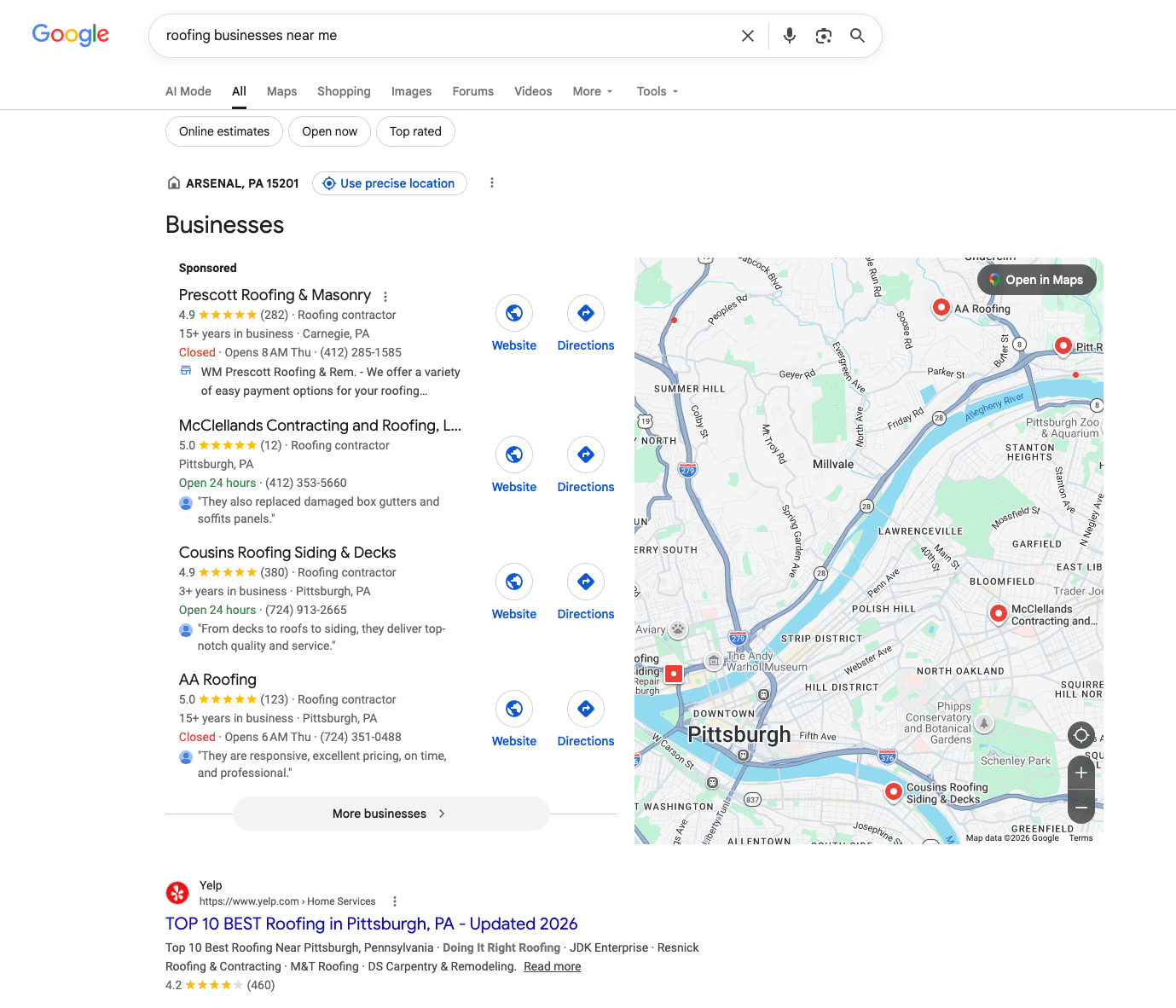
Anyone doing this same search would see a list of nearby businesses to check out. They can look at star ratings, read customer reviews, and visit the business website. Then, they decide who they want to reach out to — directly. This works the same way whether people start their search on Bing, Apple Maps, or Yelp.
Besides this being 100% free visibility, another perk here is that joining these programs and building your business listing is really simple. All you have to do is:
Claim or create your listing
Add in your business details — your category, name, address, phone number, hours, and service area(s)
Upload photos and videos of your crew and past jobs
From there, focus on actively collecting reviews. Encourage customers to leave reviews after jobs, and respond to every review you get. Reviews carry a lot of weight here — more of them and a higher star rating mean you show up more often in these platforms' recommendations and earn better placement when someone's searching.
Follow our links below to create your profiles:
Note: All of these platforms offer paid ad programs, but the free versions work just fine. You can still get seen and reach new customers without paying for any type of ad placement.
Build Your Social Media Presence
Getting active on social media is another great way to connect directly with homeowners. While these platforms might not bring immediate leads, they let you build relationships with folks in fun, organic ways, so they get to know you and your work — and can call you up when they do need you.
Now, some trades naturally have more to work with here. Painting, landscaping, pressure washing, remodeling, interior design, and holiday lighting are all visual by nature, which makes them an easy fit for social media, while electricians, plumbers, HVAC, or pest control companies have less to show off physically. Regardless, there are still lots of content ideas worth trying:
Before-and-after photos or time-lapse videos of completed jobs
“Story time” videos about your most memorable jobs
"Day in the life" content giving homeowners a peek behind the scenes
Quick how-to tips for common fixes homeowners can try themselves
Polls or quizzes on topics related to your trade, to get people commenting and interacting
Limited-time discounts to get homeowners to act quickly — plenty of home cleaning and lawn care businesses offer a discount on the first service or two to lock in longer-term work
Giveaways that ask homeowners to answer a question, share a story, or tag a friend to enter
Contests, like guessing an answer for a prize or a free service
You can really get as creative as you like here. There aren’t rigid rules for making your social media presence memorable. You can jump on viral trends or create funny videos that grab homeowners’ attention. Your content doesn’t have to always be about your work.
You can also use social media to connect with other businesses and creators to post and promote each other. Partner with local businesses and complementary home service professionals to build each other up, and work with influencers to win business from their audiences.
The big things here are staying active and engaging with audiences. You don’t need to overwhelm yourself by trying to publish a dozen reels a day, but you want to post regularly. And you want to encourage conversation on your posts — invite people to comment, respond to comments, those kinds of things. Pages that stay active tend to get more reach, meaning more homeowners see your name over time.
Putting Together a Solid Lead Gen Mix
No single strategy is going to be a silver bullet here. The businesses seeing the steadiest flow of leads use a mix of these strategies to spread their bets. The goal is building enough familiarity that when a homeowner needs your service, you're the name they think of first — and go to directly.
That said, we understand diving in all at once can feel like a lot. Here's what we'd suggest if you're just getting started:
Start with at least one outbound channel. GlassHouse is the easiest and most effective option here — you choose where to target, reach a large batch of homeowners at once, and have real conversations over text. It puts you directly in touch with homeowners instead of placing an ad and waiting for someone to reach out.
Build a website with the core home, location, and service pages covered. FAQs and blog content can come later — don't stress about having those from day one.
Set up your profiles on Google, Bing, Yelp, and Apple Maps so you show up when people search there.
Cover the basics of a referral network. Put a process in place to ask customers for referrals right after a job, and join Nextdoor since that's easy to set up in an afternoon. Building out partnerships takes more time, so treat that as something to grow into.
Create social media profiles on Facebook and Instagram, fill out your bios, and line up a few ideas for your first posts. Publish as you go and set aside a bit of time each day or a few times a week to stay active — you don't need hundreds of posts within the first few weeks.
Once you've got this set up, start tracking where your leads are actually coming from. A CRM makes this easy, but simply asking customers how they heard about you works too.
Then plan performance reviews for at least once a month. You want to use that time to measure leads and close rate by channel, because that combination helps you understand which efforts are actually bringing you the most work. It’s also helpful to look at customer lifetime value — who you’re winning and seeing repeat work from — and which channels brought in those leads.
For example, you might find that Yelp delivers a ton of leads, but you only close a fraction of them, whereas your site gets fewer leads but ones you actually close and keep. That would tell you your website is bringing higher-quality opportunities, and you should invest in building it up more.
These regular check-ins are what let you keep refining the mix over time — doubling down on what's working, testing something new where a channel's falling flat, and building a pipeline that's actually yours instead of one you're renting a piece of every month.
Getting Started
Lead providers — not just Angi and HomeAdvisor, but also Thumbtack, Houzz Pro, Porch, BuildZoom, Networx, and even those exclusive lead generation services that only sell leads to one business at a time — offer a temporary way to pad your pipeline. They can work in a pinch, but they're not going to keep your books full for long, and they'll never let you build an actual customer base of your own.
The strategies above are what actually connect you directly with homeowners. Each one builds a relationship you own outright, one you can keep working for as long as you're in this business, without any third party standing between you and the person who hired you.
GlassHouse is the fastest way to start building that kind of pipeline. You choose exactly who to reach and when, and you own every conversation and every customer that comes from it.
Schedule a free demo with our team to see how you can start making those connections ASAP.