Home Improvement Lead Generation: Strategies & Companies (2026)
By Jackie Vaughn

Millions of homeowners are sitting on mortgage rates they're unlikely to see again anytime soon. So when something breaks, or they want to modernize, they're not moving — they're putting money into what they already have. New kitchen. New roof. New bathroom.
That's good news for home improvement contractors. The demand is there. But the marketing landscape has gotten harder — you have more businesses competing for the same homeowners, the cost per lead is up across nearly every channel, and the strategies that worked a few years ago aren't pulling the same weight.
This guide covers every major lead-gen channel for home improvement businesses (outbound, inbound, buying leads, referral networks) and the strategies and companies behind each. We'll break down how each method works, what to realistically expect, and how to build a mix that holds up.
We kick off with our solution, GlassHouse, and how it's changing the way outbound looks for home service businesses.
To learn more about GlassHouse after reading, you can schedule a demo.
Outbound Lead Generation
Outbound is a proactive approach — you're going to homeowners rather than waiting for them to find you. Most of these methods are tried-and-true tactics home service teams have relied on for years. The difference now is the availability of tools to scale and support them.
Digital Door Knocking: GlassHouse
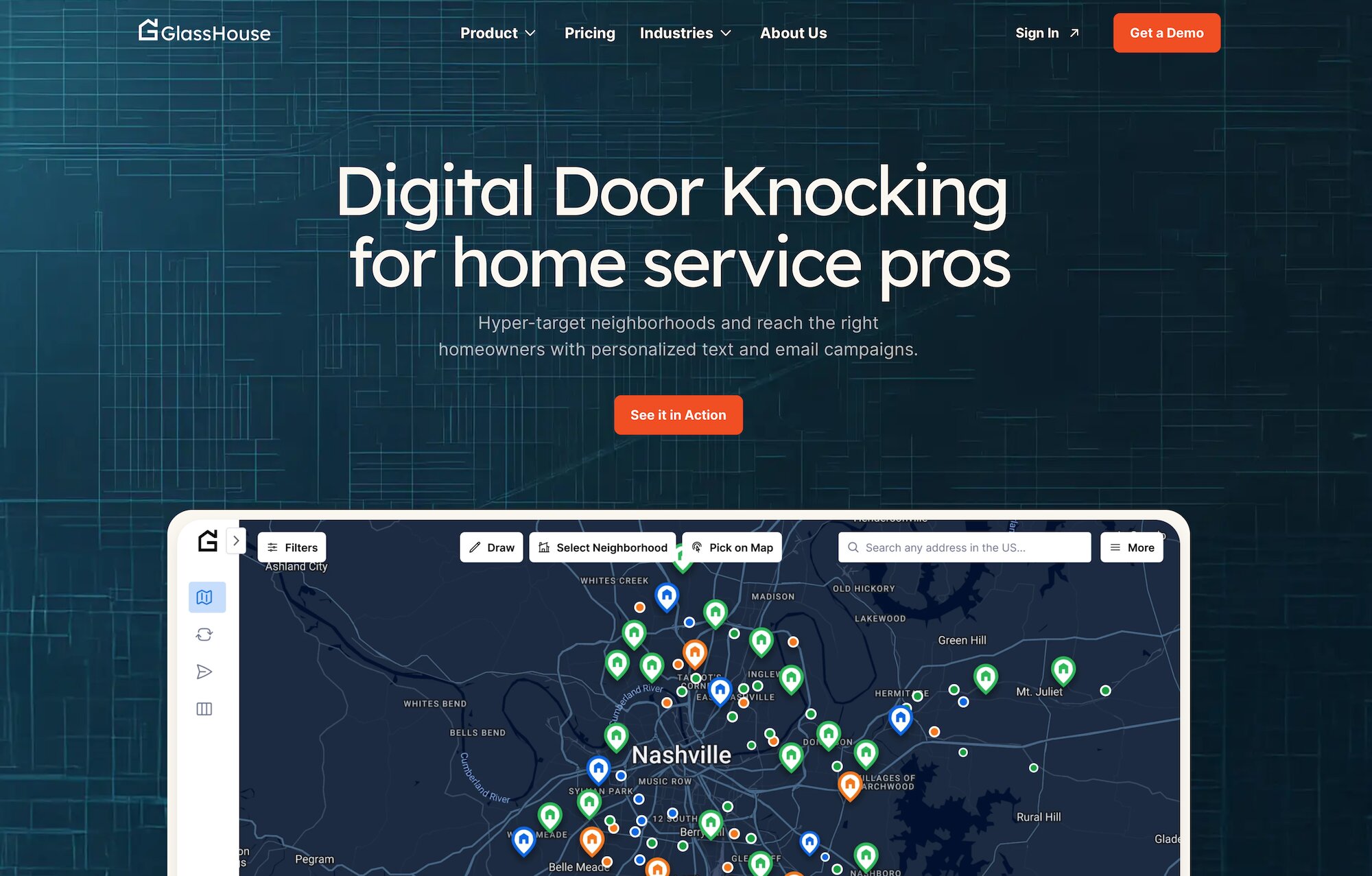
GlassHouse was built around the core pain every home service business feels: finding net-new customers is a constant uphill battle. Referrals and repeat work are great, but they have a ceiling. Growing means reaching homeowners who've never heard of you.
After years of working with home service businesses, our founder noticed they were really only trying to build their customer base in two ways: ads and door-knocking. That’s when he had the idea for GlassHouse — digital door knocking.
Instead of sending reps door-to-door, you're reaching homeowners directly on their phones. You pick the areas you want to win jobs in, set your targeting criteria, and send out a personalized text message introducing yourself. You can reach hundreds of homeowners at once.
Tim Smeltz, owner of NextGen Seal Coat in New Jersey, put it plainly: "Finding new client leads is by far the hardest thing in business. And GlassHouse provides a lot of leads. This past week, we sent out 33,000 texts for $3,300, and we've received over 100 leads. That's 100 new leads in our CRM that weren't there before."
How Our System Works
Here's what the workflow looks like from start to finish:
Pull up the territory map and draw your target area. The map displays green pins to mark homes you’ve already worked on, so you can see the neighborhoods you’re already established in and where you can expand. You can also switch over to satellite view when drawing target areas to zero in on specific streets or subdivisions.
Apply property filters to narrow your list. The targeting here is particularly valuable for home improvement — you can filter by home age, home value, lot size, income, and more. Homes that are 15 to 40ish years old in higher-income areas are often a sweet spot: owners have the means to invest, and the house is due for updates.
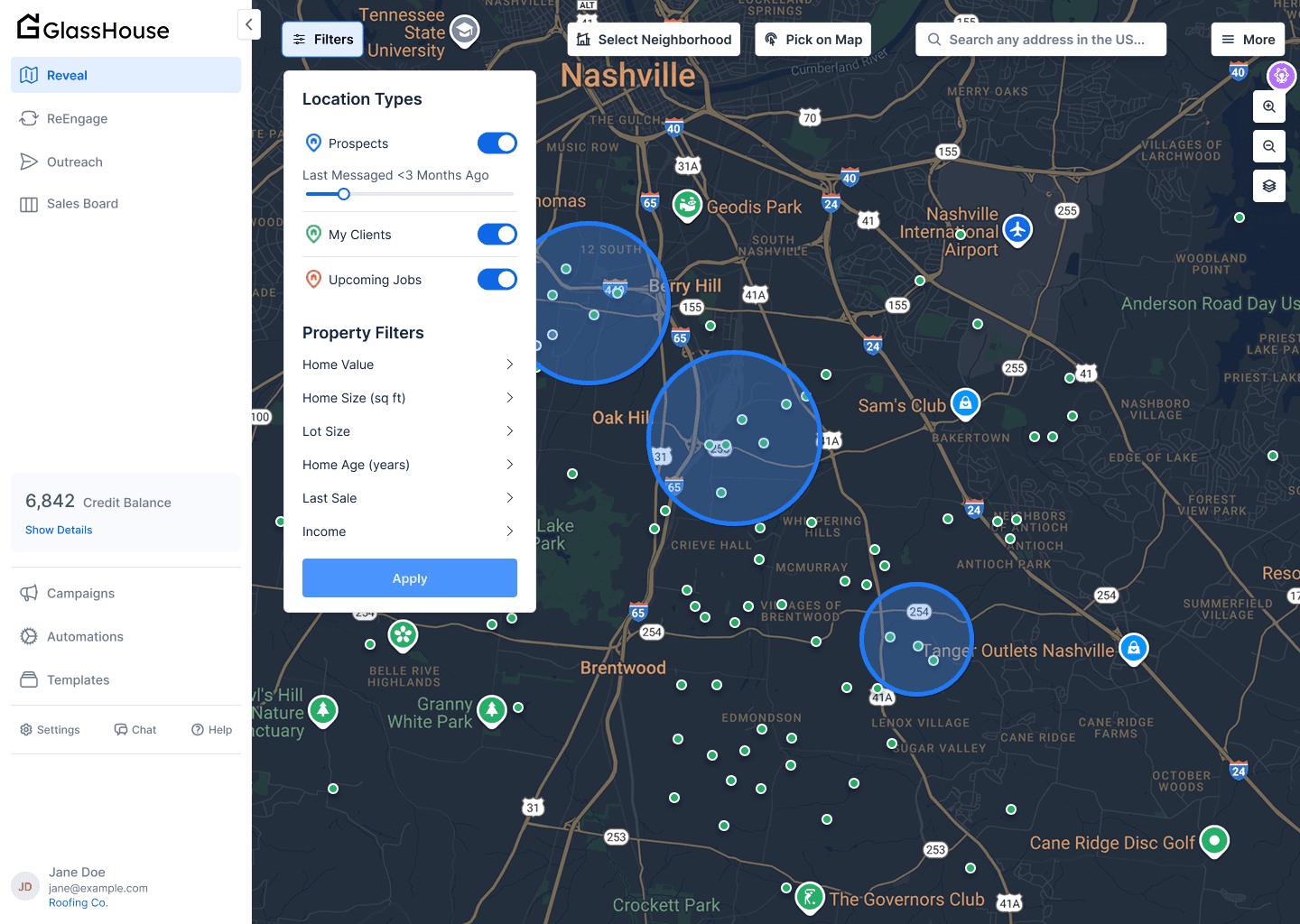
Reveal your contact list. GlassHouse pulls and scrubs data from multiple sources to surface homeowner contact info. We only reveal the folks who match your filters.
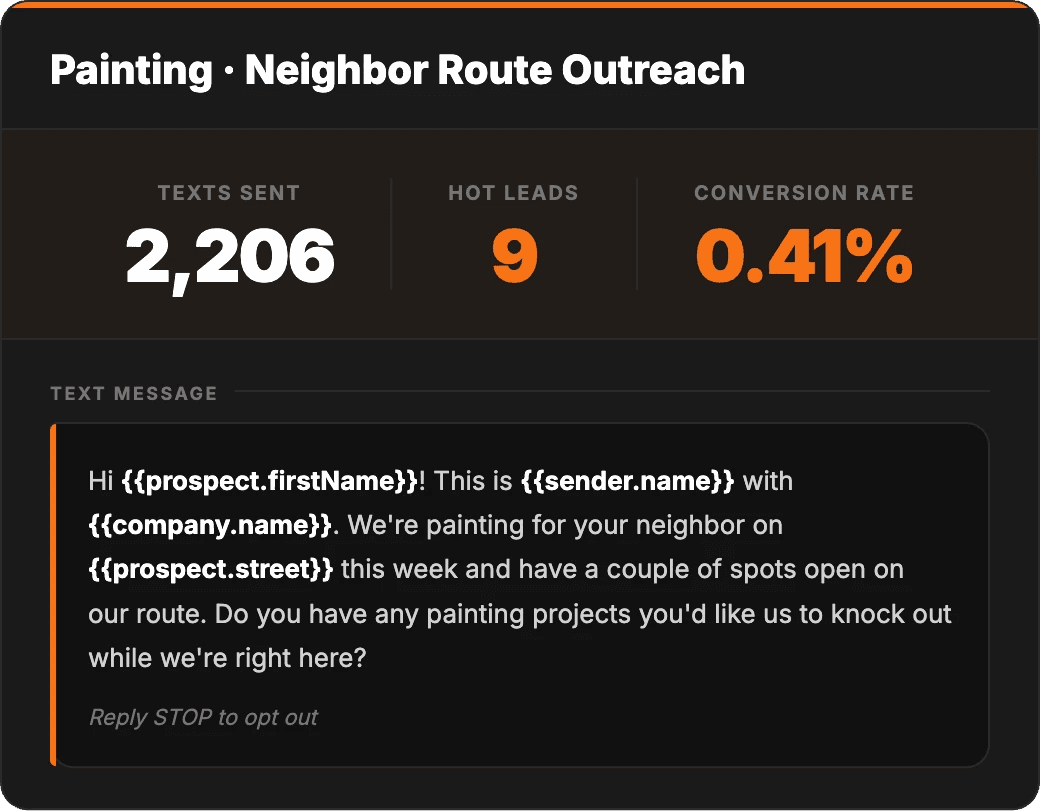
Build your campaign. Our system comes with a ton of templates — all optimized for conversions with clear calls to action — to make this easy. Our team can also work with you on brand messaging to make sure you get this outreach right. You can see an example of an introductory message below:
Schedule your campaign to send and launch.
We send you alerts when homeowners reply. Replies also appear in your sales board, so you can see all potential prospects in one place and work them into hot lead status.
There are two ways to manage prospects in our system: you can respond to messages yourself or have our AI autoresponder, Ask Jackie, handle the conversation. This tool can turn prospects into qualified leads and book appointments, so you just have to show up for the hot leads instead of fielding every single message.
Then every hot lead pushes to your CRM or FSM — we connect with Jobber, FieldRoutes, HighLevel, HubSpot, and most other systems via webhooks — so you can continue nurturing them with follow-up texts, emails, and re-engagement campaigns.
All in all, the workflow only takes an hour or so each week. Once you set up your campaigns, they run automatically, and if you use JackieAI, all the appointment booking is handled for you.
Most of our customers designate one person to oversee this, but you can add as many people as you like to the account and divvy the work in whatever way makes sense for your business. But you can also delegate all the campaign management to our team — we offer a done-for-you service where we’ll build the campaigns, put together the messaging, and schedule it all out for you.
How to Get Started
The first step is to schedule a demo with our team. We'll talk through your current lead generation strategies, where GlassHouse fits in, and walk you through the platform to show exactly how it works.
If you're ready to move forward, we'll get you set up with pricing and onboarding.
The quick pricing breakdown: $299/month platform fee (billed annually) + 3¢ per credit.
Credits are how you interact with contacts in the system — you use 1 credit to reveal a homeowner's contact info and 3 credits to send a message. You can purchase them in bundles and add more any time.
You can also add on the email package or the done-for-you service:
The email marketing bundle is $250/month. It includes 7,500 monthly emails, drip campaigns, email copy creation, AI email warmup, inbox alerts, and more.
The done-for-you service is $400/month. It includes campaign creation, copywriting and management, monthly performance reports, and dedicated account management.
See the platform in action and get a feel for what outreach could look like for your business. Schedule a demo with us.
Check out our ROI calculator below to see how much business GlassHouse could generate for you.
See what Digital Door Knocking can do for your business
Enter a few details and see the leads, revenue, and return on investment GlassHouse can drive for you.
What industry are you in?
We'll use this to set your benchmarks for conversion rate, deal size, and close rate.
Select your vertical:
Physical Door Knocking
Traditional door-to-door canvassing is still a staple for many home improvement companies — reps assigned to specific territories, working routes, and logging outcomes at each door. It's direct and personal, and for businesses capitalizing on existing jobs in a neighborhood ("we just finished a project down the street"), it can be a natural follow-up move.
The limitation is scale. Coverage depends on how many reps you can have in the field, and you're at the mercy of whether anyone's actually home.
That's why physical door knocking pairs well with GlassHouse. You can run digital outreach in the neighborhoods where your reps are working — they'll know which doors to knock, and where conversations have already started. Then the knock becomes a second touch, not a cold intro.
Tools like SalesRabbit, SPOTIO, and Knockbase help with the logistics of physical door knocking — territory mapping, route optimization, rep GPS tracking, lead status, and CRM integrations. They won't generate more doors for you, but they make working those doors a lot more efficient.
To learn more about the best door-knocking software, check out our guide here.
Direct Mail & Door Hangers
Similar to door knocking. Both methods work off the same idea: target specific addresses in neighborhoods you want to work in and put a physical ad in front of homeowners.
Direct mail goes via USPS (postcards, flyers, letters). Door hangers get left at the door without requiring anyone to be home. Both are low-cost per piece, highly targetable by zip, neighborhood, or property type, and work well as a follow-up to existing jobs. Response rates typically run 1% to 3%.
But, of course, there are limitations with these. With mailers, you’re dealing with USPS turnaround times, so you can’t really move fast (which matters most after storms or weather events). Door hangers are quicker to deploy but still labor-intensive at scale.
Good targeting angles for home improvement: homes 15+ years old, neighborhoods where you've recently completed jobs, and homes filtered by value or size for higher-ticket services.
A few tools worth knowing:
SendJim — a direct mail automation platform popular with home service businesses. Automates postcards, handwritten cards, gifts, voicemail drops, and texts, with CRM integrations that trigger campaigns after a job is completed. Their Radius Bomb feature lets you draw a shape on a map and filter by 20+ property attributes — similar targeting logic to GlassHouse, applied to direct mail.
Mail Shark — a direct mail company with radius mailing (targeting homes near recent job sites), weekly saturation campaigns, and a retention program for existing customers.
USPS EDDM (Every Door Direct Mail) — self-serve, low cost, targets entire carrier routes. No address list needed.
PostcardMania — full-service design, print, and mail.
VistaPrint — design and print for door hangers and mailers.
And if you're already running mailers or door hangers in a territory, it's worth layering GlassHouse on top of them. Doing digital outreach to the same neighborhoods reinforces your name with homeowners and gives you a faster-response channel running in parallel.
Inbound Lead Generation
Inbound is the other side of the equation. Instead of going to homeowners, you're building an online presence that pulls them to you. It's a longer play that requires some marketing know-how, but the investment can be worth it. Once your online channels are up and running, they can work for you well into the future. And the leads that come in are exclusive. A homeowner who found you specifically isn't comparing you to four other contractors at once.
Most home services teams use a digital marketing agency for this side of things. A few worth knowing:
Hook Agency — agency focused on roofing, HVAC, plumbing, and electrical. Known for SEO, Google Ads, and web design. Strong track record with larger home service companies.
Roofer Elite — niche agency focused almost exclusively on roofing contractors. Manages SEO, paid ads, and website builds.
ChoiceLocal — franchise-focused agency that works across home service verticals. Handles SEO, paid search, and reputation management.
Paid Advertising
Google Search Ads
Google Search Ads put your business at the top of results when homeowners search for services you offer — "kitchen remodeler near me," "exterior painting [city]," "roof repair cost." You choose the keywords you want to show up for and pay every time someone clicks.
Because you’re targeting people who are actively searching for what you offer, they're more likely to convert than someone who saw some random ad while scrolling. But the cost reflects that — CPL for home services typically runs $50 to $200+, depending on your vertical and market.
These also require ongoing management. Running campaigns without closely monitoring them is an easy way to blow through your marketing budget fast.
LSAs
Google Local Services Ads (LSAs) also appear at the top of search results, but they work differently. Instead of bidding on keywords, Google matches you to relevant searches based on signals like your service area and Google Business Profile.
The bigger difference: you pay per lead rather than per click. CPL typically runs $40 to $100, so it's more budget-friendly than standard search ads. To qualify, you'll need to pass Google's background and license verification — those who do get a "Google Verified" badge next to their listing to build trust with consumers.
Social Media Ads (Facebook & Instagram)
Social media ads like Facebook and Instagram work well for retargeting people who've already visited your website, or for awareness campaigns in neighborhoods where you've recently completed jobs.
That said, they shouldn't be the first place you put your ad budget — think of them as a complement to search, not a replacement. The homeowners seeing these ads weren't looking for home improvement services. They just stumbled across your ad while scrolling. So you're planting a seed rather than catching someone ready to book. And the lower intent here is reflected in the CPL (only $20 to $80).
One other note: if you're in a visual trade — painting, remodeling, landscaping — it's worth building out your social profiles with content from past jobs. Followers who see your work regularly are much more likely to think of you when a project comes up.
Google Business Profile (GBP)
Your Google Business Profile is what shows up in the map results when someone searches for home improvement services in their area — "kitchen remodelers near me," "exterior painters [city]," "fence installers near me."

If you don’t already have a GBP, this should be one of the first things you set up when you’re done reading. It’s free and simple to use; it gets you a ton of visibility when homeowners are searching for what you do; it builds your credibility with both Google and homeowners; and it gives homeowners an easy way to leave reviews. A strong GBP = more calls from local searches without ongoing ad spend.
Here’s how to get set up and maintain your profile:
Add or claim your business here
Make sure your name, address, phone number, and service area are accurate
Upload photos from completed jobs — before and afters work especially well for home improvement
Ask happy customers to leave reviews (include a link in a follow-up text or a QR code on your business card to make this even easier)
Respond to every review, positive or negative
Website & Local SEO
Search engine optimization (SEO) is all about getting your website to rank organically for the searches that matter to your business. You can do this with your home page, service pages, location pages, and blog content.
Of those, location pages — pages targeting location-specific searches like "roof repair in [city]" — are where the biggest local SEO opportunity is for home service businesses.
It also helps to get other local websites, like community organizations, partners, and local directories, to link back to yours.
This approach takes the longest to see results — at least six months with a good website — but once you’ve got solid rankings, you can see a steady flow of website visitors without paying for every click or lead. And the results here compound over time, so lead flow only continues to grow.
Buy Leads
If you'd rather skip the longer marketing plays and just pay for leads directly, that's an option too. There are two models to understand here: shared leads and exclusive leads.
Shared Lead Marketplaces
Shared leads are sold to multiple contractors at once — you and several competitors all receive the same lead and race to be the first to respond. Angi, HomeAdvisor, Thumbtack, and Houzz are all popular in this space.
The upside here is volume and speed — you can start receiving leads quickly without building out any marketing yourself. It's a decent option for newer businesses or filling gaps during slow seasons.
The downside is competition. By the time you call, the homeowner has likely already heard from two or three other contractors. And it turns into a game of who can offer the lowest price. In most cases, you lose the lead or end up undercutting your services to win it.
As you can imagine, with this type of model, close rates are pretty low (around 10% to 20%). CPL typically runs $15 to $100, depending on your trade and market — but when you factor in how many leads don't convert, the actual cost per booked job climbs fast.
Exclusive Lead Providers
Exclusive lead providers mitigate some of the downsides of shared leads because they’re sold to only one contractor. There’s no race to respond or pressure to offer the lowest price. And close rates are typically better here.
The tradeoff is cost. CPL typically runs $50 to $150+ for home services. And while exclusivity is an advantage, keep in mind the homeowner still submitted a form on someone else's platform — so you're not building an owned channel, you're renting access to someone else's audience.
Service Direct is the main player in this space.
Word of Mouth & Referrals
Word of mouth and referrals aren't really a channel you can build and scale the way you can with ads or outbound, but they're worth maintaining because the leads that come in this way are the easiest to close.
Referrals
Referrals are pretty self-explanatory — past customers refer you to their neighbors, friends, and family. These tend to be the bread and butter for home services because they convert really well (~50%). Folks are looking to hire somebody, and they get your name from somebody who already knows and trusts your work. They come straight to you looking for a quote.
The only thing with referrals is they’re unpredictable and hard to scale. They depend on your customer base, how happy they are with your work, and when somebody in their network needs you.
Establishing a consistent process for requesting referrals can help here: ask at job completion, follow up via text or email after the job, and offer incentives to customers who send someone your way (gift cards, discounts on future work).
Partnerships
Partnerships are similar, but instead of getting referrals from past customers, you're getting them from other businesses or organizations.
To get leads this way, you want to build relationships with people who regularly work with homeowners. Think insurance adjusters (especially valuable for storm restoration), real estate agents (buyers often need immediate repairs), property managers (recurring work), and home inspectors (who see firsthand what needs fixing and can point homeowners your way).
These can still be somewhat unpredictable, but the volume is usually higher, especially for those who have larger partner networks. The more businesses that can refer you, the more leads you’re likely to see (and close).
Local Events & Community Presence
This last one won't necessarily win you leads directly, but it can support all of your other efforts. Homeowners who've seen your name around are more likely to respond to an ad, return a text, or call when they need work done.
A few ways to build your community presence:
Attend home shows and HOA meetings where homeowners are already thinking about their properties.
Sponsor community events like Little League games, school fundraisers, or local 5Ks to keep your name visible.
Join your local BNI chapter or Chamber of Commerce — both are designed around building referral relationships with other businesses in your area.
How to Evaluate Your Options
Not every lead gen channel is worth the same investment. Here are a few criteria worth thinking through as you decide where to put your time and money:
Cost per lead (CPL): What does it actually cost to generate one lead? Don't just look at the platform, ad, or aggregator fees. Factor in agency costs, labor, and time to manage. The real number is often higher than it looks.
Close rate: CPL only tells half the story. You should hone in on which channels deliver the best lead quality and which you consistently close.
Cost to acquire a customer (CAC): As with CPL, you need to factor in all costs to actually win a customer. Many labor-intensive channels typically have a lot of unseen costs.
Return on investment (ROI): Once you know your true CAC, the real question is: how many won jobs does this channel need to deliver to justify the spend? ROI tells you whether it was worth it.
Exclusivity: Are you the only contractor this lead went to, or are you competing with three others the moment it comes in?
Control: Do you own the channel, or are you dependent on someone else's platform? Channels you own (your GBP, your website, your outbound campaigns) keep working for you. Rented channels are riskier because you’re paying another platform for leads, and the pricing and volume can change on a whim.
Time to results: How fast can this channel start generating leads? For example, GlassHouse and outbound can produce results in days, whereas SEO takes months.
Scalability: Can you turn up the volume when you need more leads, or are there factors outside your control limiting it?
How to Build & Optimize Your Lead Gen Mix
Now, you’re not going to find that one single channel wins on all the criteria above. So the goal isn’t to find the perfect channel, it's to build the right combination.
The basic framework here is to pair proactive with reactive. Outbound reaches homeowners before they start searching. Inbound captures them when they do. Running both means you're not entirely dependent on homeowners finding you first — and if one channel dips, you're not scrambling.
Close rates, CAC, and ROI are the main considerations when you're deciding where to invest. A channel that looks good on CPL but converts poorly or isn’t making you money isn't actually working. Double down on what closes, not just what's cheap.
For most home improvement businesses, a solid mix looks something like this: GlassHouse for proactive outbound, GBP and SEO for inbound, shared lead platforms to fill gaps early on, and referrals running in the background. You're covering every stage.
If you're starting from scratch, GBP is the first thing to set up — it's free, and you need it regardless of anything else. Then launch outbound to bring in leads while your inbound channels build.
If you're optimizing an existing mix, start by pulling close rates by channel. Whatever's closing consistently, put more behind it. Whatever's not, cut it.
See How GlassHouse Fits Into Your Mix
Building a lead gen mix that actually holds up takes time. But the outbound piece doesn't have to. GlassHouse can have you reaching homeowners in your target neighborhoods within days. See how it fits into what you’re already doing by scheduling a free demo with our team.