Is Cold Texting Legal for Home Service Businesses?
By Jackie Vaughn

Most of the home service businesses we talk to assume that cold texting is off-limits because of legal risks, which is why they’ve never spent time building an outbound sales strategy to find new customers.
However, it’s not illegal to use cold texting, as long as your outreach complies with the TCPA and any relevant state texting laws, both of which we cover below.
Our data shows that cold texting can be a cost-effective way for home service businesses to get more leads. For example, one of our clients, a pest control company in Massachusetts, spent $6,900 on cold texting and generated 144 leads, which resulted in 136 booked appointments. That works out to less than $48 per lead and $51 per appointment.
In this post, we cover:
FAQs about cold texting for home service businesses, including how opt-in consent works, what the TCPA requires, why carriers block certain messages, and more.
How to use GlassHouse, our digital door knocking software, to strategically and legally reach potential customers via outbound texting, with real success stories from our clients.
About us: GlassHouse helps you generate more affordable leads by sending targeted, personalized text messages and emails to prospective customers. We work with a national law firm whose attorneys specialize in TCPA compliance and regularly review our platform to help ensure our service complies with federal laws.
Schedule a demo to learn more.
FAQs about cold texting for home service businesses
#1. When is cold texting legal?
Cold texting, also known as outbound texting, is legal because of how it's sent, not because of some loophole or “trick.” Messaging homeowners via cold texting is legal when it’s done by a real business that’s sending the text from a real registered number, with a person sending out messages.
For example, when you use GlassHouse, our outbound sales platform that lets you manage text outreach, there's a real human (you) behind every message. You choose the neighborhoods and homeowners to message. You choose what the message says. You review each campaign and click "Send." And your messages are sent from a local phone number registered to your business for commercial texting.
So when is cold texting illegal? Per the Telephone Consumer Protection Act (TCPA), automated dialing or messaging from randomly generated numbers is strictly illegal. For example, if software is using an automated telephone dialing system (ATDS) to generate numbers at random and blast out messages with no human involved, that is illegal.
To be clear, we do not use an ATDS at GlassHouse. For one, it’s illegal. But also, an ATDS is not a good way to get new business. Our goal is to help your service business get new customers and lower its cost-per-lead by hyper-targeting neighborhoods with personalized text and email campaigns.
#2. Do I need customer consent or prior opt-in before sending a text?
Often business owners come to us and ask whether it’s necessary to get prior written consent from a customer before sending them unsolicited text messages.
But under the TCPA, opt-in consent is only required if you're using an automated telephone dialing system. And as we covered above, GlassHouse is not an ATDS.
We also put measures in place to make sure you’re only reaching out to eligible customers at the right time.
We scrub our contact database against TCPA litigator lists, national and state Do Not Call registries, and our own internal opt-out list. If a contact is found in those lists, they’re removed, so you can’t reach out to them.
We enforce compliant sending hours. GlassHouse won’t let you send a text before 9 a.m. or after 8 p.m. in a lead’s local time, or on Sundays. This way, you’re never accidentally sending a text when it’s illegal to.
Plus, an opt-out option is also included on initial outreach, so customers can opt out of receiving any more messages. Our software uses natural language models to review every response and catch an implied opt-out. For example, if a homeowner responds with “NO” but doesn’t explicitly say “STOP,” our software picks up on that and honors that opt-out request.
#3. What exactly is TCPA? Isn’t it just a do-not-call list?
Not quite. The National Do Not Call Registry (and its state counterparts) is just one piece of a much bigger compliance structure.
The Telephone Consumer Protection Act (TCPA) is a federal law that regulates how businesses use calls, text messages, and automated dialing systems to reach consumers. It's been on the books since 1991, enforced by the Federal Communications Commission (FCC), and it's the primary law governing telemarketing calls and automated outreach in the U.S. The Do Not Call list is one requirement within it.
Two things matter most under TCPA:
Are you using an ATDS to send out your messages?
Is your message trying to complete a transaction over the phone?
When you use GlassHouse, you’re by default compliant with TCPA because we don't support ATDS automations or purchase transaction management.
When you send a message with GlassHouse, the goal is to get an appointment from an interested lead. From there, the homeowner has to call or text back, talk through what they need, book an estimate or quote, and go through that visit before a job is ever scheduled — let alone paid for. Nothing about the sale happens inside the text message itself.
This is why GlassHouse is 100% compliant, even within states like Texas, Florida, Oklahoma, and Washington, which passed their own anti-solicitation rules in the past few years. For example, Texas passed a law requiring prior consent for SMS marketing / MMS marketing that attempts a transaction (called SB140). Because GlassHouse messages don't transact, they fall outside that requirement.
#4. Even if I send outbound texts legally, won’t carriers block my messages?
Carriers run their own filters on every message that passes through their network. They flag messages for a handful of reasons: an unregistered number, a link that doesn't lead somewhere trustworthy, no warm-up period on a new number, or content that trips their spam filters. Get flagged, and your messages stop delivering without warning or explanation.
This means you can be fully compliant with TCPA and any state-level laws, and still get your messages blocked, making any cold texting campaign less effective.
Here's how GlassHouse keeps you in carrier compliance so your messages are not blocked by carriers and are seen by your prospective customers.
10DLC registration. Your texts to your prospective customers come from a local number, registered to your business, that has been cleared for commercial texting.
Carrier campaign registration. Each campaign is registered with the carriers before it sends.
Compliant landing pages. Any link in a message routes through a branded page built and registered for your business, so carriers can verify where it leads.
Message content review. Every message gets reviewed against carrier content requirements before it goes out.
Number warm-up. New numbers build up sending volume gradually instead of going out at full speed on day one.
Queue timing. Messages are sent in the order and pacing carriers expect, not all at once.
Call forwarding management. Calls to your registered numbers get routed correctly, automatically.
Ongoing deliverability monitoring. We watch every message after it is sent. If a number ever needs to be replaced, we handle it before it affects your outreach.
Message variant testing. We test different versions of the same message instead of sending identical texts to everyone in a neighborhood — carriers are more likely to flag identical messages going out to hundreds of people at once. All messages are personalized to the specific homeowner, as well.
#5. What happens with customer data when it’s uploaded to GlassHouse? Is that still private and secure?
Your customer list — and any personal data in it — isn't shared or made visible to any other GlassHouse customer. We don't share customer lists between service providers, because you don't want another vendor knowing who's working with what service business in a local area.
Once your customer list is uploaded to GlassHouse, you can run warm texting campaigns to customers you've already worked with, for retargeting, upsells, seasonal reminders, and referral requests.
Plus, our system maps your existing customers and upcoming jobs, so you can see where you already have a presence when you're building new-customer campaigns, and exclude those contacts from them.
As for the contact data itself, we look at the transactional data in the system to confirm homeowner contact accuracy. Every message sent and every response helps confirm that accuracy for our customers. While your data helps improve overall deliverability, your leads, customer list, and sales information are never exposed to anyone but you.
How GlassHouse lets you send cold texts legally and efficiently to generate more leads
GlassHouse is an outbound sales platform that lets you manage text outreach, or what we call digital door knocking.
This means we help business owners strategically and legally send cold texts to prospective customers.
Here’s how easy it is to use GlassHouse:
First, you focus on where to prospect. In our software, you can draw around the neighborhoods or streets you want to target. This would be where your best prospects are, where there were recent weather events, where you want to crack into a new neighborhood, etc.
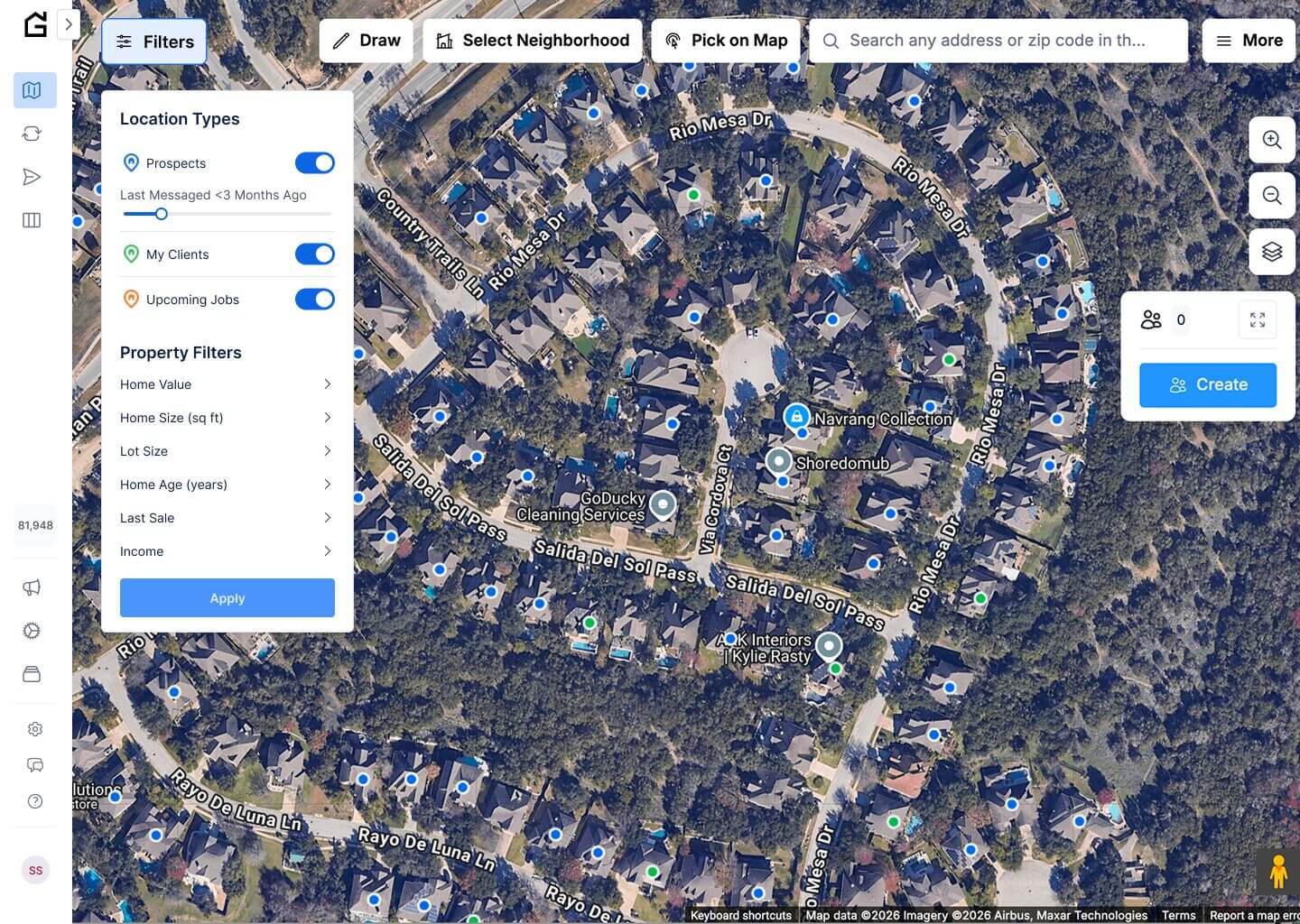
Then, you can filter who you’re targeting. You can filter by home size, home value, home age, lot size, and last sale to hone in on the homeowners that make the most sense for your jobs.
Finally, you can customize and monitor your campaigns.
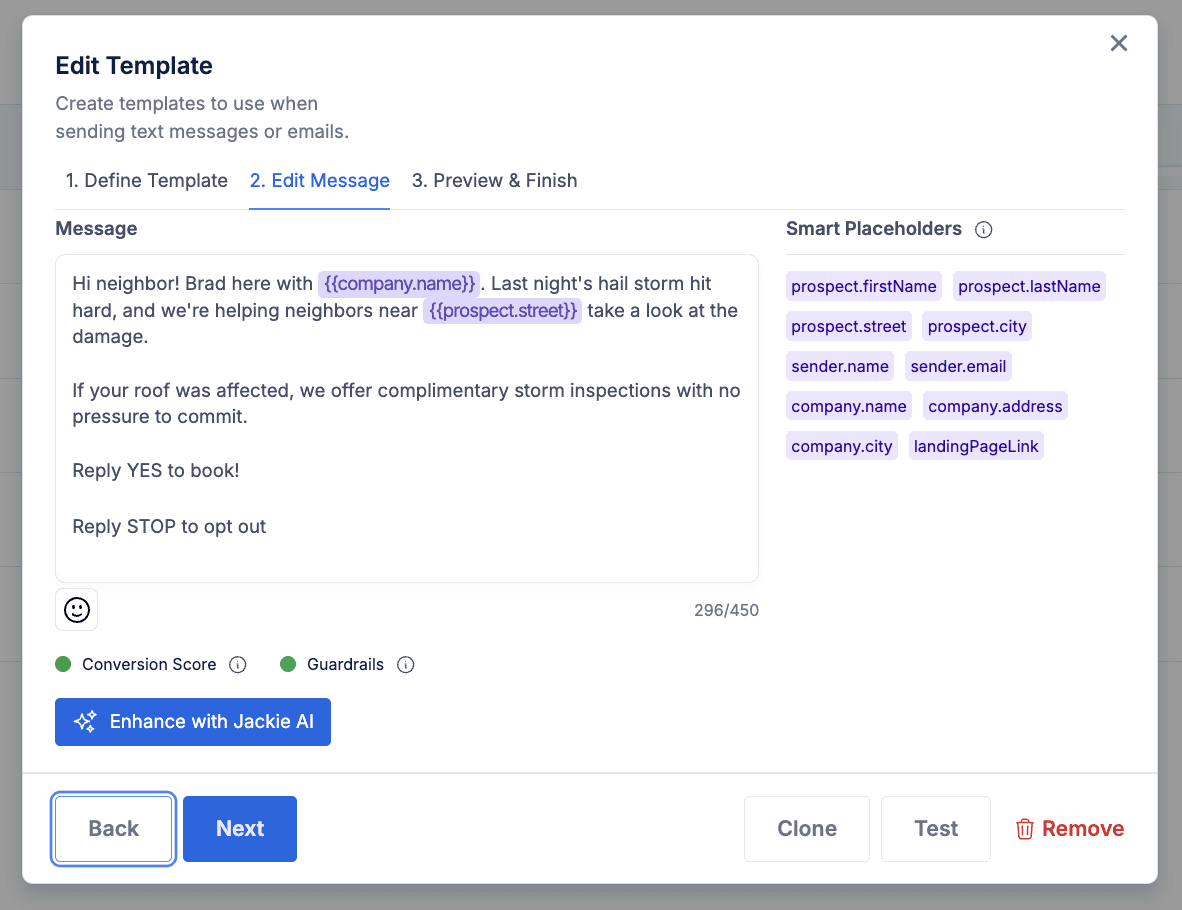
You can use our proven message templates that we have curated for home service businesses or create your own. You schedule when the messages are sent (and remember, GlassHouse will never let you send a message outside of compliant hours).
As replies start rolling in, our system monitors for opt-out language and removes those contacts from your list. Every positive reply surfaces in your sales dashboard, where you can manage the conversation and track its status.
Because our cold texting services are compliant (with federal law and individual carriers), we’ve been able to deliver strong results to our clients.
Here are some success stories from home service businesses who have used GlassHouse:
Mighty Dog Roofing closed $135,000 in revenue after spending $6,500, spread out over 6 weeks, on cold texting. They had another $126,000 in proposals still open when we pulled the numbers. That comes out to $197 per booked appointment.
Mosquito Authority, a pest control franchise in Northwest Indiana, generated $102,000 in revenue after spending $15,000 on their cold texting outreach.
MaidPro, a household cleaning service, generated $81,000 in annual recurring revenue after spending $6,463 across two locations — a 12.5x return.
If you have more questions or want to see the full workflow in action, you can schedule a free demo with our team to see exactly how you can start running text marketing with GlassHouse — the compliant way.
Additional resources for business owners: