Best Lead Generation Strategies for Solar Companies (2026)
By Makayla Schultheis

Solar lead generation has always been harder than most home services verticals. And in 2026, it got harder still.
The ticket is high. A typical residential install runs $15K to $50K+ (more in markets like California). These aren't impulse purchases — and the typical CPL reflects that.
The sales cycle is long. Homeowners research solar for weeks — sometimes months — before making a decision. They're comparing multiple companies, evaluating financing options, sorting through tax credits and utility incentives, and often consulting with different people before pulling the trigger.
The safety net homeowners once had is gone. Federal tax credits and state incentive programs helped bridge the gap between the sticker price and what homeowners were willing to spend — but those programs have been significantly scaled back. Now, homeowners have to come up with $15k+ out of pocket, or piece together financing to make the numbers work. The government-assisted demand for solar companies isn't there the way it used to be.
The sale is more education-heavy than ever. Before a homeowner is ready to commit, they need to understand how solar energy works for their home, ROI, remaining federal credits, state and local rebates, net metering, financing options, and how their utility rates factor into the payback timeline.
The companies that win aren't always the ones who show up first. The sale goes to whoever earns the trust — that means educating homeowners through the process and staying in the conversation long enough to be the one they call when they're ready.
All of this is why solar has always been a door-knocking industry. More than almost any other home service vertical, solar companies have built entire sales teams around D2D canvassing — reps in the field, reaching homeowners directly, starting the conversation in person. And it's still one of the most effective channels in the business.
But it's not the only one. This guide covers every major solar lead generation approach. We start with door-knocking — specifically, how GlassHouse is changing what that looks like.
To learn more about GlassHouse, keep reading or schedule a demo with our team.
Door Knocking
Digital Door Knocking: GlassHouse
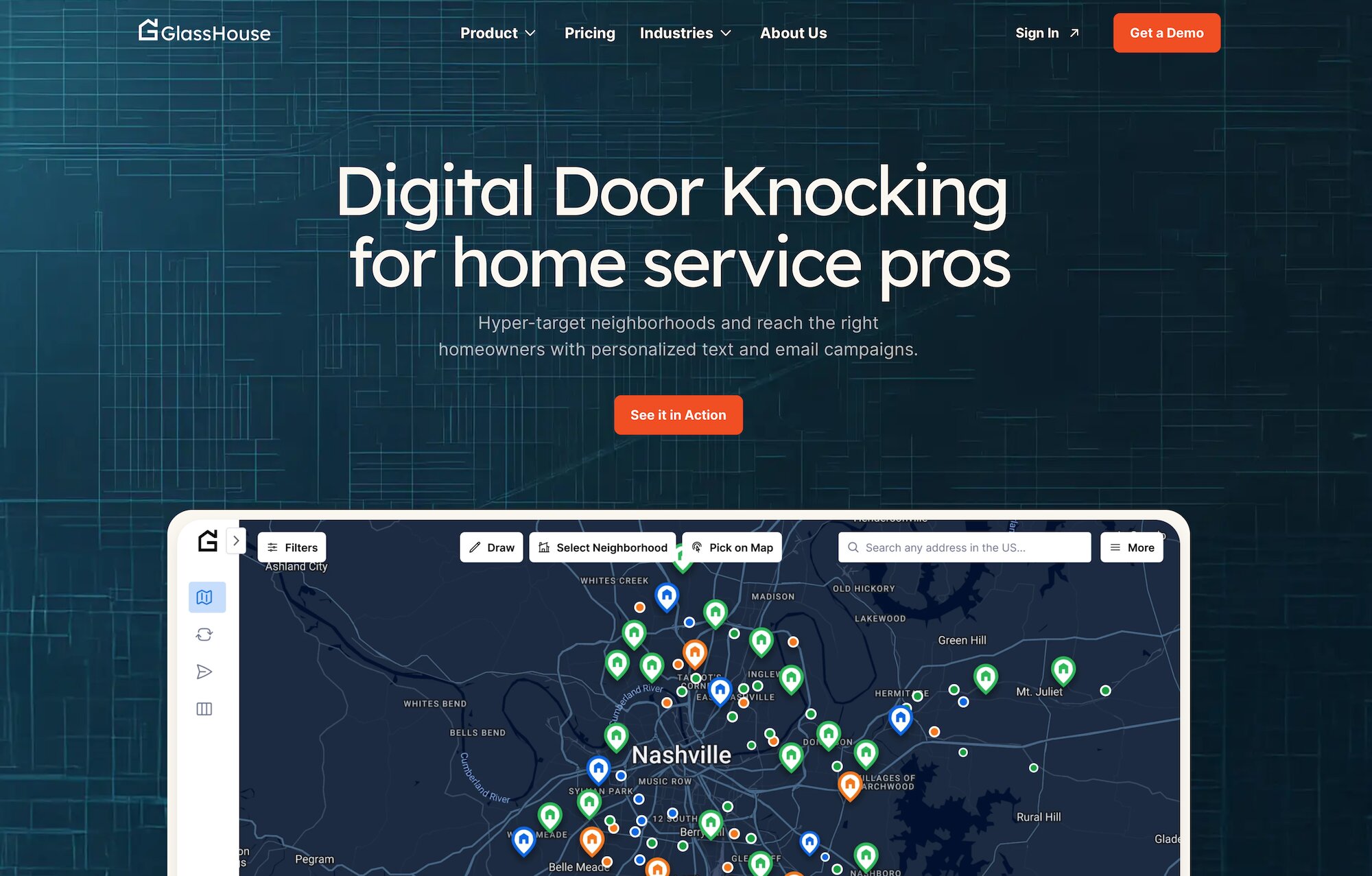
GlassHouse is a digital door-knocking platform built specifically for home service and trades businesses. It’s the only solution of its kind, and is a natural complement to your existing door-to-door operation.
Here's how the pairing works: GlassHouse reaches homeowners in your target neighborhoods via SMS and email before your reps ever knock. By the time a rep shows up at the door, the homeowner has already heard from you, so reps can get right into talking through the details and answering questions.
It's simple to run — you can send messages to entire neighborhoods across your market at once. Setting up campaigns only takes an hour or so a week (vs. tons of dead hours spent knocking on doors). Reach out to homeowners in areas where you're already known. And easily test new ones — send a message, see who engages, and send your reps to the neighborhoods showing interest.
Setting yourself up this way means you're not wasting your team's time walking neighborhoods that were never going to convert. You can focus your efforts on the homeowners who actually want to have the conversation.
How Digital Door Knocking Looks in GlassHouse
1. Plot your existing and upcoming jobs.
Connect to your existing CRM or FSM and your completed or upcoming installs show as pins on the map. You can see exactly where you won jobs and plot your strategy around that.
2. Draw your target area.
Draw a shape around the neighborhood you want to work. For solar, this is where the density strategy comes in: rather than spreading thin across a whole city, pick a neighborhood, own it for a couple of weeks, and work every house in it before moving on. Most teams start where they’ve already completed installs.
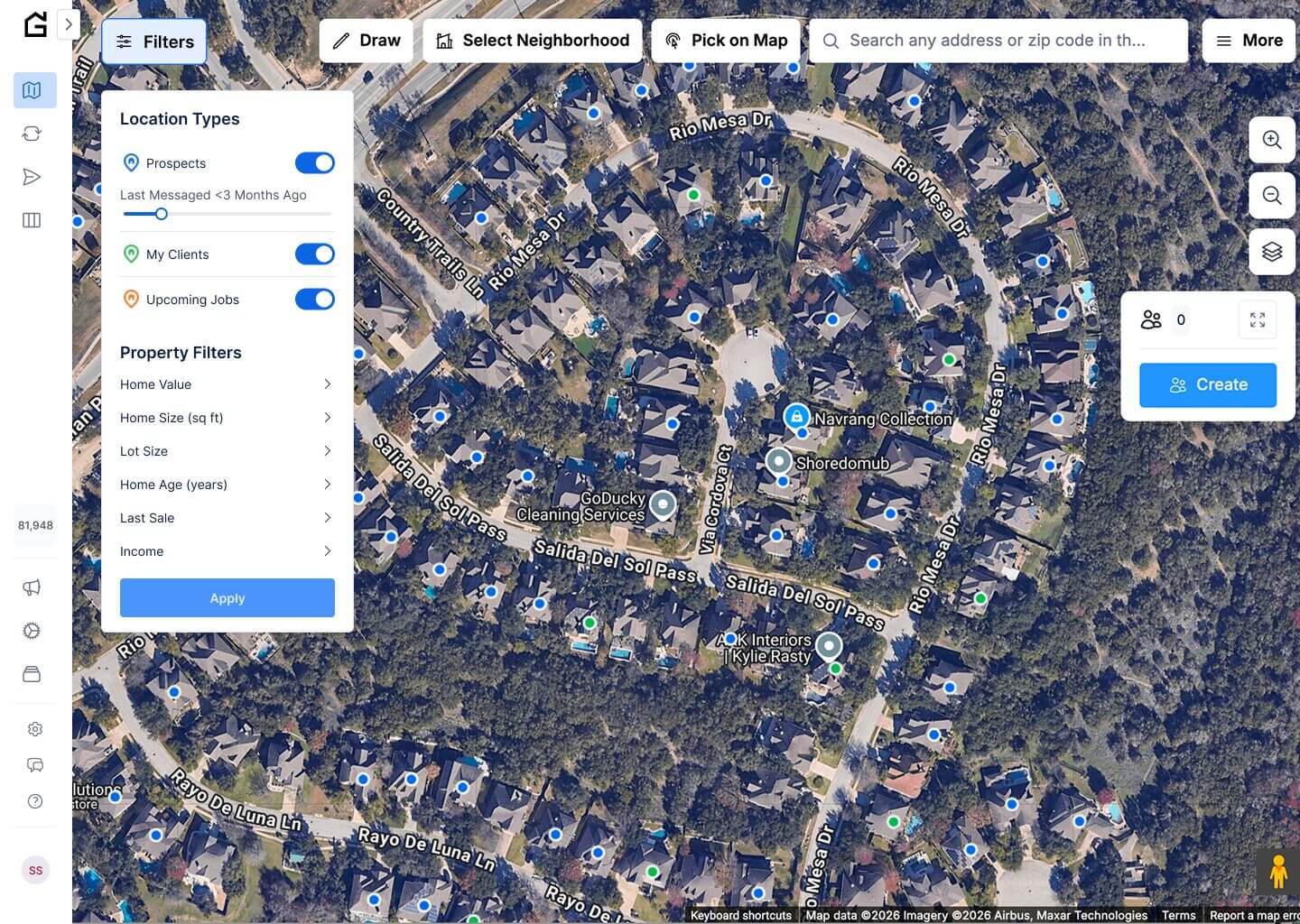
3. Set your filters.
Further filter by the property details that matter for solar — home value, home size, home age, and income. The higher-end neighborhoods are usually the ones to prioritize (especially since most incentives have been scaled back). Larger homes typically carry higher electricity bills, which is the core ROI driver for a solar sale.
4. Reveal your prospects.
Hit reveal, and GlassHouse pulls contact data for every homeowner in your selected area(s). You're only using credits on contacts that match your search filters.
5. Build your campaign.
Enroll your prospects in a multi-step SMS drip or a one-time blast. Our system comes pre-loaded with templates to help boost conversions here. A quick message might look like: "Hi [Name], we just finished a solar installation on [Street] and wanted to reach out to neighbors. Happy to walk you through what the savings look like for a home like yours — interested?"
Then you’re ready to hit send.
We handle 10DLC registration and TCPA compliance automatically — messages go out from a local 10-digit number registered to your business. Compliant sending hours are enforced within the platform.
Once your campaign is live, positive replies show up on your sales board in real time. Assign an AI Agent (Ask Jackie) to carry the conversation from first reply to booked appointment. You can jump in manually at any point. By the time your rep knocks, the homeowner is already engaged and expecting the conversation.
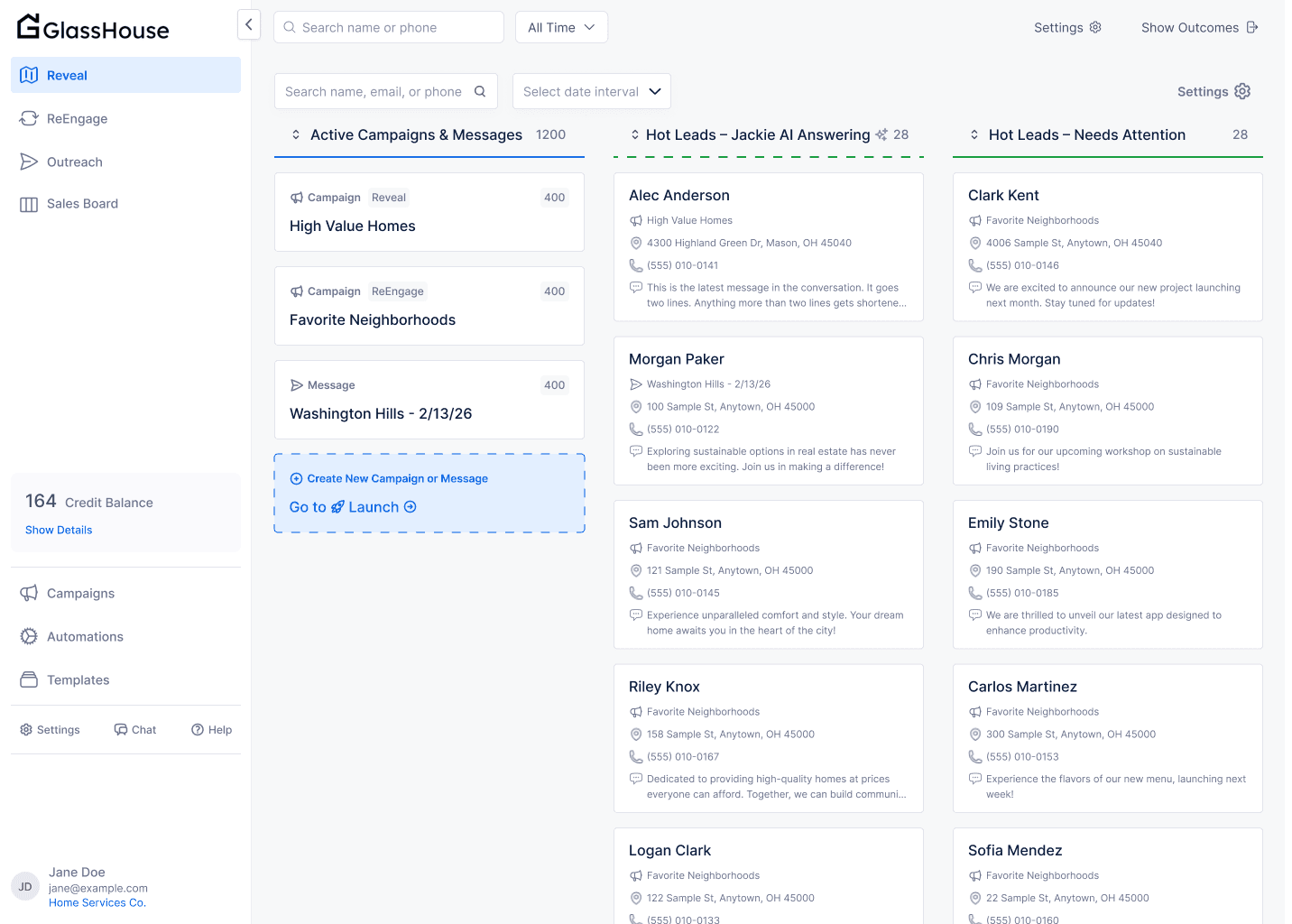
GlassHouse connects with your CRM — Jobber, AccuLynx, FieldRoutes, or whatever FSM you're using — so when a prospect hits hot lead status, a webhook fires and sends the lead record straight over.
The CRM connection helps measure the impact of your outreach, keep customer information up to date, avoid contacting existing customers, streamline lead management, and re-engage past customers.
Track attribution and ROI. Check closed jobs against leads you contacted in GlassHouse and see which outbound touchpoints influenced revenue. Some homeowners will get a text, Google you, and call in directly without ever replying — you wouldn't know the text started that conversation without matching it back. This attribution is particularly beneficial in solar, where the research process is long, and homeowners often reach out on their own terms.
Keep your data clean and enriched. Your CRM sends existing customer data back to GlassHouse so you can identify homeowners who already have panels and exclude them from your outreach and credit spend. GlassHouse also layers property-level details onto your existing contacts — home value, size, age — so your team has more context going into every conversation.
Streamline lead management. New leads sync back to your CRM automatically — you don’t have to manually import them or copy contacts between platforms. From there, leads can be enrolled directly into follow-up sequences or nurture campaigns.
Re-engage past customers. Use GlassHouse's ReEngage feature to reach back out to existing customers for upsell and cross-sell opportunities — battery storage, system upgrades, referrals. Conversion rates on re-engagement outreach run significantly higher since these homeowners already know and trust you.
Digital door knocking only takes an hour or so a week. Our team trains you on the full platform so you can hit the ground running, and provides ongoing customer support as your long-term success partner. Most solar teams designate one person to manage GlassHouse campaigns, though you can have as many people as you like on the account. We also offer a Done-For-You service where our team manages your campaigns, so all you have to do is close the hot leads.
How to Get Started
There are two types of solar companies we work with most commonly:
Companies that sell and install themselves: full service, more overhead, fewer jobs, more margin per deal.
Companies that sell solar and contract out the installation: leaner operation, significantly more volume, less margin per job.
The strategy here looks slightly different depending on which model you run — territory approach, volume targets, and how you structure follow-up. But our team walks you through it all during onboarding, so you know exactly how to use GlassHouse for your operation.
Schedule a demo to kickstart the conversation. We'll show you the platform, talk through your current lead gen mix, and map out how GlassHouse fits into it. You’ll walk away with real prospects in your zip code, a custom ROI projection, and tailored package options that fit how your business runs.
Pricing is straightforward. The platform runs $299/month (billed annually). Credits are 3¢ each — one credit to reveal a property, three credits to send an outbound SMS. Credits roll over for 12 months, and you can top up à la carte anytime.
We also offer the email add-on. This is $250/month and includes 7.5k monthly emails, drip campaigns, email copy creation, AI email warmup, inbox alerts, and more.
Our solar clients find that GlassHouse quickly pays for itself — just one closed job covers the investment 5x over. Run the numbers yourself with our ROI calculator below.
See what Digital Door Knocking can do for your business
Enter a few details and see the leads, revenue, and return on investment GlassHouse can drive for you.
What industry are you in?
We'll use this to set your benchmarks for conversion rate, deal size, and close rate.
Select your vertical:
Physical Door Knocking
As we mentioned before, door-to-door canvassing is the most tried-and-true lead-gen strategy among solar businesses. It works especially well in:
Neighborhoods where you've already completed installs. Panels on the roof are visible social proof that neighbors notice.
Markets where solar adoption is early, and awareness is still being built.
Post-event situations — local news about utility rate hikes, energy costs, or weather events can create a window where homeowners are already thinking about it.
But there are some downsides here.
The most obvious limitations are scale and inconsistency. Coverage is headcount-dependent, and you're reliant on homeowners actually being around to answer the door.
It's also one of the more expensive channels — CPL runs $200 to $400 per appointment in solar. The high CPL is usually due to solar companies outsourcing their door-knocking to specialized D2D sales teams rather than running it in-house. Since these reps all work on commission, a cut of every closed job goes to them. And on a $20K to $50K sale, that's not a small cut.
And a lot of states are moving into no soliciting. Residents in select cities can add their names and addresses to a “No Solicitation" list — or post signs outside their home — and opt out of door-to-door sales.
This is exactly why GlassHouse is the better move for teams who’ve seen success with door knocking and want to push those efforts. It helps you avoid these issues, cover more ground, and really dial in where you're getting the most interest before sending field reps to continue conversations.
Tools to support physical D2D:
SalesRabbit: A mobile-first canvassing platform with territory mapping, lead tracking, and route planning. Built for teams that prioritize speed and ease of use in the field.
SPOTIO: A field sales engagement platform with stronger analytics and reporting. Good fit for teams that want deeper visibility into rep activity and territory performance.
Knockbase: Focused on the core D2D workflow — lead pinning, territory management, and disposition tracking. Simpler and more affordable than SalesRabbit or SPOTIO.
Read more: Best Door Knocking Software for Home Service Teams
Door Hangers & Direct Mail
Not quite door knocking, but closely related, as you're reaching out to specific addresses in neighborhoods you want to work.
Door hangers are left at the door whether anyone's home or not. Faster to deploy than mail, but still labor-intensive to distribute. Given solar's deep D2D culture, you'll see door hangers used more commonly than direct mail in this vertical.
Direct mail — postcards, flyers, letters via USPS — is highly targetable by neighborhood, home age, and home value. Some are even moving into predictive sending to automate sends when homeowners are most likely to convert. The main limitation is USPS's turnaround time: you can't move fast enough.
Both work especially well as a follow-up to existing installs. "We just finished a system on your street" is a natural hook, and neighbors who've already seen the panels go up may already have an interest.
When it comes to targeting, prioritize the same areas you're already working in GlassHouse and neighborhoods where solar adoption is already underway.
Companies that can help here: Mail Shark, USPS EDDM (Every Door Direct Mail), PostcardMania, VistaPrint, or a local print shop.
Word of Mouth & Referrals
Referrals convert really well — around 37% — and the CPL is essentially zero. There are two sources here: past customers and partnerships. Both are worth building a process around.
Customer referrals are huge because they’re usually telling friends or family. You’re being recommended by a trusted source. But the challenge with these is that volume depends entirely on how many installs you're doing and how happy your customers are. The best way to drive more consistent referrals is to build a simple ask into your process: request a referral after the job is done, follow up a few weeks later, and offer incentives — gift cards, bill credits — to make it worth their while.
Partnerships work in the same way. You want to build relationships with the people who regularly work with homeowners at times when they’d be thinking about solar: roofing contractors (roof replacements often trigger conversations about solar installs), real estate agents, electricians, energy auditors, property managers, and insurance adjusters. The broader your network, the more leads you’re likely to see.
Pro tip: We also recommend attending local events, sponsoring community organizations (like Little League teams), and joining networking groups like BNI and Chamber of Commerce to get your name out there. These aren't direct lead gen channels, but they build the kind of brand familiarity that makes every other channel work better. Homeowners who've already heard your name are more likely to respond to a knock, a mailer, an ad, or a text.
Digital Marketing & PR
Inbound marketing strategies like SEO, content, and paid ads let you build an online presence to get in front of homeowners when they start researching. It's a longer play than door knocking or GlassHouse, but once you've built it, it can lead to a consistent stream of leads.
Most solar companies bring on a marketing agency for this side of things, as SEO and paid ad management aren't exactly skills that come naturally to contractors. Hook Agency, Roofer Elite, and ChoiceLocal all have specialized experience with home services teams and can manage your marketing strategy.
PR is also becoming somewhat popular for solar companies to build brand visibility, particularly in higher-end markets like California. The thinking is that media coverage and brand mentions influence how AI tools surface your company when homeowners ask questions online. It’s not proven to drive the volume that other strategies in our guide can, but it's worth knowing it exists, particularly if you're playing a longer brand-building game.
Google Business Profile (GBP)
Your Google Business Profile is what appears in Google's map pack when someone searches for "solar companies near me" or "solar installers [city]."
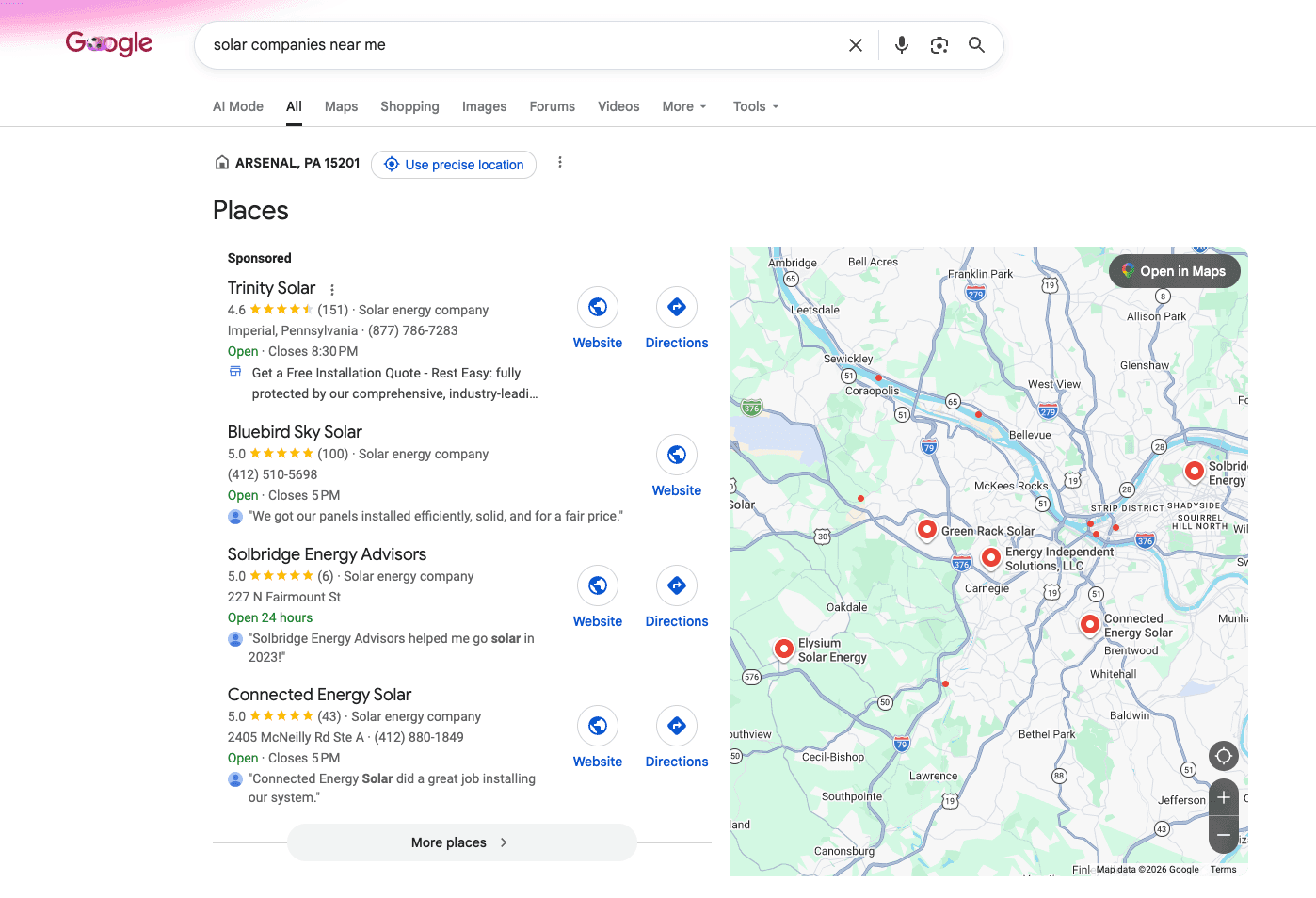
It's free and one of the first things you should have in place. And unlike some of the things below, it’s easy to set up and manage yourself:
Add or claim your business here
Keep your business details accurate and up to date
Add photos of completed installs
Ask your customers to leave reviews — make this easy for customers by sharing a link to your GBP in follow-up emails or including a QR code on your business cards
Respond to all reviews (good or bad)
Website SEO, GEO & Content Marketing
SEO is about getting your website to show up when homeowners search for solar in your area — "solar installation [city]," "solar tax credit [state]," "how much does solar cost." You can do this with service pages, location pages, and blog content.
Blog content is worth calling out here. It’s especially powerful in solar because of how education-heavy the sale is. As we discussed above, homeowners have a lot of questions before they're ready to commit: what's the ROI, what incentives are still available, how does financing work, and what will their utility bill actually look like. Blog posts that answer those questions allow you to enter the sales conversation early and build trust before they’re ready to get a quote.
Plus, all of this lends to AI visibility and GEO (generative engine optimization). When a homeowner asks one of these tools a question, it searches the web for resources to include in the answer. If you have a high-ranking site with content that covers those questions, it's more likely these engines will reference your site or mention your brand specifically in their responses.
Though it’s important to mention here — re: long game — this is arguably the longest game. It takes at least 6 months to start gaining traction and seeing results. But once you’ve built your site up enough, the payoff is usually well worth it.
Paid Ads
Paid ads get you in front of homeowners faster than SEO. The tradeoff is you're paying for every lead, and results stop the moment you stop spending.
The two most common approaches here are Google Search Ads and Google Local Services Ads (LSAs).
Google Search Ads put your site at the top of results for the solar-related searches you want to appear for (you choose the keywords to bid on). These let you capture Googlers specifically looking for solar companies, so the intent is high, but the cost is also high. You pay every time somebody clicks on your ad, and the cost-per-click (CPC) can vary drastically. CPL is usually between $100 to $300. The other thing to note here is that Google Ads require ongoing management. You shouldn’t just set 'em and forget 'em. Letting campaigns run can blow through your ad budget quickly. You need to test, retest, and keep an eye on these to make sure you’re using your budget wisely.
Google LSAs work a little differently. You still appear at the top of search results, but you don’t target LSAs by keywords the same way you do Search Ads. Google uses signals like your GBP and service area to match you with relevant searches. The perk here is that you only pay per verified lead (vs. per click), and CPL is typically $40 to $100, so it’s a little more budget-friendly. One thing to know: you need to pass Google's background and license verification to qualify. Those who qualify receive a "Google Verified" badge next to their listing to build trust.
Now, when you think about paid ads, you might also consider social ads on Facebook or Instagram. However, these don’t make the most sense for solar companies because homeowners aren’t making a $15k+ purchasing decision while scrolling social media. That’s not the platform for that kind of sale. They can work for retargeting — getting your name back in front of folks you’ve already engaged with — but even then, they’re iffy. We suggest skipping these.
Buying Solar Leads From Lead Providers
Lead providers are those third-party platforms like Angi, Thumbtack, and Houzz that let homeowners request quotes from home service providers. Many businesses create profiles on these sites so homeowners can reach out when they’re ready to hire someone.
These platforms offer a pretty straightforward and quick way to get leads in front of you, but they have some downsides. And there are a few different models worth understanding here.
Shared lead providers: Homeowners love these platforms because they can request quotes from multiple companies at once — they submit one request, and it goes out to 3 to 5 companies. Easy for them. But for business owners, it's not ideal. It kicks off a race to respond, and companies end up competing on price. Whoever responds fastest or quotes lowest wins. Most companies lose a lot of deals this way. Conversion rates are typically 5% to 8%. And by the time you've won a customer, you're looking at high CPLs (between $50 to $150).
Names here include SolarReviews, EnergySage, and EnergyBillCruncher.Exclusive lead providers. These eliminate competition by putting homeowners in contact with just one contractor. Solar companies typically see better close rates here. But CPLs are even higher ($100 to $300+).
Exclusive solar lead providers include Solar Exclusive, Invention Solar, and ResultCalls.Aged solar lead providers. These are older, unconverted leads sold at a steep discount, sometimes below $1 per record. The cost is low, but so is the intent. These homeowners filled out a form months ago and have either moved on or already gone with someone else. They can work if you have a call center that can reach out to all these folks, but most solar companies report having to work through hundreds of records to get a single appointment. Proceed with caution if you choose this route.
Aged Lead Store, The Leads Warehouse, and RGR Marketing specialize in aged leads.
Best Practices to Build & Optimize Your Lead Gen Strategy
1. Build a mix.
No single channel is enough. The best solar lead gen strategies layer proactive outbound (GlassHouse, D2D) with an owned presence (GBP, SEO) and referrals. Proactive outreach supports all your other efforts — homeowners who've already heard from you are more likely to click your ad, respond to a referral, or call from your GBP listing.
2. Measure your success across channels.
You should know your CPL per channel and your win rate on qualified leads.
Here's how CPL breaks down across the channels we covered:
GlassHouse: $35 to $75
Door-to-door: $200 to $400 per appointment
Door hangers & direct mail: $80 to $150
Referrals: ~$0 — excluding referral incentives
SEO & content marketing: ~$196 average, lower once established
Google PPC: $100 to $300 in competitive markets
LSAs: $40 to $100
Lead providers: $50 to $150 for shared leads, $100 to $300+ for exclusive leads
On win rates: solar teams don't typically track these by channel because there are often multiple touchpoints before a homeowner makes a decision. What we recommend looking at instead is your win rate on qualified leads — those who've raised their hand and want you to come out. That should sit around 25% to 35%.
3. Speed to lead matters.
Contacting a lead within 1 minute of them reaching out boosts conversion by nearly 400%.
4. Have a follow-up system before you start generating leads.
Most leads require at least 5 contact attempts before you actually connect. So a lot of solar companies lose leads not because the leads are bad, but because follow-up is inconsistent. Before you ramp up any channel, make sure you have a CRM in place and a clear follow-up process.
5. Don't push the close too soon.
Solar's long sales cycle means the goal of your first conversation isn't to close. It's to build the relationship, answer questions, and walk the homeowner through the process. The close comes naturally once they feel educated and comfortable. Companies that push too hard too early lose deals they could have won.
The last thing to mention here: it’s important to set realistic expectations. The market has shifted a lot over the past few years, and solar sales are tougher now. During and after COVID, solar companies got used to inflated demand — cash-out refis, government incentives, and homeowners with extra money to spend. That's not really the case anymore. CPLs are higher, close rates are softer, and the channels that used to just work need a lot more attention now. Going in with the right expectations means you won't bail on a channel after one bad week.
Start Filling Your Sales Pipeline with More Qualified Solar Leads
The solar industry has always leaned heavily on door-knocking, and that's not changing — but the way you do it is. GlassHouse lets you reach homeowners digitally before your reps ever knock, warm up entire neighborhoods at once, and make every door your team touches worth knocking on.
Book a demo and we'll show you how it fits into your lead gen strategy.