How to Get Painting Leads: The Best Free & Paid Strategies
By Jackie Vaughn
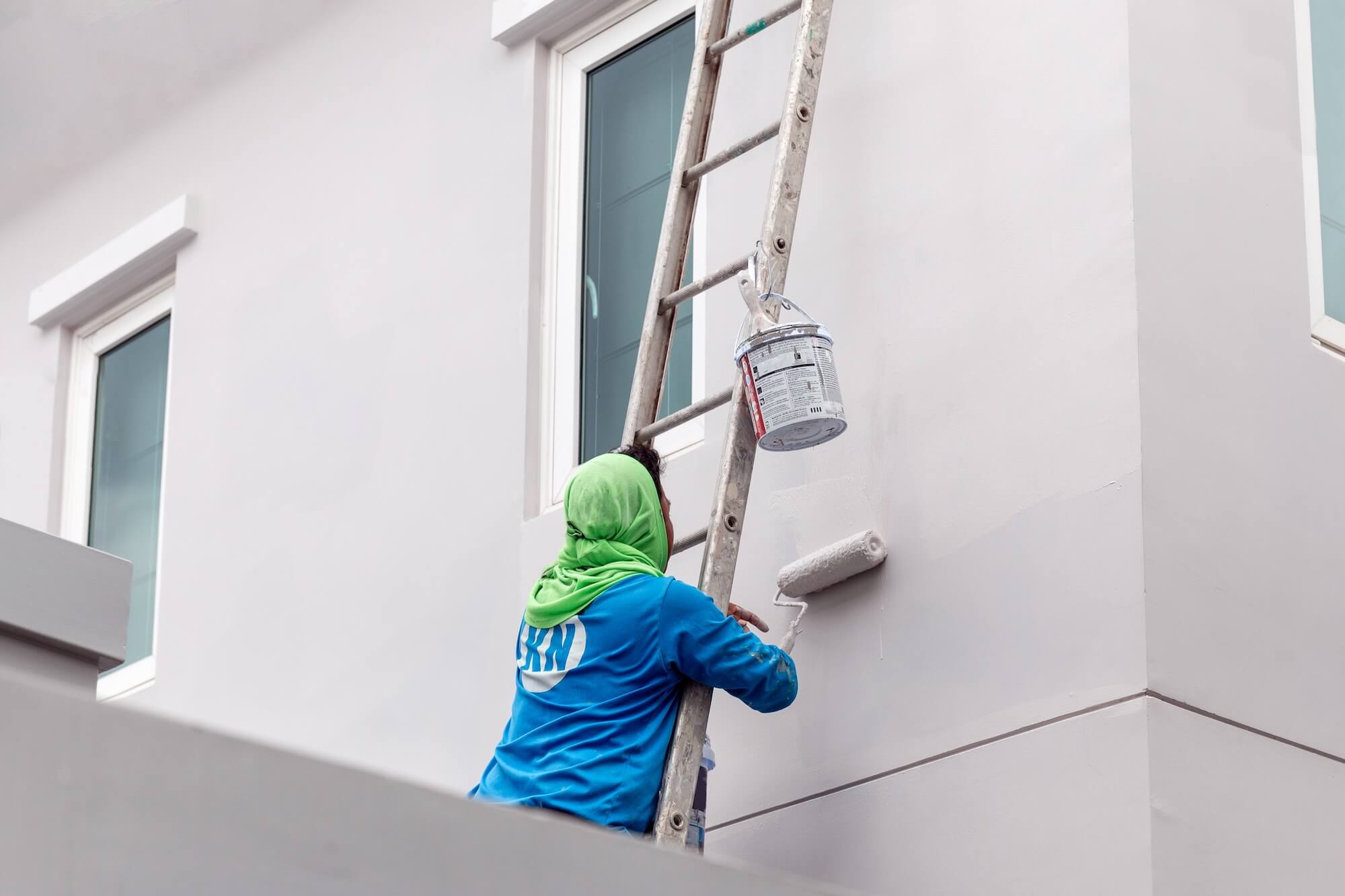
If you're a painting business owner, chances are you've tried things like flyers or mailers — and found that most of it doesn't work. 5,000 flyers might get you 6 to 10 calls. You spend time and money, and the phone barely rings.
You’re probably underutilizing your biggest advantage — painting is one of the most visually provable services out there. When you finish a job, the whole neighborhood can see it. A fresh coat of paint on a house is proof sitting right there on the street. The businesses that see the steadiest stream of leads are the ones that actually use that in their marketing, instead of relying on passive tactics and hoping someone calls.
So this guide covers the best ways to put your finished work to use, as well as a few other lead generation strategies that actually pull in business so you can build out a comprehensive mix.
We start with GlassHouse, our own system, and how it helps you turn every job into leads for the next one by reaching the neighbors directly. Then we cover physical door knocking, yard signs, referrals and partnerships, your online presence, paid ads, and buying leads when you need to fill a gap.
To learn more about GlassHouse after reading, schedule a free demo for the full walkthrough.
How to Leverage the Jobs You're Already On
Digital Door Knocking with GlassHouse
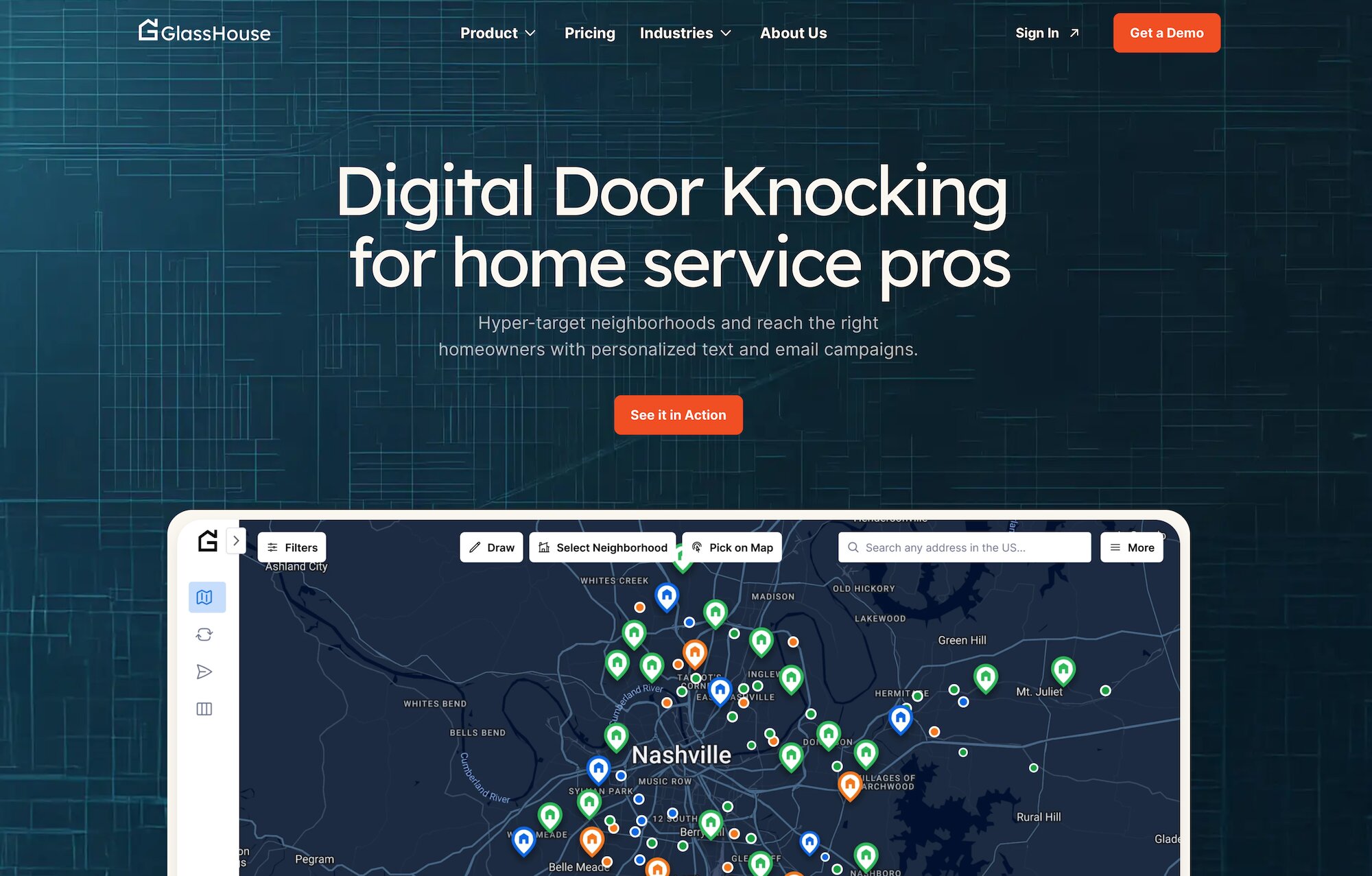
GlassHouse offers one of the easiest ways to get in touch with neighbors in the areas where your teams are working — by sending them a text message. You can introduce yourself, mention you’re working on their street, and offer to come by for a consultation if they need similar work done. It’s like physical door knocking, but over text. We call it digital door knocking.
This modernization of physical door knocking builds on its strengths — reaching homeowners directly — without the limits of getting boots on the ground or catching people when they happen to be home. You can message entire neighborhoods at once — before, during, and after jobs — and continue to build your pipeline off the proof of what your crew delivers. This is exactly when neighbors are seeing your crew and the kind of work you do. You can even send pictures of your completed jobs in these messages to really showcase your work.
Our system comes with tools to hone in on the best neighborhoods and homeowners to target, build personalized SMS campaigns, and manage all your prospects in one place. And we handle the compliance side automatically — 10DLC registration, opt-outs, complaint sending hours — so you’re always covered here.
Tasia Haygood of PaintEZ in Grand Rapids says GlassHouse lets her team win at least 1 or 2 leads around every job just by asking neighbors if they have any painting work that needs done. She notes GlassHouse lets her access customers in a way her competitors aren’t, build community, and use text messaging to connect with homeowners on a personal level. Watch her full story here.
The next sections walk through the workflow to find and reach homeowners in GlassHouse. But you can always schedule a demo with our team to see exactly how it’d work for your business. We’ll take you through the features, pull prospects in your market, and put together a tailored plan based on how your business actually operates.
How Our System Works
Our map is the starting point for every campaign you build. It displays green pins over the homes you’ve worked so you can easily identify target neighborhoods and build around them. And it includes a variety of filtering options — by home age, home size, and last sale date — to make sure you’re reaching out to the homeowners that make sense.
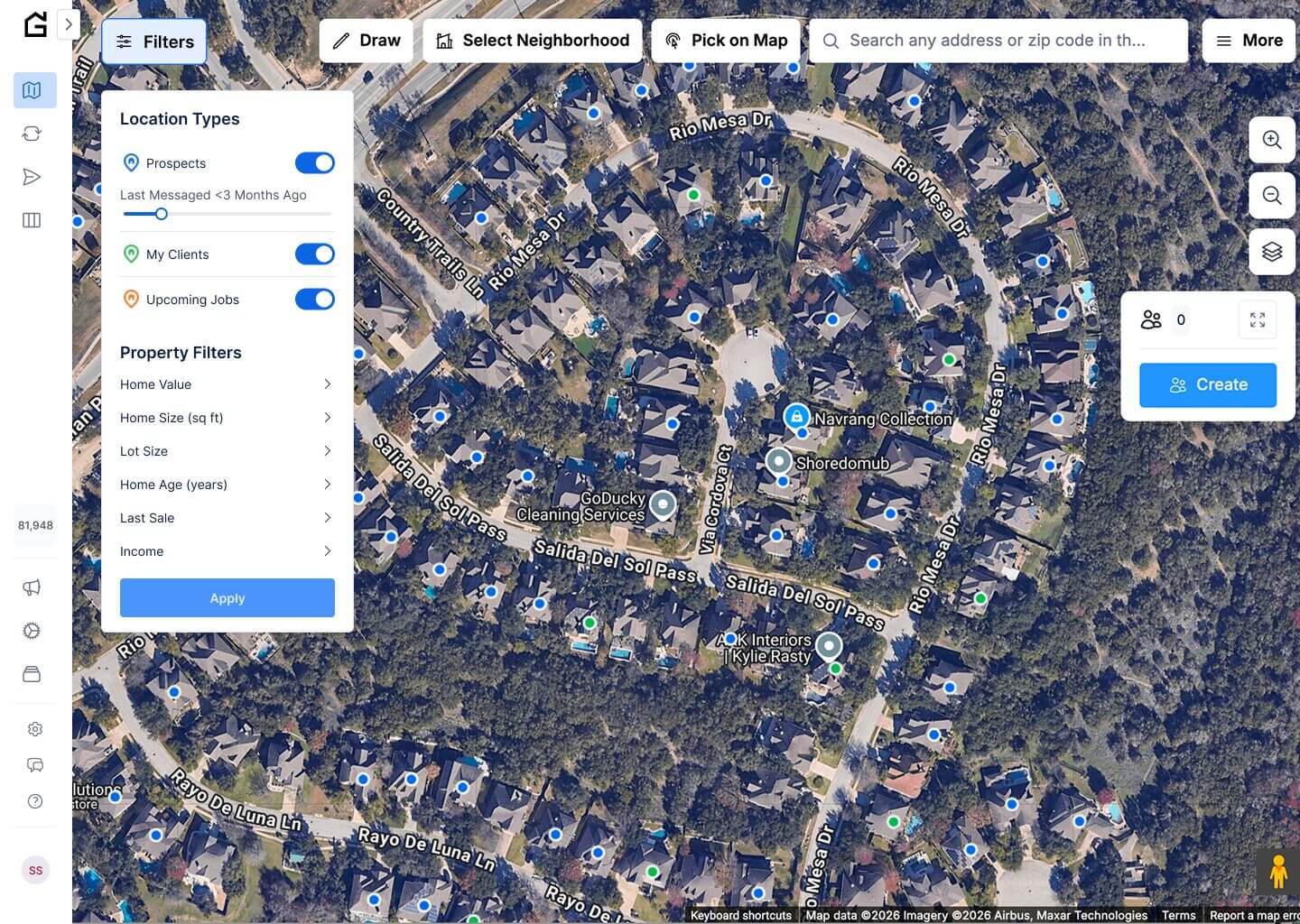
Here’s how it works:
Open the map, search by address or zip code, and draw around the areas you want to target. You can switch to satellite view here for a closer look at the homes in that area.
Apply filters to narrow in on the most fitting homes in your target areas, so you only pull ideal prospects for your campaigns.
Click Reveal to see a list of all the properties that match your search criteria.
Then, you’re ready to build out your campaign messaging.
We provide a ton of templates to help you get started here — all with clear CTAs and optimized to convert — so you’re not spending time copywriting or trying to figure out exactly what to say. You can leave templates as is or quickly tweak them before scheduling your texts.
Check out an example of one of our more popular templates below:
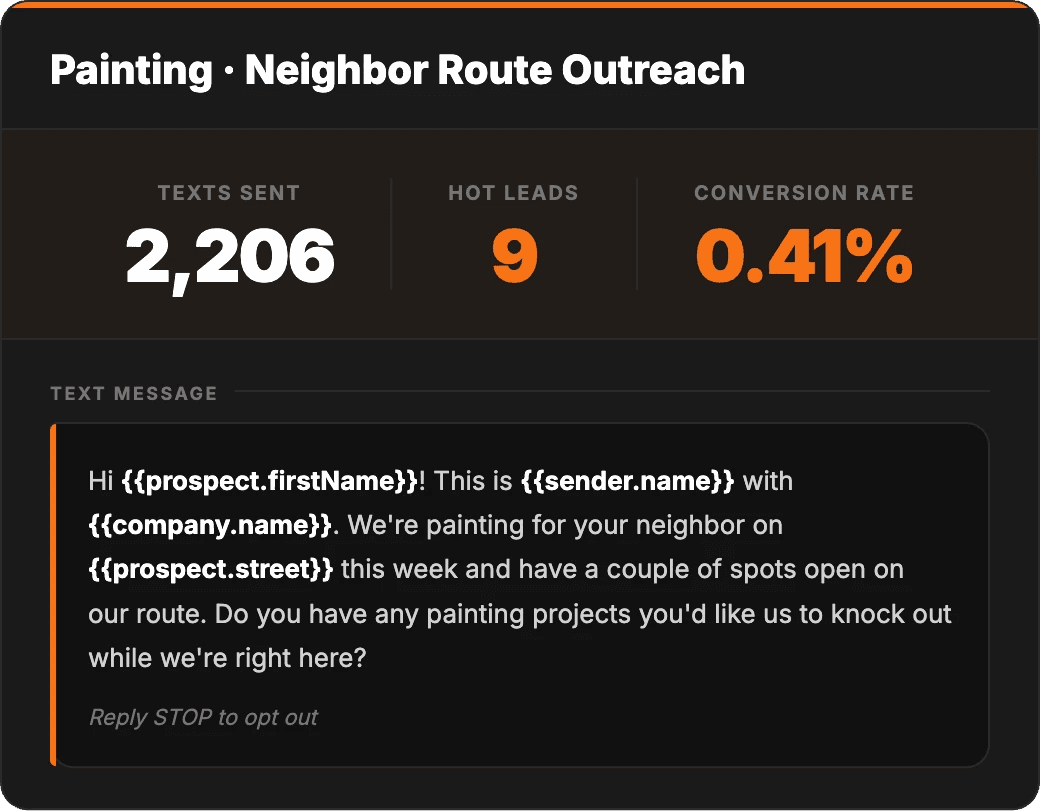
Our team is available to help you land on the right messaging and timing for your campaigns. Here are some of our best practices for painting companies:
|
After texts are sent, you can keep track of replies in our sales dashboard; we’ll notify you every time somebody messages back. You can also use our AI autoresponder (Jackie) to make sure everyone gets a quick reply.
This tool can handle all the initial conversations with customers — qualification and appointment booking — so you never miss an opportunity. However, you can always jump into conversations and chat with homeowners when you’re available.
All your qualified “Hot” leads are pushed to your connected CRM or FSM, so you have the contact record in both places. And then this two-way sync lets you manage your full customer base more effectively:
You can pull your entire contact list into GlassHouse and easily see where you’ve already worked. This is what plots those green pins on the map, so you can build campaigns in the areas you already have a presence. It also prevents you from putting existing customers into new outreach campaigns.
Our system can also enrich your current contact list with data from our database. This includes adding property-level details like home size, age, and value to your records. These details can help aid in retargeting and nurturing campaigns.
Attribution and ROI tracking become much clearer. You can measure leads by source and see how GlassHouse contributes to the big picture — not just the Hot Leads from our system but also the folks who received a text and called you later on, so you have an idea of how and which campaigns made an impact.
You can also use the GlassHouse and CRM combination for retargeting, giving you two angles to reach past customers.
Our ReEngage feature works off property and neighborhood data to trigger tailored upsell and cross-sell sequences — you can send past customers prep and sealing discounts ahead of winter, offer someone who had trim work a deal to extend that to the rest of the exterior, or provide a customer who had exterior work a discount on interior painting (and vice versa).
Then your CRM works off job history and past conversations to handle things like service follow-ups and repaint-window maintenance reminders.
Altogether, building and managing GlassHouse campaigns — whether for new outreach, retargeting, or both — takes only an hour or two each week. Most teams set aside a dedicated window at the start or end of their weeks to schedule out messages and let it run in the in-between time.
You can also pass this work over to our team with our Done-For-You service. We’ll build the campaigns and manage the copywriting so all you have to do is work the leads.
How to Get Started
Everyone starts with a free demo. This allows our team to learn more about your business and current lead gen strategies so we can see how GlassHouse best fits and put together package options for you.
Pricing thereafter is straightforward. There’s a $3,500/year platform fee, and you purchase credit bundles on top (3¢ per credit). Credits are how you scale the volume of messages you send in GlassHouse. We’ll help you determine the best number of credits to start with based on your business and market, and then you can build on from there.
You can add on the Done-For-You service mentioned above for $400/month. You’ll be paired with a dedicated account manager who will take over the legwork and provide monthly reports on how campaigns are performing.
The other add-on to mention here is our Email package for $250/month. This lets you layer SMS and email marketing, and includes 7,500 monthly emails, drip campaigns, email copy creation, email warm-up, inbox alerts, and more.
Schedule a free demo with us to see how GlassHouse turns the work your crew is already doing into your next batch of leads.
Physical Door Knocking
Physical door knocking is another way to pitch your services directly to homeowners. Most of the teams we talk to have seen a lot of success with this approach (though there are those limitations we noted above). And historically, physical door knocking has been one of the highest-performing lead-gen channels for painting — 5,000 doors knocked can produce 100+ leads.
One of the best ways to do this is to send crews before or after jobs to knock on neighboring doors and offer consultations while they're in the area. General "we're doing free estimates in the neighborhood while we're here this week" openers work well, but having something to directly point out, like peeling, fading, or cracking paint, is even stronger.
Paintviz is another tool to keep in your back pocket for these visits, and arguably the most compelling one for actually closing the job on the spot. It lets your crew snap a photo of the home during the consultation and show homeowners a rendered "after" of what the paint job would look like — playing right into painting's visual advantage and getting people off the fence and into your books.
You can also pair digital and physical door knocking to get more strategic in your approach here. You can temp check streets by sending texts first and seeing who responds, then send your crews to the homes with the most interest. Since speed to lead is so important in closing painting jobs, this layered approach lets you act fast while interest is piqued. And it saves your team from knocking on doors that aren’t going to go anywhere.
Some of the tools we recommend to manage physical door knocking efforts are Knockbase, SalesRabbit, and SPOTIO because they include features to track the doors you’ve knocked, optimize routes, and keep notes on outcomes.
You can learn more about those tools and compare other door-knocking software in our guide here.
Lawn Signs & Door Hangers
Lawn signs and door hangers are another option to leverage job visibility. You can place lawn signs after fresh paint jobs so everyone who passes by knows who did the work. And hit surrounding homes with door hangers during jobs or after they’re completed, before you pack it up and head out.
The only thing with these options is that they’re a little more passive. They’re static ads that get your name out there, so folks know who to call if they ever need painting work. But they don’t spark real conversation like door knocking does, so you might not see immediate leads from them.
One tip if you’re going to invest here: add something trackable to these ads, like a QR code customers can scan, so you can trace back to see how customers heard of you and if these played any role in them reaching out. Otherwise, you could dump a bunch of money here and never know whether it actually has any impact. Zazzle sells signage with built-in QR codes if you want to go this route.
Branded Crew Apparel & Truck Signage
Now, this tactic is more or less a best practice to ensure folks actually know who you are when your crew is out on jobs — job site visibility isn’t going to do anything for you if nobody can see your business name. Providing your crew with branded tees, sweatshirts, bib overalls, the works, puts a name to the face.
We also suggest decals or wraps for your trucks so your business name can be seen loud and clear. This not only benefits you on job sites but also gives you visibility as you drive around town, between jobs, or while picking up supplies.
You can try TshirtByDesign, Custom Ink, or LogoSportswear for custom crew gear, and FastSigns, Decals.com, or WePrintWraps for truck signage.
Build Brand Recognition & Trust Before They Search
Referrals and reviews both build trust in your name before homeowners have the first conversation with you — referrals get your name in front of them in the first place, and reviews confirm that trust once they look you up. Referrals are worth prioritizing, especially: 91% of homeowners find their pros through word of mouth, more than any other channel, and referrals carry high conversion rates, between 30% and 50%.
There are a ton of ways to get referrals. Customers are obviously one source. Beyond that, other businesses and organizations in your community can send homeowners your way. Here are some of the best ways to build out your referral network:
First, establish a process for requesting customer referrals. Asking at job completion, periodic reminder emails, and incentives (a $50 gift card for referrals that convert, for example) all work well. It's also worth asking for reviews at the same time, so anyone searching your name can see past customers who recommend you.
Partner with other businesses, like real estate agents, property managers, general contractors, interior designers, home stagers, and roofers. Roofers are a particularly strong pairing for painting, since a roof replacement often leads into a conversation about exterior repainting. Interior designers and home stagers are also good options, since both regularly need a painter for their own projects and clients.
Build relationships with paint retailers like local Benjamin Moore or Sherwin-Williams reps, who often refer customers directly to painters they know and trust.
Join a local BNI chapter or your Chamber of Commerce. These organizations are built around businesses sending referrals to each other.
Get active on Nextdoor and local Facebook groups. Chime in when someone asks for a painter recommendation, and answer questions when people ask about unrelated maintenance topics, like how to deal with peeling exterior paint or when to reseal trim. This helps you earn that “local expert” reputation where you’re providing advice and not just pitching your services in every thread, which can go a long way when folks decide it’s time to hire somebody.
Another way to get your name out there is to attend local events, like community festivals, trade shows, or home and garden shows, and sponsor things like local sports programs or a charity 5K. You can also donate a paint job to a community center, library, or nonprofit building, which gives you something concrete to point to when talking about your involvement in the area. This all helps build brand awareness, so you're already a name homeowners recognize when they need a painter.
Show Up Where They're Looking
Most of what we’ve covered above gets your name in front of homeowners before they're actively looking for a painter. This section covers the flip side: showing up when someone's already searching, ready to hire. You can do that by building up your website, creating profiles on online directories, getting active on social media, and investing in paid ads.
Website & Local SEO
First thing, every business needs a website. It’s one of the easiest ways to show you’re a legit, credible company. This is even more important for home services because homeowners are inviting you to their homes, and they’re going to want to check you out beforehand.
But how you build your site makes all the difference in how well it works for you, beyond just credibility-building.
Taking time to learn the basics of search engine optimization (SEO) — or hiring a digital marketing agency to manage your website — can transform your site into a lead engine. We’ll cover the essentials of what you need to know below so you have a jumping-off point here:
You need a clear home page that includes the basics: your business name and logo, where you work, and contact information. It’s also helpful to link to your social media profiles and online review sites; displaying your star rating on your site builds trust right off the bat. You also need to provide simple ways for homeowners to reach out for a quote — contact forms, online booking engines, or click-to-call buttons.
Couple your homepage with a contact page that clearly lists all the ways to get in touch with you. Add your phone number, email address, contact form or booking engine, hours of operation, and service areas.
Create dedicated pages for all your service areas (location pages) so your site gets listed in search results when homeowners are looking up nearby painting businesses. These pages appear for those “painters in [city name]” or “painters near me” type searches.
You should also have individual service pages for each of your job types — interior painting, exterior painting, cabinet refinishing, deck staining — so people find you when looking for the specific work they need.
Build out blog content that covers popular topics or common questions within your industry. Good topics for painting: how to choose a paint color, the best time of year for exterior vs. interior painting, signs your house needs repainting, and prep checklists homeowners can use before a job starts. This “free advice” content helps you reach homeowners earlier, before they’re ready to book, and can earn you points with homeowners — your content is here to help, not just pitch your business. If it’s helpful or memorable enough, it can earn you a phone call down the line.
Double-check your site works and loads correctly after building it out. Do this test on your laptop, phone, and tablet to make sure it looks right on all screens. And gauge load times as you go. Most people exit sites when pages appear wonky or take forever to pull up — you don’t want to lose potential leads over small technical things.
Note: Most website builders provide tools to optimize your site for all screens, or automatically handle this for you, so making fixes here shouldn’t be difficult. And if you’re having trouble determining if page load times are fast enough, you can use Google’s PageSpeed Insights for a proper (free) assessment.
One last tip to play on painting’s visual edge: Include an interactive element on your site, like a paint color visualizer (similar to what we described with Paintviz), for homeowners to preview paint jobs. These pack a bigger punch than standard contact forms and can help you generate more lead opportunities. You can check out Renoworks Pro for this.
Online Directories & Map Packs
Joining online directories is another way to appear when people are searching for painters.
One of the most important ones here is Google Business Profile (GBP). Creating a GBP profile means your name appears in the sidebar when people search for your business, which can build even more credibility with homeowners — Google recognizes you and includes a full overview so folks can see your business details and reviews. These profiles are the ones that appear in Google’s map pack when pulling local search results.
For example, if I search “painters near me,” I get a list of businesses right in my backyard, above any organic results (where your website would rank). This is the best kind of visibility you can get without investing in paid ads.
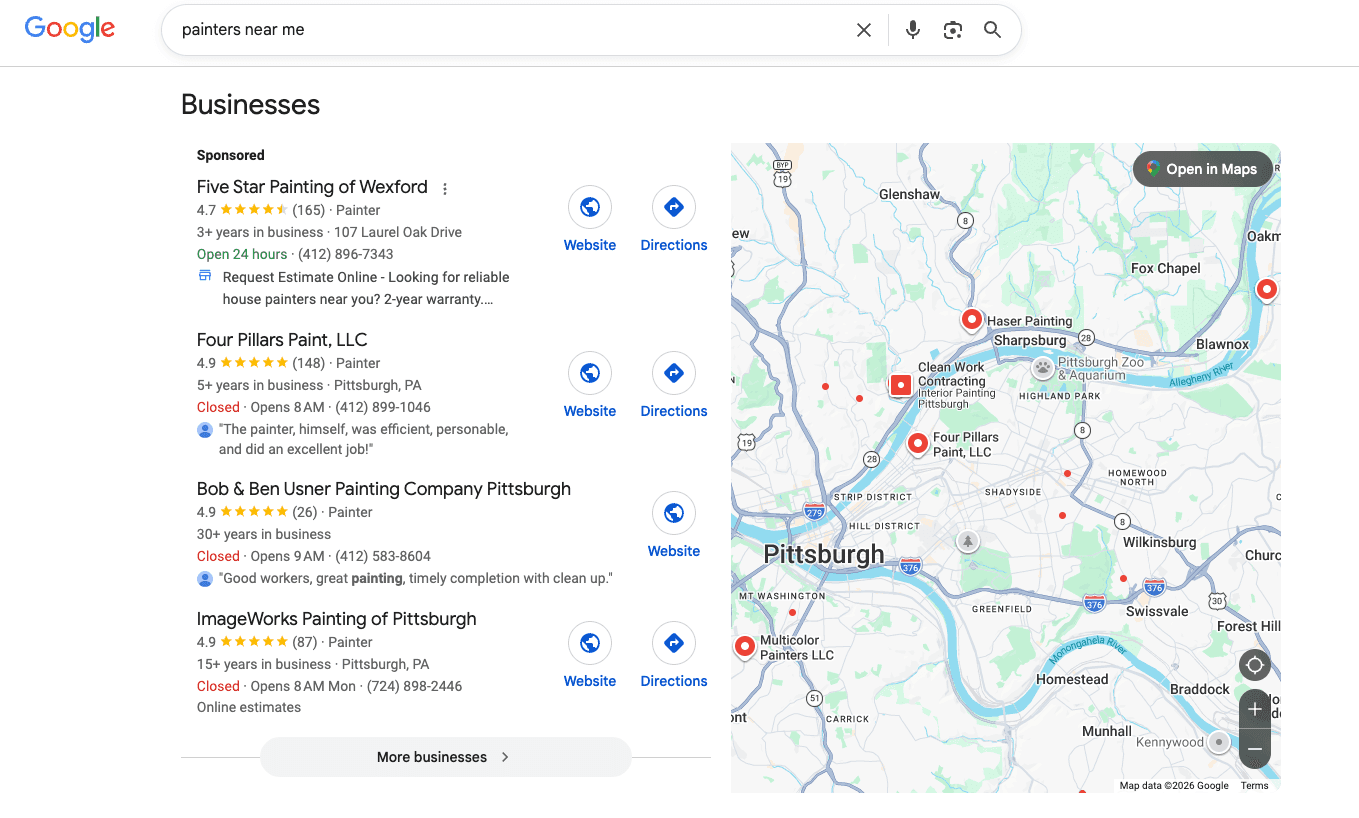
Anyone doing this search is going to see the businesses closest to them. This also appears for location-specific searches like “painters in Pittsburgh” or “painters in Philly.”
In addition to Google’s program, you can join Bing Places for Business, Apple Business Connect, and Yelp to get in front of homeowners starting their searches on those sites. They all work in more or less the same way, where you get visibility at the top of results and in map packs. Apple is somewhat of an odd man out here because you can also get Siri mentions. We recommend joining all of these to capture homeowners across all the popular platforms.
Enrolling in these programs is easy, too. Create or claim your profile, make sure your business details (name, address, phone, service area) are accurate and current, and upload photos from past jobs.
From there, the ongoing work is collecting reviews — ask for them after every job, and respond to all of them. Review count and rating play into where you appear in these lists, whether you’re closer to the top or bottom; more (and better) reviews help you move up in these local results over time.
Social Media
Creating social media profiles — and staying active on them — is another great way to show off your past jobs and connect with homeowners directly. Facebook and Instagram will be most relevant to painting businesses. And there are a ton of different types of content you can create to build your social media presence.
Before-and-after transformations are top performers — a side-by-side photo carousel or a quick reel showing the "before" for a couple of seconds before cutting to the finished room or exterior. Timelapse videos of a full paint job, from prep to final coat, are another format that consistently performs well, since they show off both the transformation and the process behind it.
In addition to transformation content, color trend and consultation posts ("what color should I paint my house") position you as a design resource, and behind-the-scenes crew content helps homeowners get to know you better and feel more comfortable letting your team into their home. Organic and paid video content is having a moment for home service businesses right now, so it's worth leaning into those ideas.
Some other ideas:
“Story time” videos about memorable jobs let you give a play-by-play of past wins, and they give your content a more personal feel, as homeowners get to hear these stories straight from you.
Run polls on homeowners’ favorite house colors to let homeowners share their opinions, get them interacting with your page, and let you learn a little more about them.
Publish "expert tips" on how often to reseal or repaint, how to prep for winter freezes, or common causes of paint peeling, chalking, and fading, and which ones are DIY-fixable vs. worth calling a pro for.
Quizzes like, "How often should you repaint your house?" "What's the best time of year for exterior home painting?" or "Repaint or just touch up?" that not only get interaction but also nudge homeowners who might not even be thinking that they're due for a paint job.
Share customer review spotlights to turn a great review into its own post, whether that's a quote graphic or a quick clip of the homeowner talking about the finished job, giving you social proof in someone else's words instead of your own.
You can also jump on viral trends — trending songs, dances, bits, or skits — just to give audiences a laugh. Your content doesn’t need to be all about your work or brand. You can post whatever’s entertaining or funny (even “dumb”) to get audiences’ attention.
And remember, social media isn’t just about what you publish. How you use it to engage audiences is just as, if not more, important. Encourage homeowners to comment and reply to them when they do, and network with other businesses to create content or cross-promote each other. The more active the page, the more often it’s shown. You can get in front of people who don’t already know you and win new followers.
Another idea to increase your following and get new leads from social media is to partner with influencers. They can promote your business to their audiences and offer incentives for requesting a quote.
Then, as we mentioned above, you also want to get active in groups — neighborhood groups, “Mom” groups, painting-specific or home services groups, whatever you feel fits. This lets you join discussions when people need a painting pro.
Paid Advertising
Paid ads can boost your visibility across all these online channels — search engines and social media. In search engines, they put you at the very top of search results, above that map pack we showed before. On social media platforms, they help you get your posts in front of audiences that don’t follow you yet and retarget past customers.
The only tradeoff with these is that they can be expensive. Most operate on a pay-per-click model; the cost per click can vary widely (from $5 to $40+), and not all of those clicks will turn into a customer, or even a lead. So you can be paying for a lot of clicks that don’t amount to anything.
The other thing to think about here is buying intent.
Somebody searching for a painter on Google is already thinking about hiring somebody. They want to see which painting businesses are available for work, get some estimates, and compare all the best options. Running ads here makes sense because you’re getting extra visibility in front of the homeowners who are ready to pull the trigger.
With social media ads, that buying intent isn’t there. The ads here get you in front of new audiences, yes, but those audiences aren’t necessarily looking for a painter. They’re just stumbling upon your ad and getting to learn your name. They might remember you later on when they do need somebody, but even that chance is slim if a paint job isn’t even remotely on their radar when they find you.
So if you’re going to invest here, we suggest putting the budget toward search ads first. These are more likely to win you immediate leads and provide ROI. Social ads can come later down the line if you want to experiment or have some extra budget for them. Focus them on retargeting customers — pushing maintenance services, touch-ups, or reminders that they're coming up on their typical repaint window.
For search ads, there are three types to know:
Google Ads: These appear in Google search results and YouTube. With these, you bid on the specific keywords you want to show for (like "painters near me") and build out campaigns — write the copy that shows with them, and choose the landing page Googlers will hit when they click. Then you've got ongoing management; you should monitor how ads perform to see how your budget is being used, so you can fine-tune campaigns by adjusting bids and cutting keywords that aren't converting. These can be a little complex to run and require a lot of manual work, so many painters bring in a marketing agency or a freelancer who knows the ropes to handle them.
Google Local Services Ads (LSAs): These work differently than standard Google Ads. Instead of bidding on keywords yourself, Google automatically places you in relevant searches based on your Google Business Profile details and service area, so there's a lot less for you to manage day-to-day. That makes LSAs easier to get started with on your own, without needing to bring in a pro. And you only pay per lead here, not for every click, so they help you stretch your budget further.
Bing Ads: These work just like the Google Ads we described above, but appear on Microsoft's search network instead (Bing, Yahoo, and a few partner sites). These can work well for teams testing paid ads because the stakes are a little lower here. There aren’t as many businesses running ads on Bing, so clicks tend to run cheaper. And home services is actually one of the better-performing verticals on the platform, so the clicks you do get here may convert better. However, the reason why Bing doesn’t have as many businesses in its advertising program is that the search volumes on Bing and Yahoo are much lower than Google’s. It’s a channel you can turn on in the background and let run, since you’re less likely to blow through ad budget, but it might take longer to see new leads from these ads.
Buy Leads When You Need To
The last option to win new leads is to purchase them from lead generation platforms like Angi, HomeAdvisor, Thumbtack, and Houzz. However, we mention this option last on our list because you gotta proceed with caution here.
Those big, household names we listed above don’t work as well for business owners as they do for homeowners.
When homeowners come to these sites and request a quote, that request is sent off to several painting contractors at once. Easy for them — they can get a batch of quotes with one form fill and compare all their options.
For the business owner, though, that creates a race to respond and offer the lowest price. If you don’t get back to homeowners within a few minutes, or offer the most competitive price, you’re likely to lose their business.
But you pay for every lead here, whether you win the customer or not, and leads can be pretty expensive. With this shared lead model, most home service businesses end up spending a lot of money only to see very few customers in return.
With that, we recommend most businesses skip the shared lead providers altogether.
If buying leads is something you’re really interested in, direct your budget toward exclusive lead services instead. These providers sell leads to one business at a time, so you actually have a fair shot of winning the business (though exclusive painting leads are even pricier than the shared ones Angi or HomeAdvisor sell). Service Direct is one of the most popular names in this realm, though you can also look at painting-specific sites like PaintingLeads.com and Painter Choice.
Read more: How to Get Leads Without Paying for Angi & HomeAdvisor
Turn Jobs Into Repeat Business
Painting doesn't repeat on the same tight cycle as something like lawn care or pest control, but it's not a one-and-done service either. Between full repaints (typically every 5 to 10 years for exteriors), there's regular maintenance work — touch-ups, trim, sealing — that keeps you in the picture if you stay on top of it.
Upsell while you're already there. If your crew's finishing up a room, it's an easy ask: "Since we're already here, we could knock out the trim, doors, or garage for [X]." Homeowners are more likely to say yes to add-on work mid-project than to schedule a whole separate job later.
Send repaint-cycle reminders. Interior timelines vary by room and use, and exterior work follows the cycle mentioned above — a periodic email or text letting past customers know it's likely time for a refresh is a natural way to generate repeat business without waiting for them to think of you first.
Do proactive warranty check-ins. If you offer a workmanship warranty, call past customers to ask whether they need any touch-ups, rather than waiting for them to reach out. It shows attentiveness, and it's a natural opening to catch new work while you're already back at the house.
Use a CRM to track it all. Keeping customer history, job details, and follow-up timing in one place means these reminders and check-ins actually happen on schedule instead of depending on someone remembering.
Ask for reviews fast. Request them within 24 hours of job completion, while the work (and the homeowner's satisfaction) is still fresh. Waiting even a few days drops your response rate.
Deliver a five-star experience. Clean, professional, communicative crews are what actually earn the reviews and referrals that fuel everything else in this guide.
Best Practices
A few habits that apply across every channel covered above:
Respond fast. Contacting a lead within 5 minutes makes you dramatically more likely to convert it than waiting even 30 minutes — some research puts it as high as 21x more likely. Speed matters more than almost anything else once a lead comes in.
Keep your online presence current. An outdated website or a neglected Google Business Profile costs you credibility the moment a homeowner checks you out.
Track every lead source. You need to know what's actually working before you cut or scale anything. Ask new customers how they heard about you, or use a CRM to track it automatically.
Don't rely on a single channel. Diversify across the strategies in this guide, with GlassHouse as your foundation for proactive outreach.
How to Build & Optimize Your Lead Gen Mix
Start With the Math
Work backward from a revenue goal to figure out how many leads you actually need. Wanting an extra $100K this year, for example, might mean roughly 100 more estimates, which — depending on your close rate — works out to just a handful of extra leads per week. Use that number to judge whether your current mix is even in the right range before worrying about which specific channel to add.
Layer Your Channels
Start with GlassHouse around your active jobs (you can also follow up with targeted paid ads in those same neighborhoods), build reviews and reputation in those areas, and create neighborhood-specific content. Each layer reinforces the others instead of competing for the same homeowner's attention in isolation.
Tailored by Business Size
Solo Painters / Independent Contractors
As a one-person operation, focus on efficient lead generation:
Prioritize digital door knocking around jobs you've already completed, since these can be some of your easiest wins.
Lean into word-of-mouth and local networking.
Get a basic website and CRM in place.
Stick to free online channels like your Google Business Profile and Nextdoor.
Low-budget print, like lawn signs, rounds this out.
Small Crews (2 to 5 Painters)
With a small team, you need a more structured approach:
Systemize your GlassHouse outreach instead of running it ad hoc.
Balance inbound channels (SEO, social) with outbound lead generation (door knocking, GlassHouse).
Job-site marketing — branded apparel, yard signs — starts pulling more weight here too, since you've got more jobs running to build visibility around.
Growing & Larger Painting Businesses
With multiple crews, you need a comprehensive strategy:
Scale GlassHouse across every service area you operate in.
Build out a multi-channel plan instead of relying on one or two core channels.
Integrate your CRM tightly enough that leads and follow-ups don't fall through the cracks as volume grows. Dedicating a person (or team) specifically to follow-up becomes a worthy investment at this stage, since speed-to-lead matters just as much at scale as it does for a solo operator.
Measure & Optimize
Track lead source by channel and close rates, and adjust spend based on what's actually converting. And judge cost per closed job, not just cost per lead, across every channel. Cheaper lead channels with low close rates can end up costing more per booked job than a pricier one that actually converts, so run the math against your own close rate before doubling down on or cutting anything.
Getting Started
GlassHouse is one of the most direct ways to turn the jobs you're already doing into your next ones — reaching the neighbors who are already seeing your crew's work, before they've even thought about hiring a painter.
Schedule a free demo to see how GlassHouse fits into your mix.