10 Best Ways to Get Leads for Your Holiday Lighting Business
By Jackie Vaughn
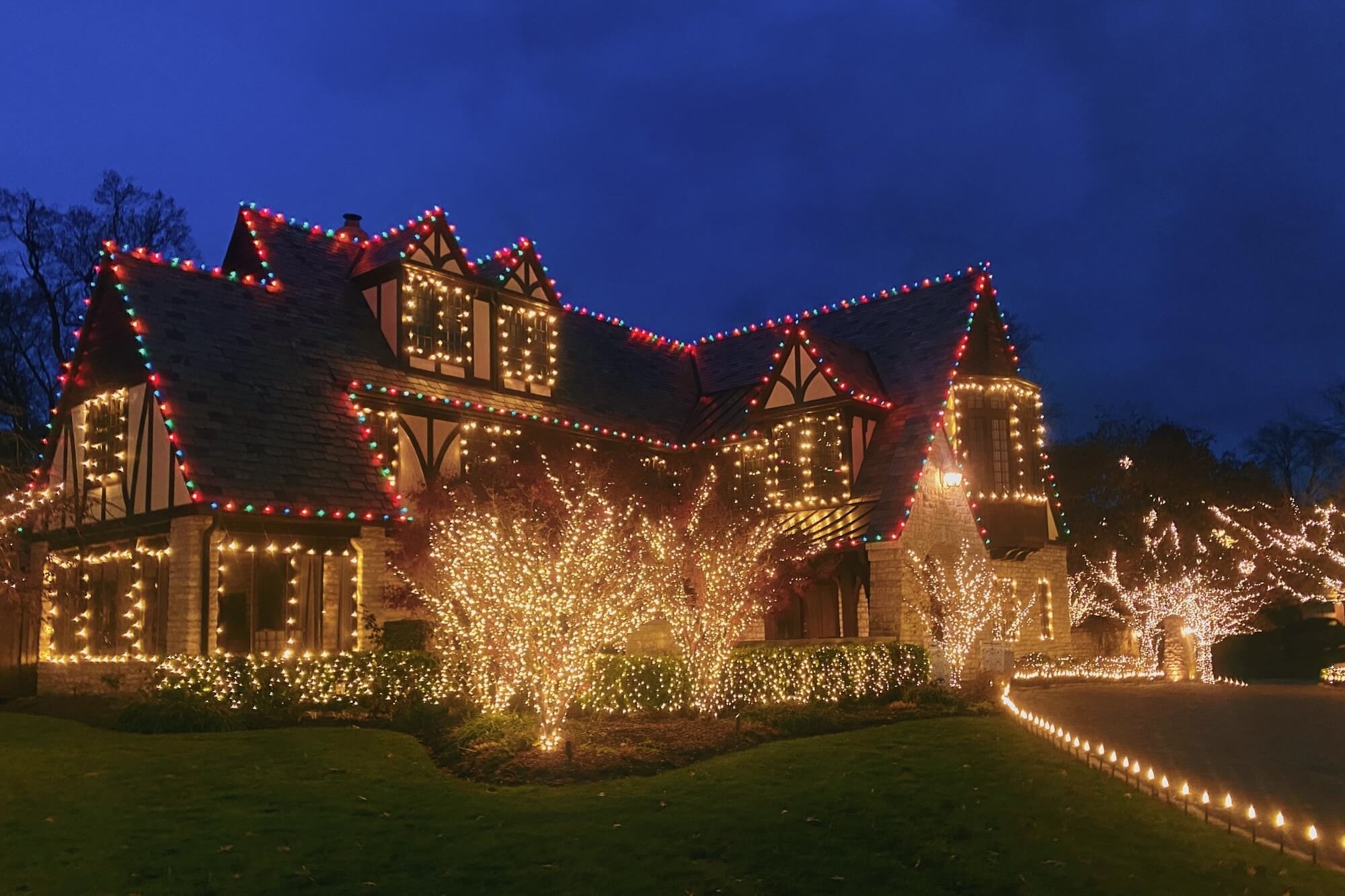
Holiday lighting has a built-in advantage most home services don't: every installation is eye-catching proof of the work you do. Every house you work essentially becomes a nightly ad, seen by neighbors, drivers, or anyone walking the dog after dark.
Most of the holiday lighting businesses we talk to aren’t fully leveraging this advantage. They finish an install and move on, instead of working the homes around it. They’re not putting up yard signs, dropping door hangers, or reaching out to the block that just watched a crew light up their neighbor's house.
The other thing we notice is that they wait to start marketing until way too close to the holidays. Many do so around Thanksgiving, when they should already be putting up displays. So they go into the season with only a few jobs lined up.
This guide addresses both of those problems: the best strategies to win new leads from existing jobs (and how GlassHouse helps with that), and how to prepare yourself for the season so those leads compound.
To learn more about how GlassHouse helps you reach homeowners in your target neighborhoods, schedule a free demo with our team.
Strategies to Win New Leads Around Installs
Digital Door Knocking with GlassHouse
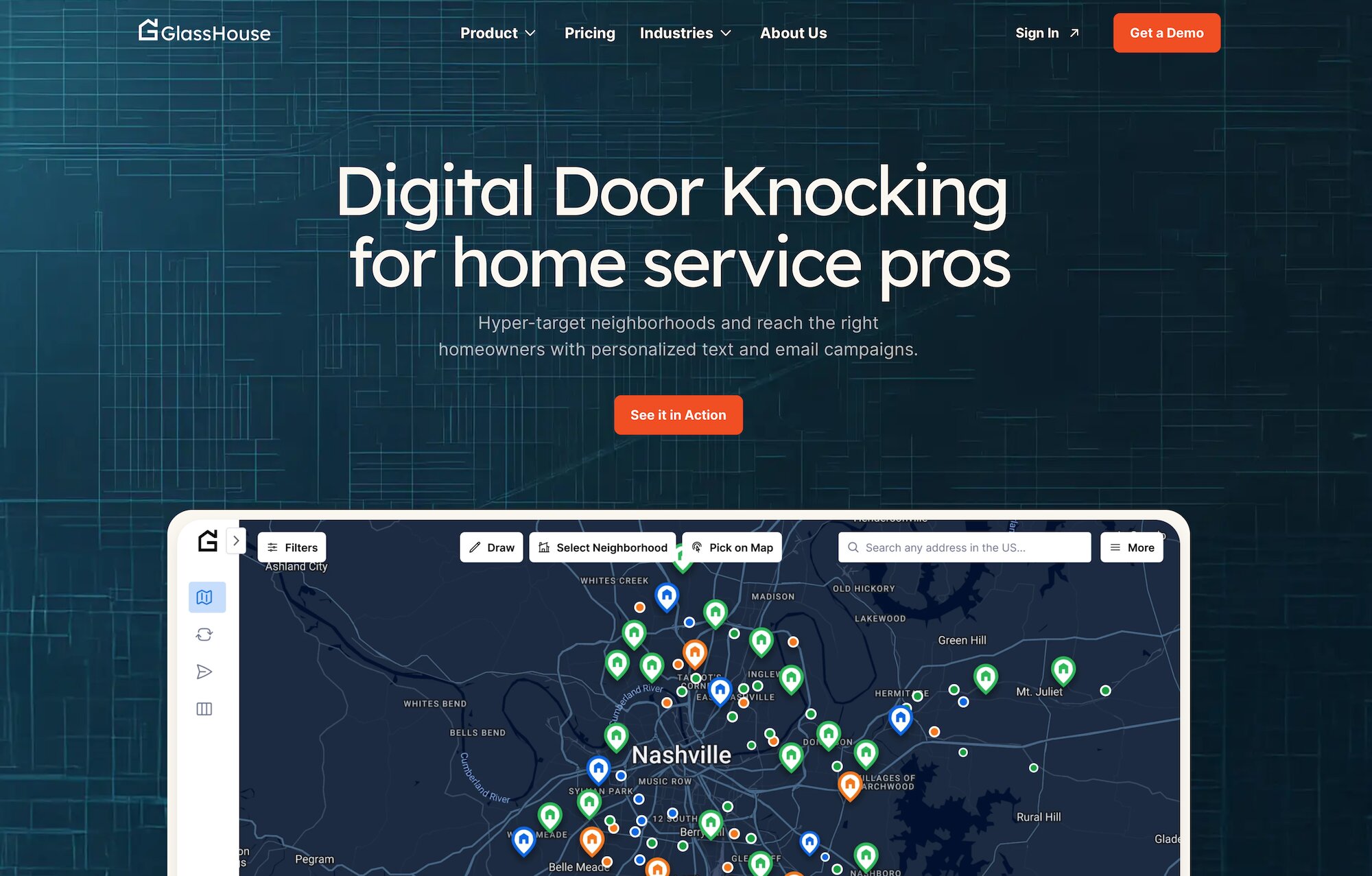
Our platform, GlassHouse, was built to market to homeowners in a more personalized, targeted way. Instead of placing yard signs or running Google Ads, you're reaching out directly — texting them with a custom offer for their neighborhood.
It works the same way as door knocking, just over the phone. Homeowners aren't getting a random knock at the door, and your team isn't walking streets after an already exhausting day of installs. You're having the same conversation, through a channel that's easier for everyone.
It also lets you build your pipeline on your own timeline. You don’t have to wait for someone to Google you or buy leads from a third-party provider. You decide when outreach starts — we suggest late summer or early fall — schedule campaigns ahead of the season, and then work the streets around jobs as they get scheduled. It’s one of the best ways to get a jump on the short season.
And the targeting capability is what makes this work particularly well for holiday lighting. You're not just blasting zip codes — you're targeting exact neighborhoods and filtering down to the property types that actually book installs: higher home values, well-maintained neighborhoods, homes that are clearly going to get decorated.
Our painting businesses see a ton of success with GlassHouse for the same reasons. Take Tasia Haygood of PaintEZ in Grand Rapids, for example. Her team typically wins one or two leads around every job simply by texting nearby homeowners to ask if they have any painting projects that need to be done while the crew is already in the neighborhood. She says GlassHouse gives her access to homeowners in a way her competitors can't and lets her connect with them on a more personal level through text messaging. Watch her full story here.
We’ll take you through our core features so you can see exactly how GlassHouse works. But if you'd like a more in-depth walkthrough to see how it’d fit your business, schedule a demo with our team. They’ll show you the full workflow, pull prospects in your market, and put together a tailored plan for you.
How Our System Works
You’ll start here on our map — it has all the features to search neighborhoods, filter properties, and find the homeowners you want to reach. Build campaigns from our template library and schedule your messages to send. (It’s super simple; most teams only spend an hour or so on this per week.)
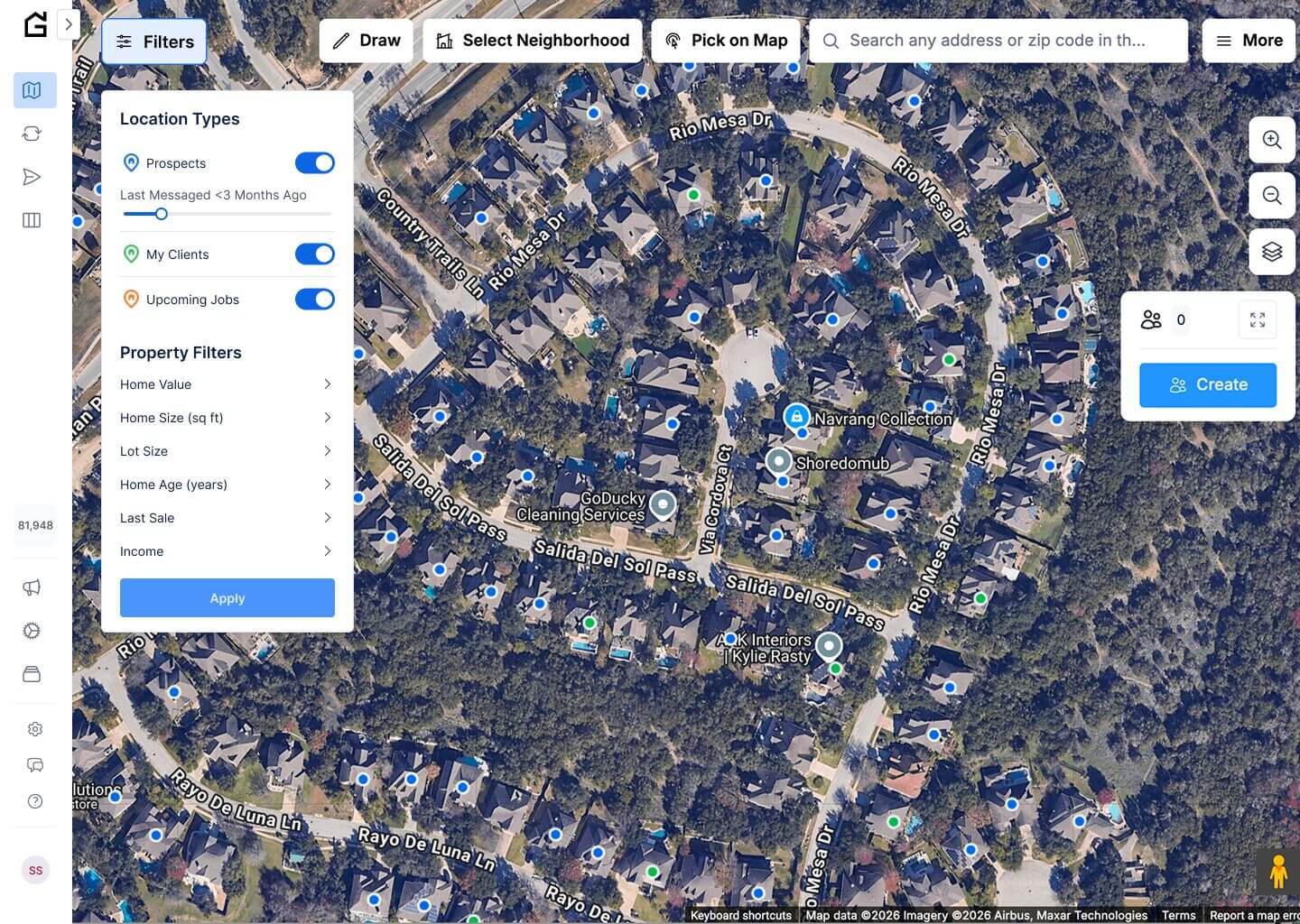
Open the map and search the addresses or zip codes you want to target — where you’ve already worked or areas you want to break into. We display green pins on the homes where you’ve completed jobs, and orange pins for upcoming jobs, so you can easily see where you have a presence and build around it.
Draw any custom shape to cover entire areas or select neighborhoods automatically.
Apply filters so you only reach homeowners likely to be in the market for holiday lighting. Home value and home size are going to be most relevant here — those with bigger homes are the bread and butter.
Click Reveal to pull the list of properties that match your search criteria.
Then build and schedule out your campaigns!
On campaign building:
GlassHouse comes with different templates for you to pick and choose from based on industry types, offers, seasons — you name it. All of them are conversion-optimized with clear calls to action (CTAs) so you can get started quickly without worrying what to say.
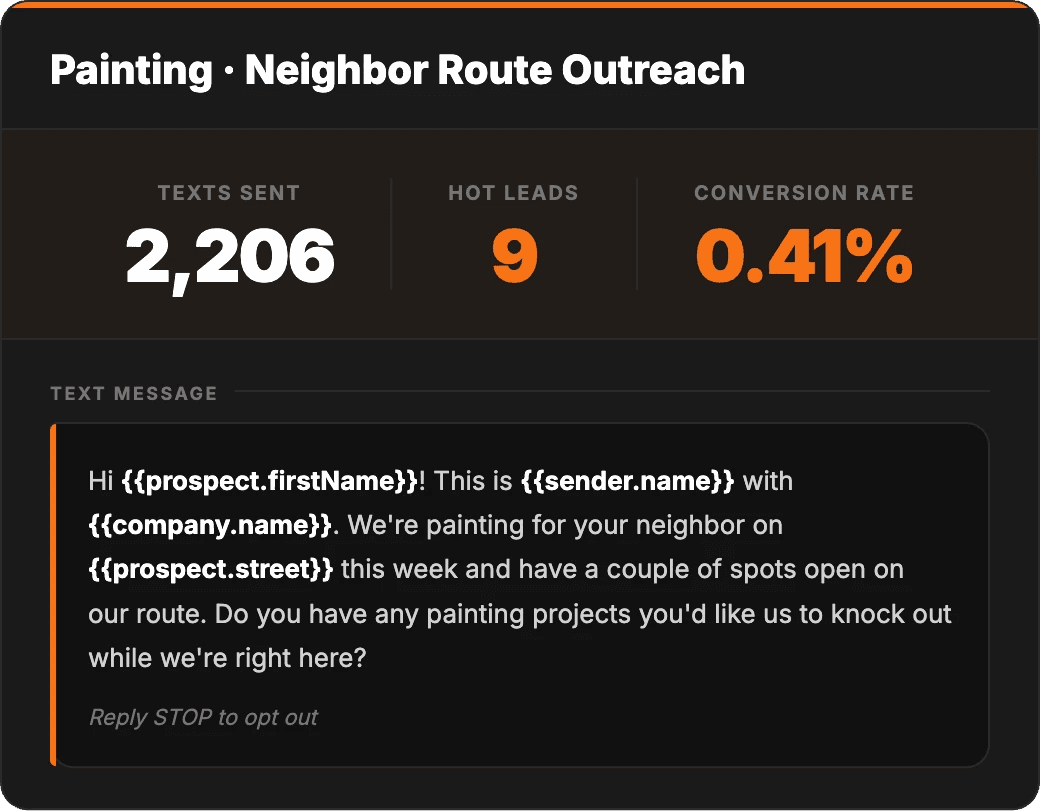
That said, you can always edit your messaging to fit your brand. Our team can even help hone in on the best strategy and messaging — you always have a partner dedicated to your success. A few best practices to follow:
Lead with something concrete and current, like a nearby job, the start of the season, or a limited install window. This hits harder than a generic "We do holiday lighting."
Anchor to proximity. "We're lighting up [Street] this week" style messaging performs better than a blanket announcement.
Try a safety-angle variant. Professional installation avoids the ladder and fall risk that comes with DIY, which is a real differentiator few competitors lead with.
For higher-income targets especially, consider a permanent lighting variant: install once; lights stay up and are controllable year-round; pay only for maintenance going forward. A distinct pitch from the seasonal one.
Offer a neighborhood-specific incentive tied to booking early, not just a generic discount.
When you’re ready to schedule out messages, our system enforces compliant sending windows so you’re never sending during early or late hours. All your texts go out from a local 10-digit number registered to your business.
Note: We cover all compliance here automatically so you never have to worry about this end of things. Our system scrubs local and national DNC lists and TCPA litigator lists, and handles any opt-outs, to exclude those homeowners from your contact lists — so they never get swept into your campaigns.
After campaigns are sent, you can monitor and manage all replies in our sales dashboard. This dashboard includes user-friendly Kanban-style boards to see everybody’s status and work prospects into hot leads.
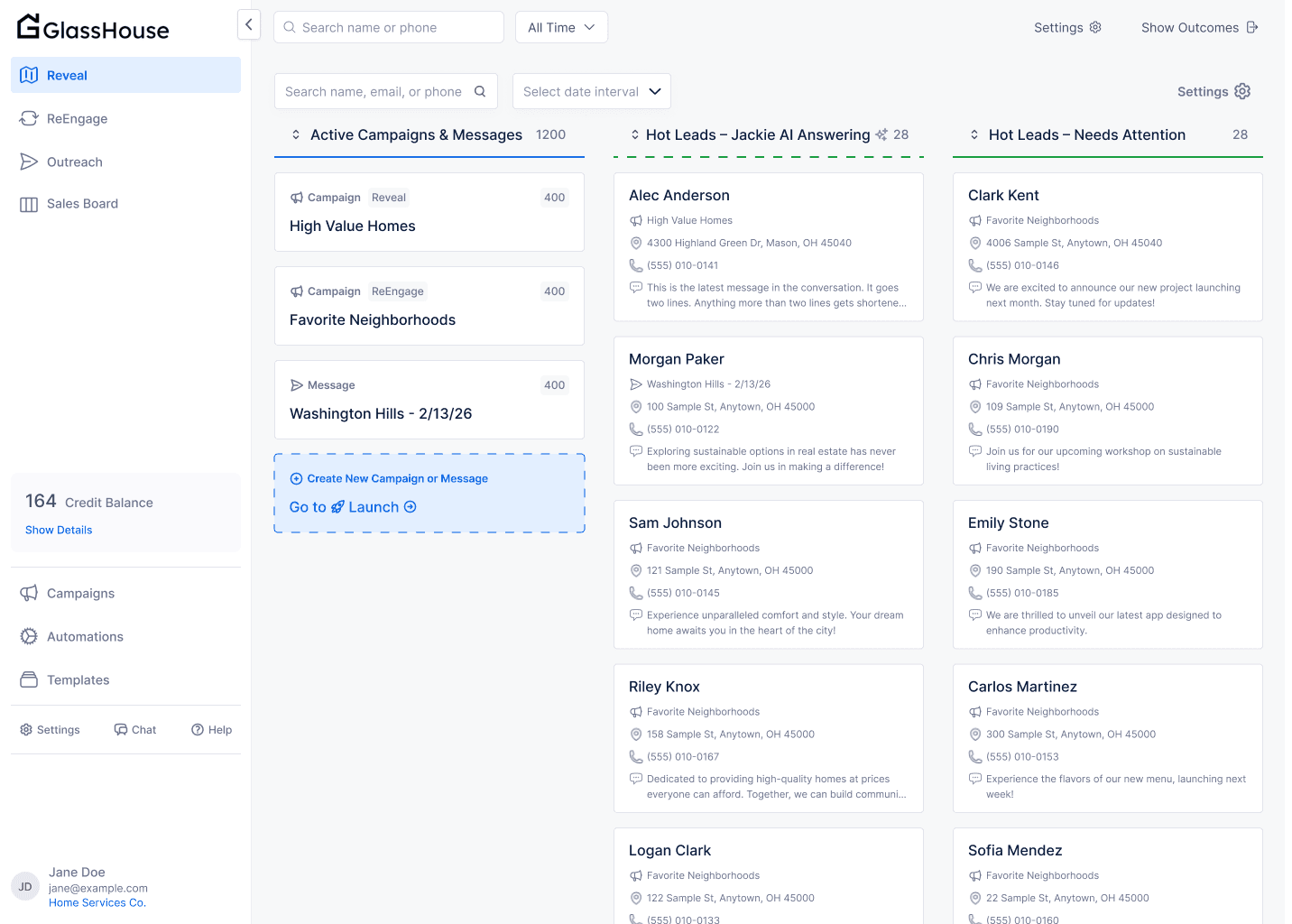
We also have an AI responder agent (Jackie) to help with lead management. She ensures everyone gets a prompt reply — responding to leads within minutes of their reply. She’ll handle the initial conversation, qualification, and even appointment booking to convert interest into actual booked jobs. You can even change Jackie’s name to match your own brand’s agent — Sara, Michael, whoever. You can track and review conversation threads, jump in when you like, and you’re always notified when a human in the loop is needed.
All your qualified leads are automatically pushed to your connected CRM or FSM tool, so no contact falls through the cracks. Enroll those leads into nurture campaigns or use them in combination with GlassHouse for retargeting — for next year’s lighting or your other services.
Our ReEngage feature lets you retarget your existing contacts and send outbound campaigns.
It helps with upsells and cross-sells opportunities (e.g., home and landscape lighting, permanent lighting installations).
The GlassHouse <> CRM and FSM connection also comes with other benefits:
No manual downloading or importing contacts between systems — everything syncs automatically, so your list stays accurate across tools.
GlassHouse enriches your existing CRM or FSM records with property-level details that are missing, like home value, size, and age, giving your team more insight into your contacts and leads.
It also visually maps homeowners already in your customer base so you target around past customers, upcoming jobs, or exclude them from your outreach.
New leads sync back to your CRM or FSM automatically, so you can drop them straight into follow-up or nurture sequences without more steps.
You can also track which outbound touchpoints influenced booked jobs. Some homeowners will get your text, Google you, and call in without ever replying; without matching it back, you'd never know the text started that conversation.
How to Get Started
Everyone gets started with a free demo. Our team can take you through the system, discuss your current lead gen strategies, and put together a plan that supports your business needs.
Pricing is standard across the board and pretty straightforward. There’s a $3,500/year platform fee (billed annually), and you purchase credit bundles as you go (3¢ per credit).
Credits are how you scale the volume of your outbound messaging on the platform. Our team can help you determine how much to start with, and you top up more as needed.
All our customers get free onboarding, ongoing support, and unlimited users.
You can also build your package with the Email add-on and our Done-For-You service:
The Email add-on is $250/month. It includes 7,500 monthly emails, drip campaigns, email copy creation, domain email warmup, inbox alerts, and more. You can run email campaigns in parallel with your SMS campaigns.
The Done-For-You service is $400/month. It includes campaign creation, copywriting and management, monthly performance reports, and dedicated account management.
Schedule a free GlassHouse demo to see how you can keep a solid pipeline before, during, and after the holiday season.
You can also check out our ROI calculator to learn more about your best package and just how much business GlassHouse can bring you:
See what Digital Door Knocking can do for your business
Enter a few details and see the leads, revenue, and return on investment GlassHouse can drive for you.
What industry are you in?
We'll use this to set your benchmarks for conversion rate, deal size, and close rate.
Select your vertical:
Physical Door Knocking
In-person door knocking is another option to win new leads off the back of completed installs. Your crew can knock around the neighborhood before leaving jobs to see if anybody else on the block wants you to light up their home. They can directly point to the work they just completed and offer free estimates or a neighborhood discount to win some quick business.
However, there can be some limitations here — and even more barriers for holiday lighting:
You’re capped on how many people you can send knocking. It makes the most sense to have your crew do this after they complete installs, but by then they’ve spent a day on the job and are pretty tired — not really fresh or up for selling. The other route is to split your crew (half knock, half install), but then you’re taking folks away from actual installs.
Conversations are dependent on homeowners actually being around to open the door. If your crew is out in the mornings or afternoons, chances are those knocks won’t be answered. Your best bet is to hit homes after typical working hours, but then you risk interrupting dinnertime or catching folks when they’re just trying to unwind. Not everybody is receptive to a random knock at the door.
You’re battling weather, as half the country is hit with cold temperatures and snow during the holiday months. Your crew may not be eager to knock on doors in cold weather. Homeowners probably don’t want to stand at the door shivering.
These limitations are what GlassHouse was designed to work around.
Texting homeowners means you can reach dozens of people at once; you’re not limited by boots you can get on the ground or taking crew off jobs. People can also get back to you when it’s convenient for them (you’re not tied to the “then and there” aspect of physical door knocking). Lastly, you don’t have to keep your people out in cold weather longer than necessary.
We recommend any team that still wants to lean into physical door knocking to pair it with GlassHouse to boost your conversions. You can start with digital outreach to gauge interest and introduce your brand, then send your crew to the homes that show the most promise. It’s a focused, layered approach that helps you win jobs from the homeowners most likely to buy.
Read more: Best Door Knocking Software for Home Service Teams
Yard Signs, Door Hangers, & Mailers
Yard signs, door hangers, and mailers are all low-cost, simple ways to put a name to your work. Anyone driving by an install sees the display, but they don't necessarily know who put it up. These fix that.
Yard signs at active installs. A sign at a job site you're actively working (or just finished) is more effective than a blanket sign campaign scattered around town. It's tied to real, current work someone can point to.
One tactic worth trying: Offer free installs on a handful of high-visibility homes in exchange for keeping a lit yard sign up through the season. One company turned $2K in free work into $40K in new business this way!
Door hangers to the closest neighbors. Hit 5 to 10 homes on either side of a completed job. Same logic as the yard sign: you're leaning on proximity and current, visible work, not a cold pitch to someone who's never seen what you do.
Direct mail can work too, as a supplement in neighborhoods you're targeting. But of the three, we'd rank it last. Yard signs are the most effective, door hangers next, and mail as more of a layer on top if you have the budget.
Whichever you use, make it trackable. A QR code linking to a quick quote request or a simple contact form lets you see if leads are actually coming from these channels.
Referrals & Partnerships
Referrals are another way to get new business from past work, and these extend beyond the houses right around recent installs. Past customers and business partners tend to happily share your name with anybody they know who’s looking for a holiday lighting company — friends, family, coworkers, clients, and so on.
Referrals hold really strong conversion rates (between 30% and 50%) because your name is being recommended by a trusted source. You don’t have to do much convincing or compete for their attention. These leads are coming straight to you for the job.
Building out a network of people who can refer you helps you see more of these high-quality leads. Here’s what we suggest:
Ask for referrals and reviews at the end of installs while you're still on site, in a follow-up text, or both. For referrals, dual-sided incentives tend to work best: a gift card for the customer who sends someone your way, and a discount for whoever they refer. Both parties have a reason to follow through. And reviews can go a long way here because, unlike referrals, they don't require your customers to mention your name to someone specific. Anyone who finds your business online can read them, which means they keep working for you long after the job is done.
Build partnerships with the businesses already in homeowners' yards. Landscapers, roofers, exterior remodelers — these teams are up close to the same properties you want to work on, talking to the same homeowners you're trying to reach. A landscaper finishing a job in October is talking to a customer who's about to start thinking about the holidays. That's a natural hand-off. Build a handful of these relationships, and they become a consistent lead source.
Show up in your community. HOA meetings are worth attending — holiday displays often come up, and being the person in the room who handles this professionally is an easy opening. Sponsoring local events or offering free lighting for a nonprofit or community space gets your work visible in the neighborhood and puts your name somewhere people will remember it.
Join your local BNI chapter or Chamber of Commerce. These organizations are specifically set up around businesses referring one another, so they're a reliable way to generate word-of-mouth leads from the local business community.
Get active on Nextdoor. Homeowners go there to ask for contractor recommendations, and holiday lighting comes up every year — which companies are worth hiring, whether DIY is realistic, how much it costs. Set up a business profile and join those conversations. Pitch yourself when someone's actively looking and offer advice in other threads. This “free advice” can also win you the customer later on, as plenty of homeowners who start installing Christmas lights themselves end up calling a pro halfway through anyway.
How to Get in Front of Homeowners Looking for a Holiday Lighting Service
The strategies above let you make the most of the installs you’ve already completed and keep your pipeline full as the season progresses. Everything below helps you capture new leads from homeowners actively searching for a holiday lighting business. They’re online looking to hire somebody just like you — you want those folks to find you.
Website & Local SEO
Your website is one of the highest-value things to invest in because once it gains traction, it can bring you free leads season after season. It’s the thing that ranks in search results when people look up “holiday lighting near me,” it builds credibility with everyone who finds you, and it lets people reach you directly.
There are two big things to think about when building your site: usability and visibility.
On the usability side:
Include clear ways to contact you across your site — contact forms, online booking widgets, click-to-call buttons. Place them on your home page, service pages, location pages, “About Us” page, and in blog content, so people can easily reach out wherever they enter your site.
Make sure your site is optimized for desktop and mobile devices (cell phones, tablets). Most website builders automatically handle this for you, but it’s worth running a test across your site after it's live. Check each page to make sure it looks and functions right across different device sizes.
Check page load speeds. Pages should load in ~2 seconds. Slow-loading pages are among the main reasons people leave sites and search elsewhere — and you don’t want to lose potential leads just because a page didn’t pull up fast enough. You can gauge this as you do your QC check above or use Google’s PageSpeed Insights (a free tool) for a proper assessment.
Search engine optimization (SEO) comes into play on the visibility side.
These strategies are what get your site ranking in search results for all the queries relevant to your services and service areas — “holiday lighting near me,” “Christmas light installation businesses in [city],” “companies to hang Christmas lights and wreaths,” “permanent holiday lighting” — those kinds of things.
A lot of home services bring in a digital marketing agency to build and manage their site so they know it’s set up the best way. That said, there are some standard best practices that most teams can handle without having to hire help.
Have a clear home page with your business name, logo, service areas, and contact information. Beyond those basics, we also suggest displaying your star rating and including links to your review profiles and social pages. This helps people browsing your website easily click over to see the presence you’ve built on other platforms.
Create dedicated service pages for each type of work you offer — residential holiday lighting installation, commercial holiday lighting installation, permanent lighting, wreaths and garland, custom design, maintenance, and takedown and storage. Add FAQs at the bottom of each page to answer the most common questions about that service. Things like “How far in advance should I book?” for installs, “What's included in a maintenance visit?” for maintenance, or “How long does takedown take?” for removal. This is how you show up when homeowners search for those specific services.
Set up location pages for each service area you cover. These cover location-specific or “near me” searches, so you appear in those results.
Include an “About Us” page with background on your business and team. How long you've been in the industry, what makes your installs stand out, who's showing up to the job. Homeowners want to know who they're letting onto their property, and this is where you give them that confidence. Photo libraries and quick bios for your main crew earn you even more familiarity.
Add a contact page that lists all the ways to contact you — your phone number, email, and contact form — as well as your service areas.
Once you have these main pages, you can keep building out your site with blog content. Write about the topics homeowners are researching when deciding whether to hire someone or what type of install to go with. Cover topics like cost breakdowns, DIY vs. pro, when to book, and permanent vs. seasonal lighting. This kind of content gets you in front of homeowners earlier in the process, so they already know your name.
Note: You may also hear chatter about generative engine optimization (GEO) when researching ways to build out your site. GEO is about showing up in AI tools like ChatGPT, Gemini, Claude, and Perplexity when homeowners use them to research services or ask for recommendations. It can sound more complex than SEO, but the two are closely linked. AI tools scan and pull from top-ranking search results to generate their responses, so if your site is well-optimized for search, you're already covering most of the GEO ground too.
Online Directories & Map Packs
You can also get visibility in search results by adding your business to online directories: Google Business Profile, Bing Places for Business, Apple Business Connect, and Yelp.
These directories can even get you seen sooner than your website (as that can take some time to grow and move up in rankings). Once you create directory profiles, you immediately start showing up in local search results and map packs. And since homeowners can see your business information and customer reviews all in one place, these profiles do double duty: visibility and credibility.
Let’s pull up an example here. When I Google “holiday light installation businesses near me,” I get a list of businesses in my area. I can see their star rating, how many reviews they have, snippets from reviews, as well as their phone number and direct links to websites and booking forms — so I can easily gauge their quality of work and take action. (This works the same on Bing, Apple, and Yelp, too.)
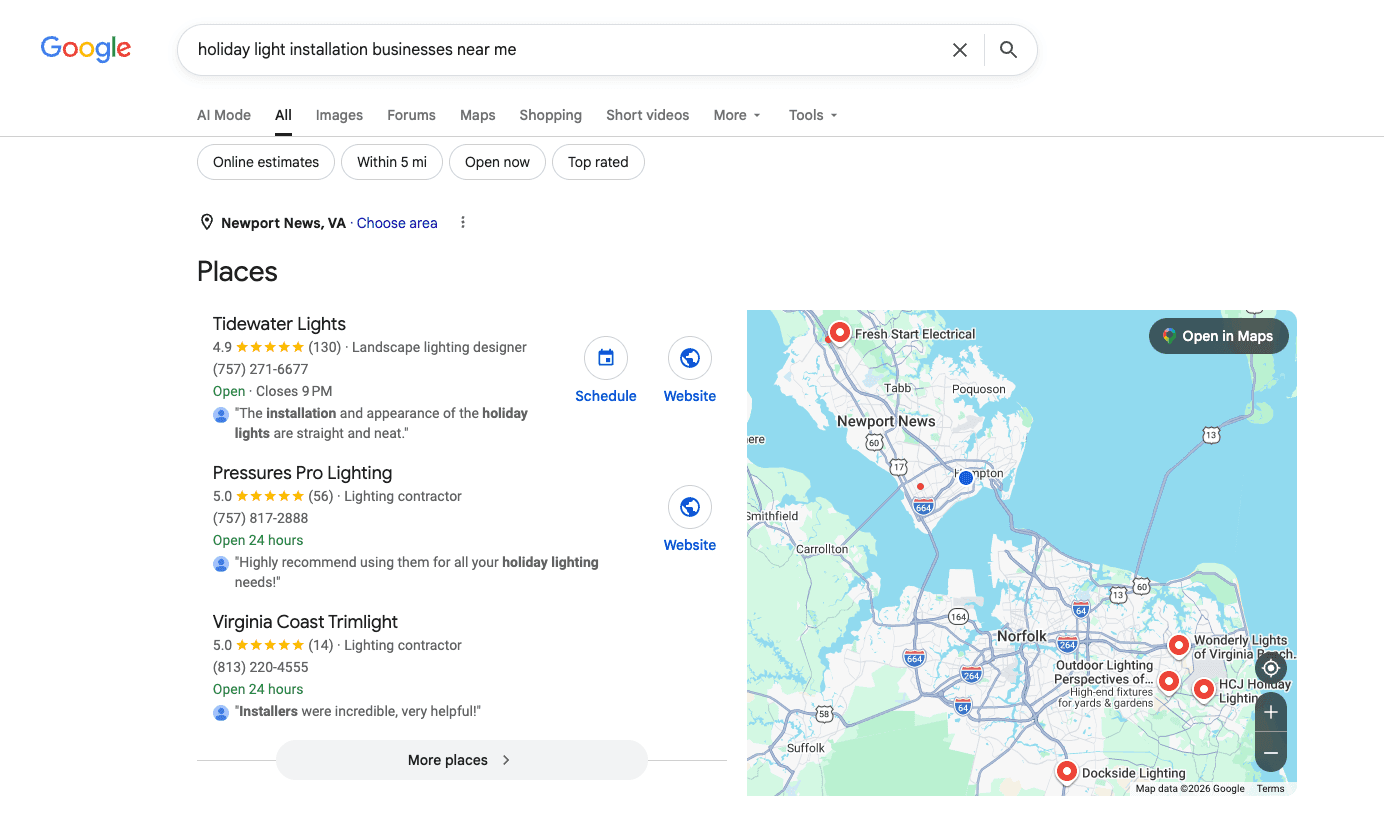
All the directories we listed above are completely free to join, and adding profiles is super easy:
Start on the main directory page and search for your business name to claim or create your profile. A lot of directories scan the web to identify and automatically add new businesses to their database, so you may already have profiles on some of these platforms.
Whether you’re claiming a profile or creating one from scratch, the next thing you’ll do is add all your business information — your name, category, contact information, operating hours, service areas, and so on.
Upload photos and videos of past installs and your crew — before-and-afters, roofline shots, finished displays, team photos — so homeowners can get a feel for your work and the people behind it.
After your profiles are made, the ongoing work is just collecting reviews. As we mentioned above, you want to do this at the end of every job. Profiles with high star ratings and ample reviews get shown more often and closer to the top of directory results.
Online Search Ads
Online search ads get you listed at the very top of results — above the map pack and any website listings. And the homeowners clicking those ads are actively searching for someone to hire, not just browsing. That's about as high-intent as it gets.
Google and Bing each have advertising programs you can check out.
Google Search Ads are the most common starting point. You bid on keywords relevant to your services and location — a mix of service-based terms like "Christmas light installation [city]" and higher-intent long-tail searches like "professional Christmas light hanging cost" — and your ad appears when homeowners search those terms.
Clicks for holiday lighting typically run $20 to $30, and it takes roughly 3 clicks to generate 1 lead, putting your average cost per lead between $60 and $90. Close rates in this industry tend to fall between 20% and 25%, so factor that into what you're willing to spend per lead.
Google also offers Local Services Ads (LSAs), which work differently than standard search ads. Instead of bidding on keywords yourself, Google automatically matches you to relevant searches based on your business profile and service area. It's less day-to-day management, and you only pay per lead rather than per click.
The catch for holiday lighting businesses is that there's no dedicated LSA category for holiday or Christmas lighting. If that's your primary service, you can't enroll directly. However, if your business also falls under a broader category that Google supports (like landscaping, electrical work, or window cleaning), you may be able to advertise under that category and include holiday lighting as a sub-service.
Bing Ads follow the same model as Google Search Ads but run on Microsoft's network — Bing, Yahoo, and a handful of partner sites. But these aren’t as popular as Google Ads because Bing’s user base is smaller, so search volumes are lower. You aren’t going to reach as many homeowners here as you would on Google.
The plus side, though, is that clicks tend to cost less and you’re not competing with as many businesses for visibility. So you could use Bing’s program as a “training ground,” so to speak, while you learn how to set up and manage campaigns, as there isn’t much risk of blowing through the budget here. You can also let these run in the background with Google Ads — you won’t see as many leads as quickly, but they’ll trickle in as campaigns run.
A few things to keep in mind before jumping in:
Timing these right is critical to seeing return on ad spend. Homeowners don't really start searching for holiday lighting until after Halloween, and most installs happen between Thanksgiving and mid-December. That means your window for search ads is pretty small.
You have to stay on top of these to make sure you’re bidding on the best keywords and using your budget wisely. Because the season is so short, a bad week of ad spend hits harder than it would for a business with twelve months to recover. A lot of teams bring in a freelancer or an agency that knows Google Ads to make sure they're getting it right from day one, rather than burning through their budget while figuring it out. And it's not always smart to bring on a new vendor at the start of peak season.
These ads only work as long as you're paying for them — the moment you stop, so do the leads. You’re really only renting visibility from these platforms. They’re best as a complement to the long-term channels you're building, like referrals, your website, and directory profiles, not a replacement for them.
Social Media
Social media can be the best possible channel for the holiday lighting vertical. The work is dramatic, it's festive, and it looks great in pictures and videos. Holiday lighting, unlike other home services, brings homeowners joy. Capturing that joy through a neighborhood transformation video or beautiful b-roll that shows off a roofline close-up at night is the kind of content people stop scrolling for. Facebook and Instagram are where most of your audience will be, with Reels and short-form video being the highest-performing format right now.
Some content ideas that work especially well for holiday lighting:
Before-and-after reveals. A dark, undecorated house cut to the same house fully lit is one of the most compelling things you can post. Keep it short, add some music, and let the transformation speak for itself.
Time-lapse installation videos. These show off both the finished result and the skill behind it — homeowners can see how much work goes into a professional install, which is a natural pitch for why hiring someone beats doing it yourself.
Roofline and detailed close-ups. The kind of shots homeowners can't get themselves. Tight, well-lit footage of a clean roofline or a perfectly hung display is proof of craftsmanship in a way a wide-angle shot isn't.
Neighborhood transformation videos. If you've lit up multiple homes on the same street, film a slow drive down it at night. These perform well because they show scale and make neighbors want to join in the festivities.
Customer reaction videos. Film the homeowner seeing the finished install for the first time. Authentic reactions function as a testimonial without feeling like one.
Behind-the-scenes crew content. Homeowners are letting your team onto their property — content that shows who your crew is, how they work, and how they treat a job site builds the kind of trust that gets you hired over a competitor with the same price.
"How we do it" explainer content. A quick walkthrough of how you plan a design, measure a roofline, or choose light placement positions you as the expert and answers questions homeowners have before they even ask.
Safety-angle content. Ladder falls are one of the most common holiday injuries — there's a real reason to hire a pro beyond just convenience. Posts that lead with this angle ("here's what a professional setup looks like vs. a DIY attempt") are a strong differentiator, especially early in the season before people have started thinking about decorating.
DIY gone wrong content. Tasteful, not mean-spirited — but showing common mistakes homeowners make trying to hang lights themselves (tangled cords, uneven spacing, wrong clips for the roofline type) reinforces the value of hiring a pro.
Permanent lighting content. Year-round controllable lighting is a relatively new concept for many homeowners. A short video showing the same home lit for Christmas, then Valentine's Day, then the 4th of July is a compelling pitch that most competitors aren't making.
Seasonal countdown posts. "X weeks until the holidays — here's what your install timeline looks like if you book now." Creates urgency without feeling like a discount push.
Local holiday event tie-ins. If your neighborhood or city has a light display, a holiday parade, or a home-decorating contest, posting about them puts you in front of a locally engaged audience that cares about exactly what you do.
Beyond what you post on your own page, neighborhood Facebook groups are worth getting active in. Join before the season and show up helpfully — answering questions about timing, safety, what a professional install actually costs — before you pitch anything. Early, salesy posts get you muted fast. But being the person in the group who actually knows their stuff means that when someone asks, "Does anyone know a good holiday lighting company?" your name comes up.
Partnering with local influencers is another angle worth exploring — think local lifestyle or home decor creators in your area. A free install in exchange for a post or reel showing the finished display puts your work in front of an engaged local audience that already trusts that person's recommendations.
Paid social is also worth testing here, and holiday lighting is a particularly strong fit. The visual nature of the service is exactly what performs well on platforms built around imagery and video. Run these closer to the season, when homeowners are starting to think about decorating, and use your best transformation content as the creative.
How to Buy Leads When You’re in a Pinch
The very last strategy to discuss here is purchasing from lead generation platforms — Angi, HomeAdvisor, Houzz, Thumbtack. We mention this at the very bottom of our list because this route is expensive and competitive. Most home services companies, across all industries, report frustration and wasted money when trying to win new work this way. So while it’s an option, it should not be your first approach.
All the big names in this space, including the sites listed above, operate on a shared-lead model. That means every lead is sold to multiple contractors at once. A homeowner completes a request for a quote on Angi, and that’s sent to five other holiday lighting companies at the same time it hits your desk.
Then you’re stuck racing to respond before the other guys and offer the lowest price — as most homeowners on these platforms just want to compare a couple of quotes and find what’s easiest on their wallets.
This model is often the most common and favored one because it works really well for homeowners and lead providers. Homeowners can expedite comparison shopping with a single form fill. Lead generation companies can sell each inquiry to multiple contractors.
But the home service companies on these sites get the short end of the stick. They pay (a pretty penny) for each lead, lose half of them, and usually end up undercutting pricing to win the few they do.
With holiday lighting being such a short season, this song and dance quickly becomes a waste of your time and marketing budget.
If you’re really in a pinch, need to get a few jobs on the calendar, and don’t mind paying for a couple of leads, we suggest spending your money with the exclusive lead providers.
There aren’t as many of these sites — the ones for holiday lighting include We Hang Christmas Lights and CLIPA — and the leads from these providers are more expensive than shared ones. But here, you actually have a fair shot at winning the customer because leads are only sold to one business at a time. After you buy the lead, it’s yours to work; it’s not going to five other competitors. Most businesses have much better luck at converting customers this way.
Read more: How to Get Leads Without Paying for Angi & HomeAdvisor
Best Practices to Run This Playbook Well
Start Marketing Before the Season Hits
We suggest getting started in late summer or early fall, before the holidays pick up.
Website content, social media, and referral and partnership relationships all take time to build — these need months of runway, not weeks. Get moving during the off-season so they're doing something for you come fall time.
GlassHouse outreach can start just as early. You're already in homeowners' inboxes before they've even started thinking about holiday lights. And for a lot of them, that's actually a relief. Finding and vetting a lighting company is one more thing on a long holiday to-do list. If you reach out first with a solid offer, many are happy to just book and check it off.
The one exception is paid ads — both search and social. Homeowners aren't really looking for holiday lighting until Halloween comes and goes, so running ads before that window tends to be money spent before anyone's ready to act. Hold these until mid-November and run through mid-December when the timing actually lines up.
Respond Fast
When a lead comes in, get back to them fast — ideally within the first five minutes if you can, but no later than a few hours or the end of the day. A season this short doesn't give you much buffer, and a slow response can be the difference between a booked job and a homeowner who moved on.
Manage Leads Consistently
Track every lead in one place — your CRM or GlassHouse's sales board — and keep it up to date. During your busiest weeks, it's easy for things to slip. A lead you meant to follow up with on Tuesday can fall through the cracks, and by Friday that homeowner has already hired someone else.
Set a follow-up cadence and stick to it. If a homeowner doesn't respond to your first message, follow up. If they went quiet after showing interest, send one more nudge. Most leads don't convert on the first touch, and the ones who do book are often just the ones somebody remembered to follow up with consistently.
JackieAI can handle a lot of this for you automatically — following up with prospects, keeping conversations moving, and booking appointments — so you're not relying on memory or a spreadsheet to keep things on track.
Diversify Instead of Betting on One Channel
Spread your efforts across a few of the strategies in this guide rather than going all in on one. Having a mix keeps you covered. If one channel has a slow week — a lull in referrals, a slow stretch for ads — you're not stuck with nothing coming in during an already-short season.
Pair proactive outreach like GlassHouse with inbound channels like SEO and paid ads. This lets you get in front of homeowners before they start searching and comparison shopping, and catch them when they do.
Get a website up ASAP. Cover the basics first. Everything else can come later. You don’t need to have it fully built out from day one; you just want to have something up for when homeowners search your business. If they can’t find a legit site, they’re probably not going to trust your business enough to call you out for an estimate.
Create your directory profiles so you appear in local search results and map packs. It's free, and you can knock most of them out in an afternoon. From there, focus on collecting reviews as you go.
Social media is worth building up, but don't let it overwhelm you. Create your profiles, start posting, and go at your own pace. A lot of teams burn out trying to publish constantly and end up abandoning it entirely — that's worse than a slower, more sustainable cadence.
Referrals are worth working all season long because they carry such high conversion rates. Always be asking, building your partner network, and showing up in your community where you can.
Have yard signs and door hangers ready for peak season so you can place them around jobs as you go — these are what put a name to your work for everyone driving by. You can also test mailers, but as covered earlier, those are more of a last-resort layer on top.
Run paid search and social ads closer to peak season when people are actively looking and ready to hire someone.
Measure Cost Per Lead & Close Rate, Not Just Volume
Don't just look at how many leads each channel brings in — also track cost per lead and close rate by channel. A cheaper channel with a low close rate can end up costing you more per booked job than a pricier one that actually converts.
You should also identify your repeat customers and where those leads originally came from, as those would be channels to double down on.
Getting Started
Every strategy in this guide works better with a full pipeline behind it — and GlassHouse is how you build one before the season even starts. Reach homeowners in your target neighborhoods weeks ahead of the rush, then keep working the streets around your jobs as installs come in. By the time most of your competitors are scrambling to fill their calendars, you're already booked.
Schedule a free demo with our team to see how it works for your business.