5+ Ways to Get More Pest Control & Mosquito Treatment Leads
By Jackie Vaughn

Pest control is a tough business to keep leads flowing in because it's seasonal. Spring and summer bring the surge, and things slow down the rest of the year. You've got a narrow window to win customers, and once it closes, you’re waiting until next year.
But there's an upside: Win a customer once, and you're likely to keep them with seasonal treatments and one-off calls when something new pops up. Pest control has some of the best repeat business in home services if you can land the first job.
Getting new leads matters, but so does what you do with the customers you already have. We put together this guide covering both: our pest control marketing strategies for keeping a full pipeline, and how to hold on to more of the business you win.
The approach we lead with tackles that seasonality head-on: reaching homeowners directly via SMS before they're even searching for someone like you. It's exactly what we built GlassHouse to do. From there, we get into building a referral network, growing your website and online presence, running paid ads, and working with lead providers.
To learn more about GlassHouse after reading, schedule a free demo with our team.
1. Door Knocking to Reach Customers Directly
Digital Door Knocking with GlassHouse
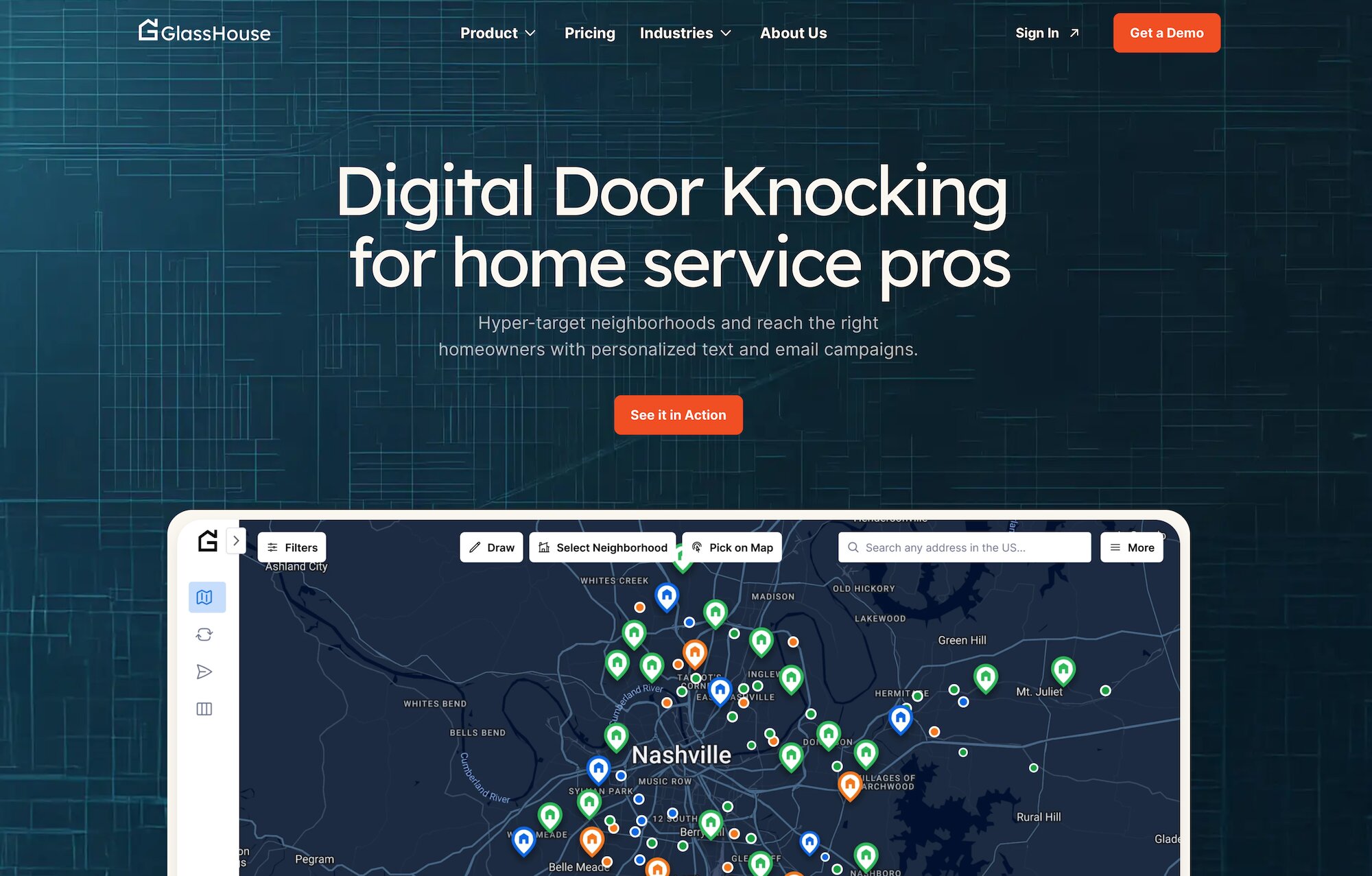
Most pest control leads come in already annoyed. By the time someone's searching for "mosquito treatment near me," they've usually got a yard they can't sit in, bites up and down their legs, and a couple of unwelcome guests that found their way inside. They're likely comparing multiple quotes, hoping to get someone out yesterday.
Digital door knocking is our approach to getting ahead of that scramble: text homeowners directly before they're bugged (sorry, had to), so they can schedule sprays before mosquitoes move in.
Here's how it works: Draw a shape around any neighborhood or territory on a map, and we'll instantly pull contact data for the homeowners inside it. From there, you can filter by property details — home value, size, lot size, age, last sale date — so you're only reaching out to the households that actually match your target audience. No wasted texts on a condo with no yard to treat, or a brand-new build that hasn't had time to develop a pest problem yet.
Of course, timing matters as much as targeting here. Our team can work with you to create and schedule your campaigns, but generally speaking, we recommend that pest control companies launch the first wave of campaigns 4 to 8 weeks ahead of peak season — so late winter or early spring, well before summer.
Beyond that seasonal push, and once the season’s underway, you can build campaigns off the jobs you’ve already completed. Some of the best-performing campaigns come from a quick text to the house next door. Something like: "Hey, we just treated a home on your street for mosquitoes — pests move! Let us know, and we'll get you taken care of too." This reads as a heads-up from somebody paying attention, not a sales pitch.
The key takeaway: You're not waiting for Google to send you a homeowner who's already shopping three competitors. You're building a pipeline of people who hear from you first.
Nathan Banga, a Mosquito Authority/Pest Authority franchise owner, put this to work starting in March 2026 out of NW Indiana. On a $15K spend, he's landed 221 new customers and generated over $100K in annual recurring revenue — a 7x ROI — with about $4K left in credits from that original investment.
Below, we’ll give you a quick rundown of GlassHouse so you can get a feel for the workflow. But if you want to see exactly how it’ll work for your business, you can skip straight to a demo with our team.
How Our System Works
Identifying homeowners to target and putting together campaigns is super simple — most teams only need to spend an hour or two each week managing this outreach. And our team is here to help when you need us.
Here’s a preview of what the workflow looks like:
First, you’ll draw your target territory on the map.
Open the territory map and draw a shape around any street or neighborhood you want to work. You can also switch to satellite view and get a better look — here you can find homes with those big backyards or near wooded areas that might be more prone to infestations.
This map also shows pins over your existing customers, so you can see exactly where you’ve built a presence when choosing where to target. It’s especially helpful for mid-season when building campaigns off existing jobs.
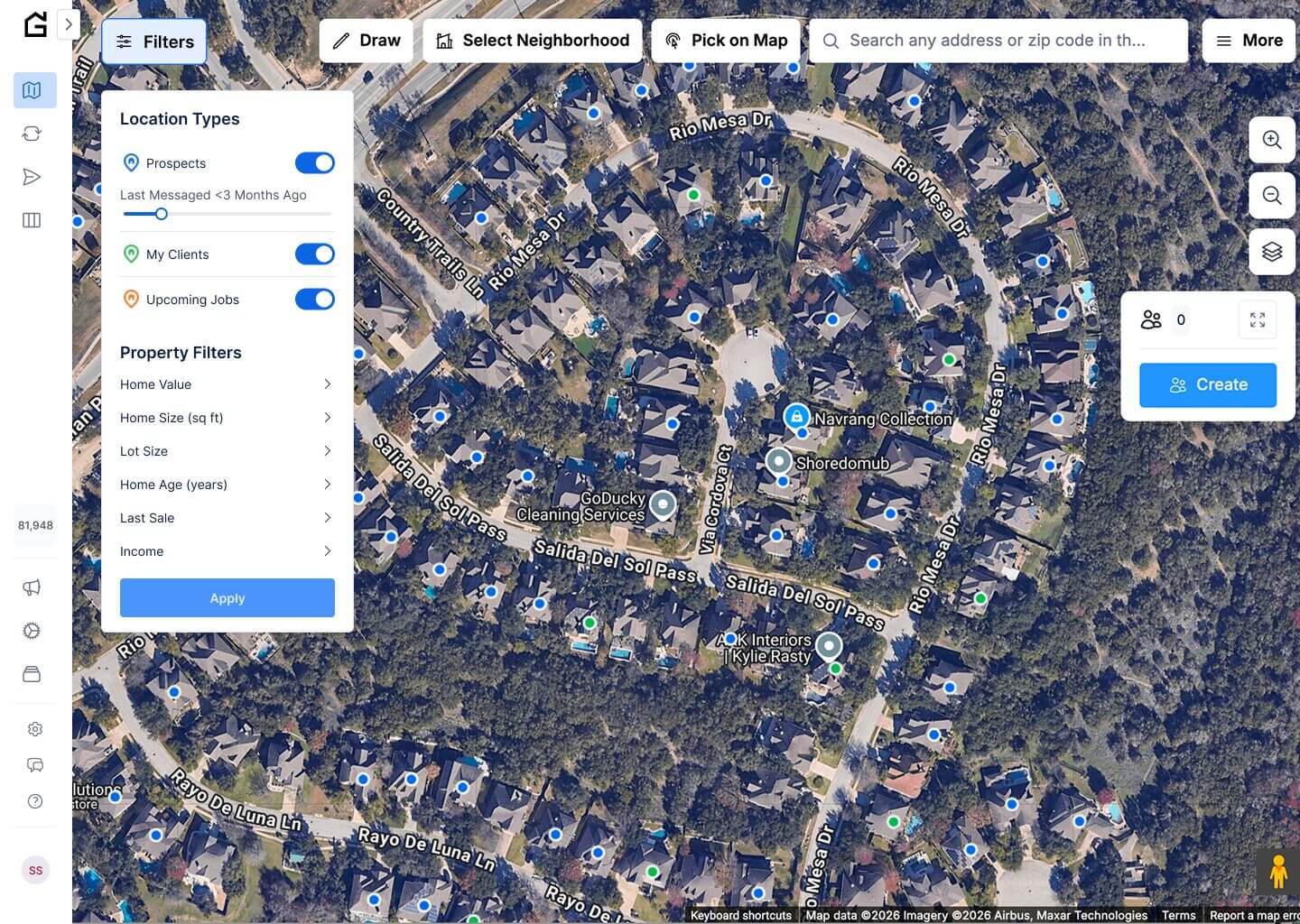
Next, you’ll filter homeowners by property details — home value, home size, lot size,
home age, and last sale date — to narrow in on the best-fit homeowners.
Lot size and home age are most relevant for pest and mosquito treatment, as larger yards mean more hiding spots for pests, and older homes tend to have more gaps and entry points pests use to get inside.
After you do this filtering, you can reveal contact data for the properties that match. You get a list of everybody who fits your search criteria, so you only target the homes that actually make sense for you.
Then it’s time to build and launch your campaigns. We provide a ton of templates to get you started here. They’re all conversion-optimized with clear CTAs, shown to get replies, so you know the best ways to reach out and aren’t left guessing at messaging.
Check out some of the examples below:
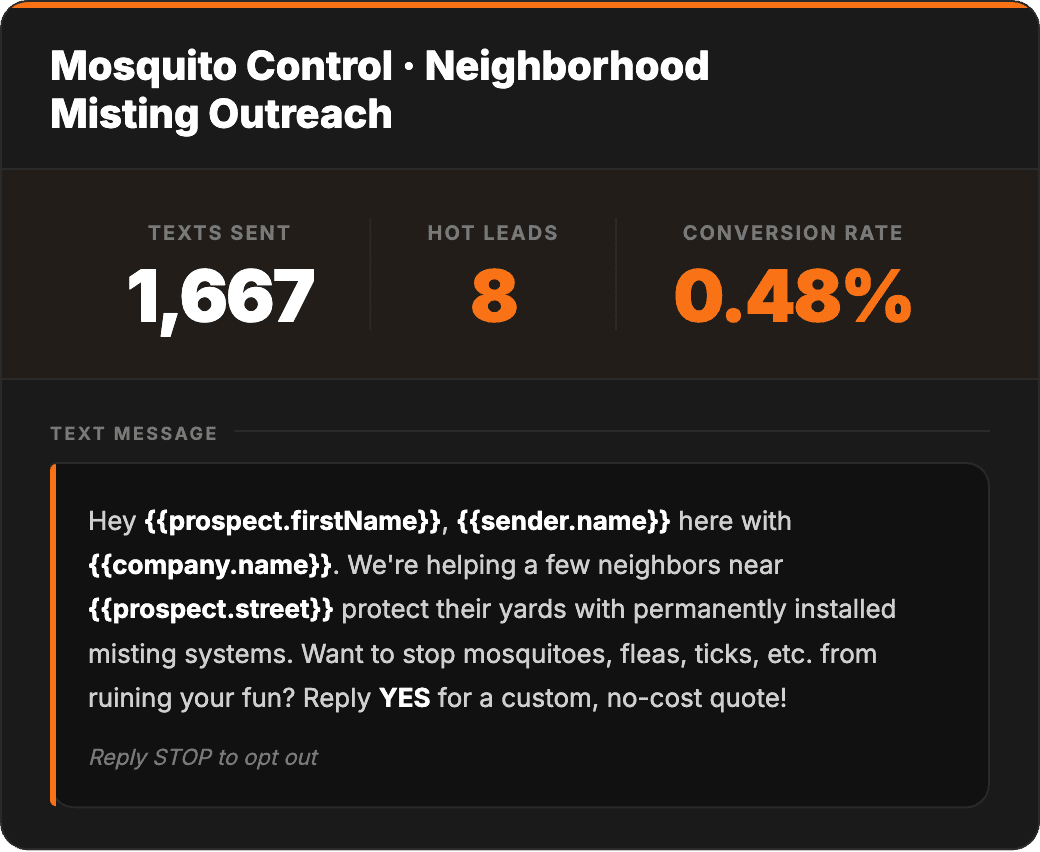
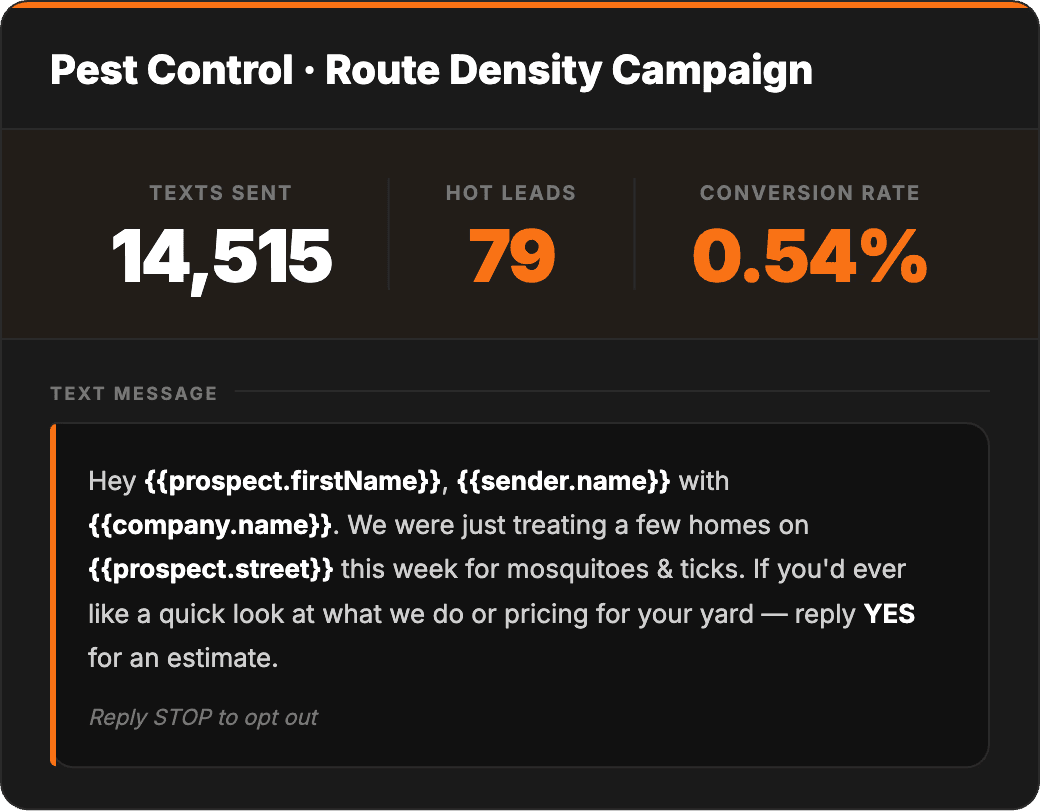
Note: GlassHouse handles all 10DLC registration and TCPA compliance automatically so you never have to worry about this. Your messages are sent from a local 10-digit number registered to your business, and we enforce compliant sending hours within the platform.
Any positive replies to your messages show up in the sales dashboard so you can pick up conversations and book appointments, but we also offer an AI agent (Jackie) that can assist here. Jackie can respond to homeowners to gauge interest, confirm details, and set up appointments, improving your lead conversions.
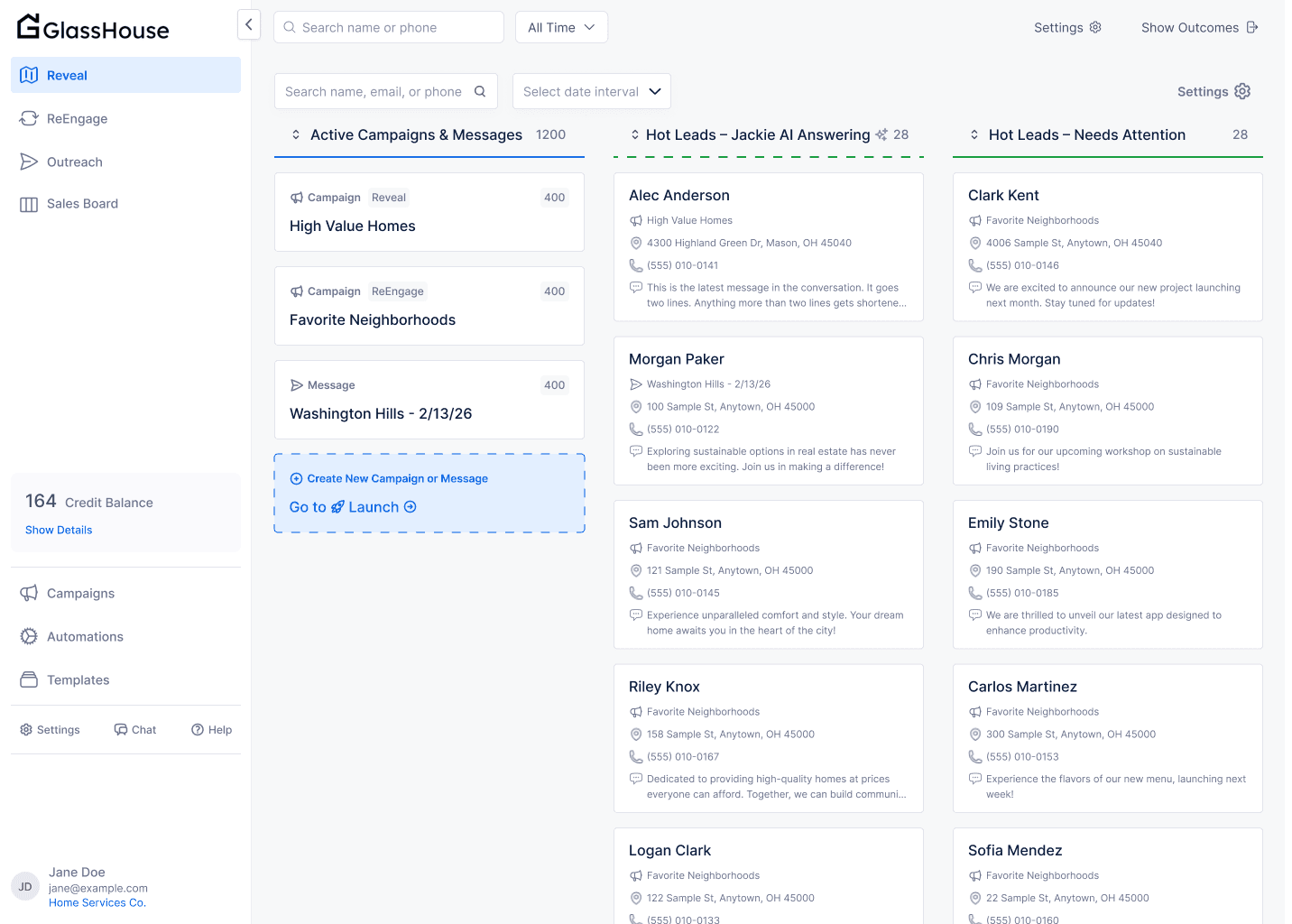
Then, all your qualified leads automatically push over to your CRM or FSM through our integrations so you can keep the relationship going well past the first job. We integrate with most home service CRMs. Click here for our full list of integrations.
Connecting GlassHouse to your CRM also helps refine your targeting. By pulling in your existing customers, you’ll be able to map your entire customer list visually. This keeps customers from getting swept into a new outbound campaign — which keeps you from spending credits (and annoying someone you already treated). It also allows you to send more personalized campaigns around your existing customers and upcoming jobs.
The connection helps you clearly track attribution, so you can see which outbound touchpoints actually led to a closed job, even when a homeowner called in instead of replying.
With both systems talking to each other, lead management becomes manageable.
How to Get Started
We offer free demos for everyone interested in our system so you can see under the hood. Our team can walk you through the full platform, show you real prospects in your zip code, discuss strategies, and provide tailored package options with custom ROI projections.
And pricing is pretty straightforward. There’s a $3,500/year platform fee, and you purchase credits on top of that (3¢ per credit). As your volume of outbound messaging increases to reach more of your market, you can purchase larger credit bundles or just top up when needed (if you’re entering a busy season, for example).
You can also pair the SMS messaging with our Email add-on. This includes 7,500 monthly emails, drip campaigns, email copy creation, email warmup, inbox alerts, and more for $250/month.
Our team can also discuss the Done-For-You service during the demo. With this, you’re assigned a dedicated account manager who will create campaigns and manage all the copywriting for you, so you only have to step in to close sales. This add-on also comes with monthly performance reports, where you can check on how your campaigns are working for you and plan strategies for upcoming months. This more hands-on help is only $400/month.
Ready to see how GlassHouse fits into your lead gen mix? Schedule your demo.
Physical Door Knocking
Door knocking has always been one of the most common ways for pest control businesses to get new customers. You choose which neighborhoods or streets to target, then go door-to-door. It gives an opportunity to meet homeowners, introduce your business, and speak directly to what's happening on that street right now, whether that's a mosquito problem after a wet spring or a termite swarm a few doors down. Some teams even offer to do a sweep of the property or complete treatments right then and there. It’s an effective way to reach out to new customers and get the job done all in one go.
But the problem pest control teams run into here is limited resources. You only have so many boots you can get on the ground, and working through a whole neighborhood can be time-consuming. Not only that, but you have to move at the times homeowners will be around to answer the door. Otherwise, you’re circling back through neighborhoods multiple times to catch every door you missed.
That’s why digital door knocking works so well for pest control. You can start this outreach in GlassHouse and introduce yourself over text — nobody needs to be around to answer a door. Then you can see which homeowners you hear back from and send teams to the neighborhoods with the most interest. You can focus your time on the most promising streets, and you have more concrete lead-ins for conversations: “I just talked to your neighbor Jon about a mosquito yard treatment and wanted to stop by to see if you're experiencing any of the same issues and need a quick spray.”
Many of the teams we talk to pair GlassHouse with physical door knocking to get more strategic about their efforts and avoid some of the limitations here. (That said, others use it to replace door-knocking altogether once they see how much ground a single text campaign can cover.)
If you're still keeping reps in the field, a few tools can help make that work more efficient: SalesRabbit, SPOTIO, and Knockbase all handle territory mapping, route optimization, and rep tracking. You can check out our full breakdown of the best door-knocking software here.
Yard Signs, Door Hangers, & Mailers
Yard signs, door hangers, and mailers all work off the same idea as door knocking — you’re reaching out to homeowners directly — but with a physical ad.
For pest control, direct mail can be especially effective when it’s targeted and personalized, with benchmark data showing prospect-list response rates around 5.3% and stronger results when offers are customized to the neighborhood.
Yard signs are already commonplace for pest control teams because most states legally require these after a spray, so you may already be planting one in every treated yard whether you think of it as marketing or not. A branded version turns that compliance requirement into a passive ad for every neighbor who walks by.
And door hangers work well to target homes around surrounding jobs. A tech can easily drop hangers on the five or six closest homes in the ten minutes before leaving a job site, building the same route-density effect as the neighbor-targeted texts we covered above.
Mailers are also an option here, as they’re a solid way to reach a bunch of homeowners at once. But it's worth being realistic about how to use them, since direct mail is slower than yard signs or door hangers, and it relies on USPS turnaround times. This option is best for advertising preventive care or for sending a couple of times throughout the season to keep your name top of mind. What it’s not a fit for is anything urgent, like a mosquito outbreak after heavy rains — the timing is nearly impossible to get right.
A few tools worth knowing if you want to run any of these at scale: VistaPrint, Zazzle, Mail Shark, USPS EDDM (Every Door Direct Mail), SendJim, and PostcardMania.
2. Establish a Referral Network
A lot of home services businesses have success with referrals, and pest control is no exception. When a homeowner hires you off a friend or neighbor's recommendation, there’s already trust there. They’re coming to you directly because they want the same fix that worked next door.
There are a few ways to build out a referral program so you can see more of these:
Through your existing customers: Ask right after the job, while the relief of getting rid of pests is still fresh — customers are most likely to refer someone in the first 60 to 90 days after treatment. Incentives can help. We've found double-sided rewards (a service credit or discount for both the referrer and the new customer) convert better than one-sided ones.
Through partnerships: Real estate agents, property managers, home inspectors, and insurance adjusters all regularly work with homeowners, and pest issues come up. A home inspection turns up termite damage, a property manager needs recurring service across units, an insurance adjuster is looking at water damage that's created a mosquito problem in someone's yard. Building relationships with a handful of people in these roles can turn into a steady stream of leads without running any ads.
By staying visible in your community: Garden clubs and farmers markets put you in front of homeowners already thinking about their yards. HOA meetings often turn into landscaping or lawn-care discussions, which is a natural opening for a pest control pitch. Sponsoring local events — Little League teams, school fundraisers, a 5K — is another way to get your name in front of the same homeowners you're trying to reach with referrals and partnerships. You can also join your local BNI chapter, which is built specifically around passing referrals between members, or your Chamber of Commerce for broader visibility in the local business community.
3. Build Out Your Website
Now this one might seem obvious: you 100% need a website and some online presence. Homeowners are going to want to look you up and make sure you’re legit before you show up to treat their home. That’s table stakes. If they can’t find any proof of your business online, they may feel leery about trusting you to do the job.
But your website can do more than just prove you're legitimate. If you build it right, it can actually win you new business.
That's where search engine optimization (SEO) comes in. It's the practice of getting your website to show up when homeowners search for pest control services. “Pest control businesses near me,” “termite treatment in [city],” “get rid of ants [city],” and so on.
The way you rank for those searches comes down to a mix of things: your homepage, service pages, location pages, and the blog content and FAQs you build out to answer what homeowners are actually searching for. Here's how each one fits in.
Your homepage is where you establish who you are and where you work — company name, service area, and a clear way to book or call. Your homepage often functions as the landing page for more general pest control searches, so it needs to cover the basics and make it super easy for someone to get in touch with you. You can also add customer testimonials and links to your online profiles (Google Business Profile, social media) to boost your credibility.
Service pages are worth splitting by pest type — termites, ants, rodents, and mosquitoes — rather than lumping everything under a generic "pest control" page. Having dedicated pages for each pest increases your chances of showing up for those more specific searches. And it lets you speak directly to what that homeowner is actually dealing with and the different treatment options your team can provide.
Location pages cover the local SEO side of things. Create one for each city or service area you work in so you show up when somebody searches for pest control in their area.
Content marketing with strategic blog posts lets you catch homeowners earlier, before they're ready to book. Create content to address some of the most common questions homeowners have about different types of pests and how to deal with them. Think topics like: “natural ways to get rid of mosquitoes,” “signs of a termite infestation,” or “is pest control safe around pets.” Offering this free advice earns you points with homeowners and gives you a chance to introduce your brand without selling them on your services. Then, if it comes down to hiring someone, they already know who you are.
FAQs serve a similar purpose but at a smaller scale — quick, specific questions that don't need a full blog post to answer. Things like “how long does treatment take to work” or “do I need to leave the house during treatment” are common and simple enough to warrant a quick answer on your service pages.
A couple of technical things worth checking here: page load speed and how your site performs on mobile. Most home service searches happen on a phone, and a homeowner dealing with a pest problem right now isn't going to wait around for a slow page to load.
Also worth mentioning: well-built, top-ranking sites are frequently pulled by AI engines like ChatGPT, Gemini, Claude, and Perplexity, so setting yourself up here can help you get mentioned when homeowners have conversations with these platforms.
4. Grow Your Online Reach
There are a few other avenues to grow your online visibility and get your name in front of homeowners searching for pest control services.
First, you’ve got online directories like Google Business Profile (GBP), Bing Places for Business, Apple Business Connect, and Yelp.
Having Google, Bing, and Apple profiles increases the likelihood of appearing in pest control search results in your area, as these platforms display the most relevant businesses in their map packs. For example, check out my search on Google below:
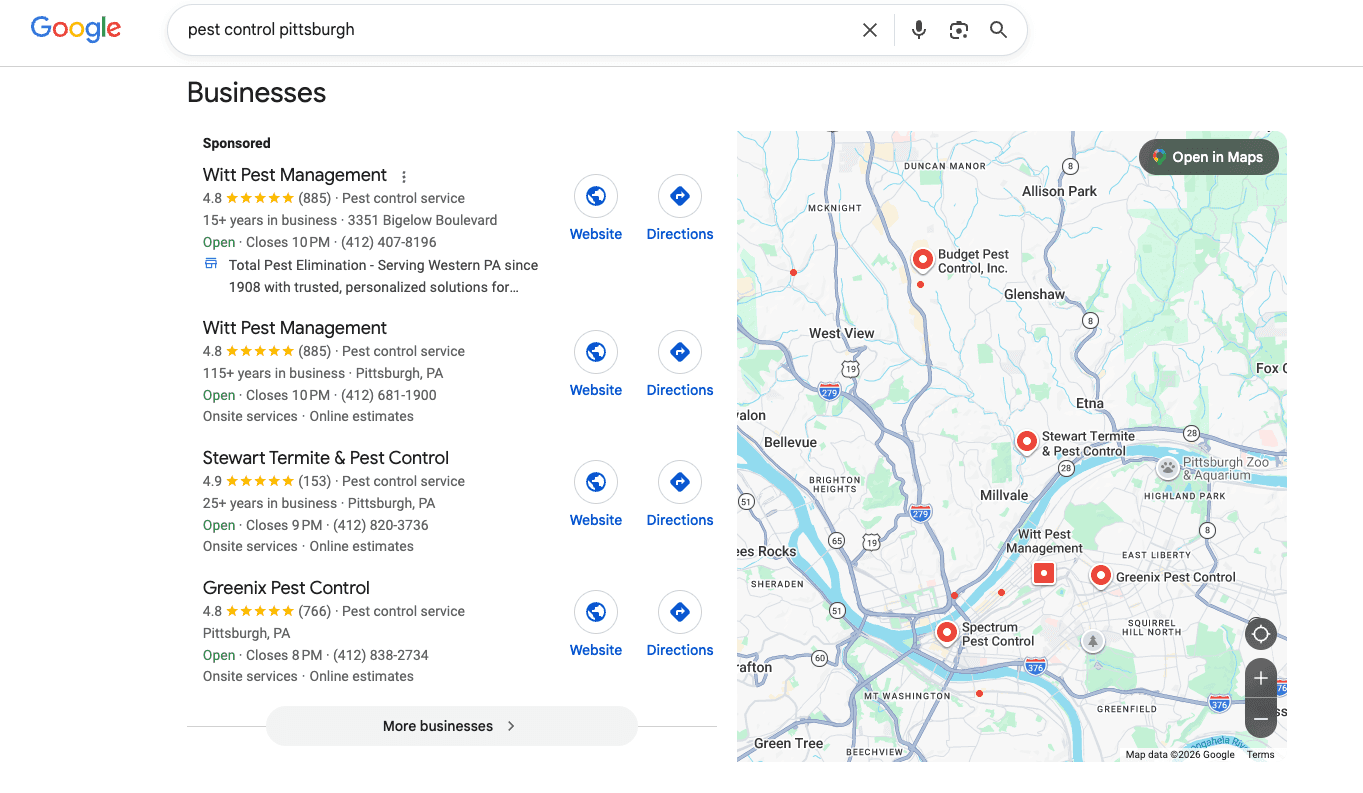
Creating these profiles is really easy.
Claim or add a profile.
Plug in your business details — name, address, phone number, business category, service area, and hours.
Upload pictures and videos of your crew and past jobs to put a face to your business name and show off your expertise.
And Yelp is a name just about everybody knows. A lot of people use Yelp to find local recommendations, so you can get in front of Yelp’s user base by listing your business there. The steps to create your profile are pretty similar to what we outlined above — you can start the process here.
You've also got sites like Nextdoor, where neighbors go to ask for recommendations and hold local discussions. It's a strong fit for pest control specifically: "does anyone have a good pest control company?" is a pretty common conversation here. And you can jump in by creating a profile and watching for those threads. Pitch your services when they’re relevant, or just offer some advice — a quick answer about what's likely causing an ant trail, or what to look for with a possible termite problem. That type of engagement is what turns a Nextdoor presence into actual leads (instead of a page nobody notices).
Then there’s social media marketing. Pest control isn't as visually flashy as some other verticals — nobody's scrolling Instagram for exterminator content the way they might for holiday lighting or a fresh paint job — but a presence on Facebook and Instagram still helps.
Post a mix of educational content (what to do about standing water before mosquito season, signs of a termite problem before it gets expensive), behind-the-scenes (from an actual treatment or of your team), and before-and-after photos.
Beyond building out your own page, there are a few other ways to leverage social media:
Encourage customers to tag you once their yards are treated. Offer something small in return, like a discount on their next service or a few dollars off their bill. That makes it an easy yes rather than a favor they have to remember.
Partner with local influencers. Think local lifestyle or home-and-garden content creators in your area. A free treatment in exchange for a post or story showing the before-and-after can put your name in front of an audience that already trusts that person's recommendations, much like a neighbor's word-of-mouth.
Join local groups. Homeowners constantly post here asking for recommendations. Answering a question well (what's actually crawling around their baseboards, whether it's worth calling someone for a few ants) builds the kind of trust that turns into a booked job down the line.
You can also explore paid ads on both social media and Nextdoor — we’ll talk about those a little more in the next section.
Across all platforms here, you want to stay on top of reviews and engagement.
Ask your customers to leave reviews on your business profiles, and respond to all customer reviews to show you’re active on your pages and you care about that feedback.
Encourage customers to interact with you on social platforms. You can create polls asking which pest people dread most, true-or-false quizzes busting common myths (does bleach actually kill roach eggs?), open Q&A stickers where people can ask questions, or a post asking followers to share their worst pest encounter and get conversations going in the comments.
Be an active member of the groups you’re involved in. Showing up consistently and responding to comments does more for your reputation than posting once and disappearing for a month.
5. Invest in Paid Ads
Paid ads can help you get new business quickly. The trade-off here is that they can be expensive, and setting them up right requires some strategy. We’ll run through what you need to know for each option below.
Google Search Ads let you bid on keywords and appear at the top of search results for high-intent searches — someone typing "exterminator near me" or "termite treatment." Search ads operate on a pay-per-click (PPC) model, and clicks tend to cost around $5 to $30 for the pest control industry. Though emergency-type keywords — “rodent removal near me” or “wasp nest removal” — tend to run higher, closer to $25 to $40 per click, usually working out to a $40 to $70 cost per lead.
Google Local Services Ads (LSAs) work differently than typical Google Ads. Here, you’re not bidding on keywords — Google matches you to appropriate searches based on your GBP details and service area. It’s a little less for you to manage. And you only pay per lead, not per click, so it’s easier on the budget.
Social ads on Facebook and Instagram can work especially well around peak season, when homeowners are more receptive to proactive pest and mosquito messaging. Both platforms let you target by city, neighborhood, or zip code, and you can run these as image or carousel ads (a treated yard before-and-after tends to perform well) or short video showing your crew at work. Timing these to launch just ahead of seasonal demand — the same 4- to 8-week window we mentioned earlier — puts your ad in front of homeowners before they're actively searching. Cost per lead varies widely depending on your market and targeting — typically ranging from $10 to $45.
Nextdoor ads work off the same neighborhood-level targeting, but since the whole platform is built around trusting your neighbors, the ad itself needs to read differently than a typical Facebook ad. Something framed as a helpful heads-up ("Mosquito season's starting early this year — here's how we can help") lands better than a straightforward promotional pitch. You can set these up directly through Nextdoor's business ad platform, targeting the specific zip codes in your service area. Pricing here runs on cost-per-click rather than cost-per-lead, typically $2.50 to $3.50 per click in competitive markets.
6. Try Lead Providers
The last option is to purchase leads through lead generation companies. Providers like ServicePestLeads sell leads directly to pest control businesses — homeowners submit a request for service, and ServicePestLeads sends them your way.
But you have to be careful going down this road because there are two types of lead providers in this realm. Exclusive lead providers (like ServicePestLeads) and shared lead providers (like Angi, HomeAdvisor, or Thumbtack).
If you’re going to put a budget here, we suggest exclusive pest control lead providers. Lead quality is better since these companies are only sending leads to one business at a time, so you have a fair chance of converting the lead you pay for and ultimately winning the business.
Shared lead providers sell leads to multiple companies at once, creating a rat race to respond and offer the lowest price. You end up paying for a lot of leads that you never convert, and they aren’t cheap — around $15 to $60 per lead. And when close rates are between 5% and 15%, you can end up shelling out hundreds just to land a single customer.
Read more: How to Get Leads Without Paying for Angi & HomeAdvisor
How to Keep More of the Business You Earn
As we noted above, the pest control industry sees more repeat business than most other home service verticals. But that’s not just an automatic thing. You have to do the job right and put in a little work re-engaging customers to actually see this business.
Provide a Five-Star Experience
First and most obviously, you need to provide a good experience. Your team should take time to fully understand the homeowner’s problem, walk through treatment options, and answer any questions they have along the way. And of course, you need to do a thorough job at treating the problem so it’s actually resolved. On top of that, your techs should show up clean and professional and maintain that professionalism throughout the service.
Be Quick to Respond When Customers Reach Out
Speed matters more than people think: research shows that 60% of pest control customers will call the next company on their list if they don’t get a prompt response. Try to get back to every inquiry within the hour (first 5 minutes if you can!), or by the end of the same day at the latest. Auto-dialers and AI-powered inbound answering tools can help here too, especially for after-hours calls or during peak season.
Use a CRM System to Track & Follow Up With Customers
A CRM keeps service history, appointment dates, and communication in one place, so nothing falls through the cracks and follow-ups actually happen on schedule instead of depending on someone remembering. It's also where attribution, lead tracking, and data cleanliness come together — the same benefits we covered in the GlassHouse section above, just applied to your full customer base rather than net-new leads.
Email Marketing
Send updates on new services, seasonal discounts, or free advice on prepping for pest season — just don't overdo it. An occasional, useful email keeps you top of mind without becoming something people tune out or unsubscribe from.
And worth mentioning here: GlassHouse's ReEngage feature assists with this kind of retargeting. You can reach back out to your customers with a simple text message, or run SMS and email campaigns in parallel.
Rewards Programs & Returning Customer Discounts
Giving past customers a reason to come back — a discount on their next treatment, a referral bonus, a loyalty credit — keeps them choosing you over a competitor they've never used before.
How to Build & Optimize Your Pest Control Lead Generation Mix
No single channel here is enough on its own. The strongest mix layers proactive outbound — GlassHouse, physical door knocking — with referrals, a solid online presence, and paid ads, so you're not depending on any one source to carry the whole business.
Once you've got a mix running, here's what to track:
Cost per lead by channel
Close rate by channel
Customer lifetime value — arguably the most important to watch, since pest control is so heavy on repeat business
Your own time spent managing each channel
Speed-to-lead (a.k.a. how fast you're responding once a lead comes in)
But the key thing here: you need to give these channels enough time to generate real activity to get fair numbers across each of these categories. Cutting something after a week because it hasn't brought in a ton of leads doesn't give you a fair chance to assess whether it actually works.
Now, that said, we understand pest control businesses don't have a huge window for this type of testing. But that can work out well for you. Because so much volume comes through in such a short time, you can usually accumulate enough data to get real answers within just a few weeks of the season, rather than needing months of calendar time the way a slower, year-round business might.
Then, once you've got solid data, evaluate each channel against the full picture — the metrics we outlined above — rather than zeroing in on one thing over another.
For example, you might be all in on one channel because it has a low cost per lead, but then realize it also has low close rates, or that customers who do close churn fast and you don’t really earn much from them. In that case, this channel isn’t one to keep investing in, even if it does look inexpensive on the surface.
On the flip side, you might find another channel is more expensive, but you close a lot of those deals and keep the customers you win. That would be one to double down on even though it feels like an expensive investment.
After you have an idea of what works for you, you can focus more of your efforts on those channels and cut the ones that aren’t pulling any weight.
Getting Started
Pest control's window is short, but that's exactly why getting ahead of it matters. GlassHouse can have you reaching homeowners in your target neighborhoods within just an afternoon — which is the difference between spending your busiest weeks building a pipeline vs. already working one.
Schedule a free demo with our team to see what that looks like for your business.