The Three-Part System for Growing a Home Service Franchise (2026)
By Anthony Garber

Growing a home service franchise comes down to three things:
A solid operational foundation
A marketing engine that fills your pipeline
The right franchisees to expand your network.
Most franchises only get one or two of these right. They push growth before their operations can handle it. Their marketing doesn't have a way to measure what's working. Or they start recruiting before proving out their own system and business model.
This guide covers all three, in that order.
Note: We recorded a webinar on growing a franchise — The Great ROI Reset: The New Economics of Franchise Growth — where we speak with 5 franchise leaders with over 110+ years of combined experience to learn how rising media costs and labor rates have rewritten the math behind franchising.
Part one: Build the operational foundation before you push growth
Iron these out first, or your workflows, service quality, and the customer experience may fall apart once you start pushing growth.
Document your workflows before you multiply them across locations
Without written workflows, every location invents its own version of how to run the business. Quoting, scheduling, and follow-up all drift from one location to the next. Create a living document that covers the need-to-knows, so any location can follow the same processes and uphold brand consistency.
Document the core processes first: Job quoting and estimating, service delivery steps, customer communication touchpoints, and post-job follow-up.
Set standard pricing and discounting rules alongside your quoting process. Without them, locations undercut each other, and margins erode across the network.
Define what a completed job actually looks like. A workflow tells a technician what steps to follow. A quality standard tells them what "done right" looks like when they're finished — inspection checklists, photo documentation, whatever fits the service.
Make sure to update this documentation as your services, pricing, or tools change.
Build a training system that gets new hires & new locations up fast
In addition to having documented processes for day-to-day operations, you also need a sound training program so new locations get up to speed quickly, everyone trains to the same standard, and every location operates the same way.
Outline a documented onboarding process with a clear ramp time — 30 to 60 days for most roles.
Keep training materials in one central place every location can access.
Assign someone to deliver the training — a dedicated trainer, a regional manager, or a shadowing period with an experienced technician.
Require sign-off before a new hire or new location goes live to confirm training is complete.
Revisit training when processes, products, or regulations change, not just once at onboarding.
Centralize the software your locations run on
Without a shared system, locations end up on their own tools. That makes it nearly impossible to compare performance or offer consistent support across franchise locations.
A centralized system should cover:
Scheduling and dispatch: To assign and track jobs across every location, so nothing gets double-booked or missed.
CRM and customer communication history: To keep every call, text, and email in one place, where any location can pick up a customer's history without starting from scratch.
Invoicing and payment processing: To maintain consistent billing processes across locations.
Reporting and performance dashboards: To compare locations side by side instead of chasing spreadsheets.
Review and reputation management: To track online reviews and responses across every location.
Payroll and technician time tracking: If managed at the franchise level rather than per-location.
Data access and permissions: To set clear permission tiers that allow you to see performance across every location, while each location only sees its own data.
Field service management (FSM) tools like Jobber, FieldRoutes, ClientTether, and ServiceMinder cover most of this out of the box.
Part two: Drive growth across every territory with the right home service franchise marketing strategies
Most franchise growth advice treats this as a single-channel problem — SEO, ads, or referrals. But the best franchise marketing plan incorporates a stack of channels, and where you start on that stack matters.
Proactive outbound: Targeting the neighborhoods around existing jobs
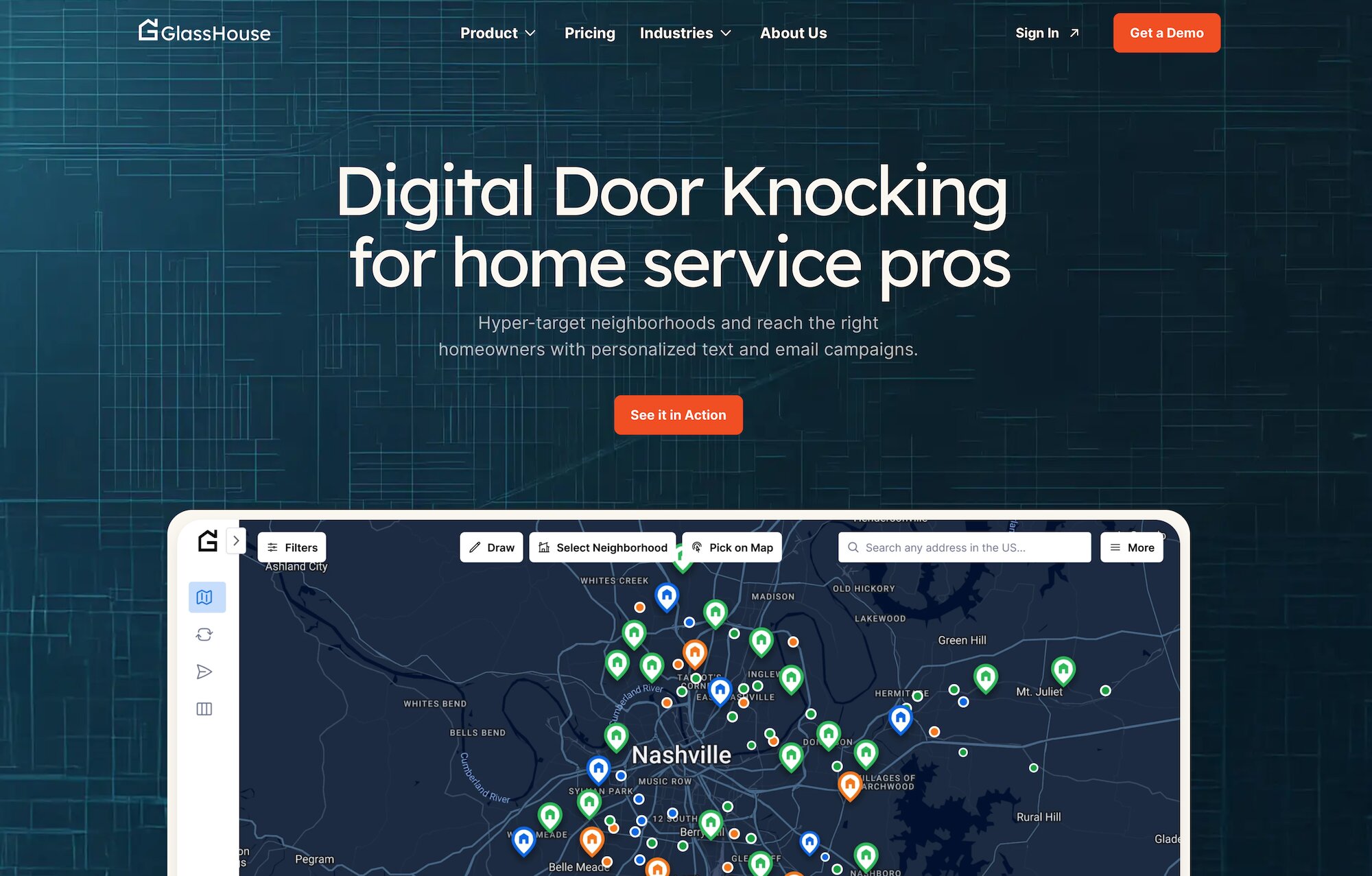
Franchise operators managing multiple markets can't sit back and wait for the phone to ring. Every territory needs its own pipeline, and the most strategic businesses get proactive in how they fill them.
That's what GlassHouse is built for: an outbound sales platform that reaches homeowners directly through text campaigns (both SMS and MMS).
Our system lets you build outreach campaigns in the areas you want to work. The point of each message is simple: introduce your brand, ask if the homeowner has a [insert your project type here] they need help with, and offer an estimate to get them on the books.
This outreach also gives you more control over your pipeline. You can run campaigns to feed it when it's thin, so you always have a steady flow of upcoming work.
For a franchise, this matters most when you're opening a new location. You don't have to wait months for local SEO to catch up, or bid against every other contractor for the same paid ad. You can start reaching homeowners in your new territory from day one, the same way you would in a market you've operated in for years.
We currently work with 60+ franchise systems across the home services industry, including sectors like pest control, roofing, maid services, painting, landscaping, and more. Here's what some of them have seen since joining GlassHouse.
Matt Bielawa of Mighty Dog Roofing shared: "In just one month of use, we've generated 28 booked appointments and closed just under $100k in revenue." Since then, he has captured another ~$35,000 in booked revenue and has another $126,000 in outstanding proposals still open when this data was taken. Cost per appointment landed at $197.
Six other Mighty Dog locations have signed on since, with five live and running campaigns. Across the system, that's 130 unique hot leads generated from over 30,000 homeowners contacted.A new Mosquito Authority franchisee in Northwest Indiana spent $15,000 and generated $102,000 of recurring revenue in ~3 months.
Mosquito Joe of Peabody generated 144 leads and booked 136 appointments on a $6,900 spend. That's a $47 cost per lead and a $50 cost per appointment.
MaidPro's Broomfield and Indianapolis locations spent $6,463 and generated $81,000 in annual recurring revenue — a 12.5x return.
We offer flexible pricing and volume discounts for franchises. Our team can put together a custom package, complete with an ROI projection, based on your franchise's size and goals. You can schedule a demo to learn more, or you can keep reading below, where we'll walk you through exactly how GlassHouse works for franchises.
How GlassHouse works
Our team will meet with you to discuss how GlassHouse can support your franchise and franchisees to build out a custom package. Here’s what this typically looks like:
We'll create a single master account managed at the corporate level, with sub-accounts for each franchise location. There's no cap on sub-accounts, so you can have as many as you need. Then you can assign someone at each location to manage outreach for their sub-account.
We'll discuss flexible pricing options, whether you want to go pay-per-lead or work off a shared credit pool, and set you up with what's most fitting for your business and budget.
Our team helps you build templates around your brand identity and messaging, then we can push those templates down to every sub-account so all locations work from approved copy.
We'll connect your FSM or CRM, wherever you manage customer relationships, so you can pull in those contacts for mapping and retargeting campaigns. That same connection also works in reverse: new prospects from GlassHouse get pushed back into your system, so you own the relationship from the first message on. We work with all the major names mentioned above and can connect with virtually any system.
We also provide one-on-one onboarding and training for every franchise location, so every team knows the GlassHouse workflow and can get up and running quickly.
After you’re all set up, the actual campaign building is super easy.
Start on the map and search the addresses, zip codes, or specific neighborhoods that you want to target. Existing customers show up as green pins and upcoming jobs as orange pins (that’s the mapping we mentioned above), so you can see where you've already built a presence and expand from those areas.
Draw a shape around the neighborhood or street you want to target. It can be as tight as a single block or as wide as an entire zip code.
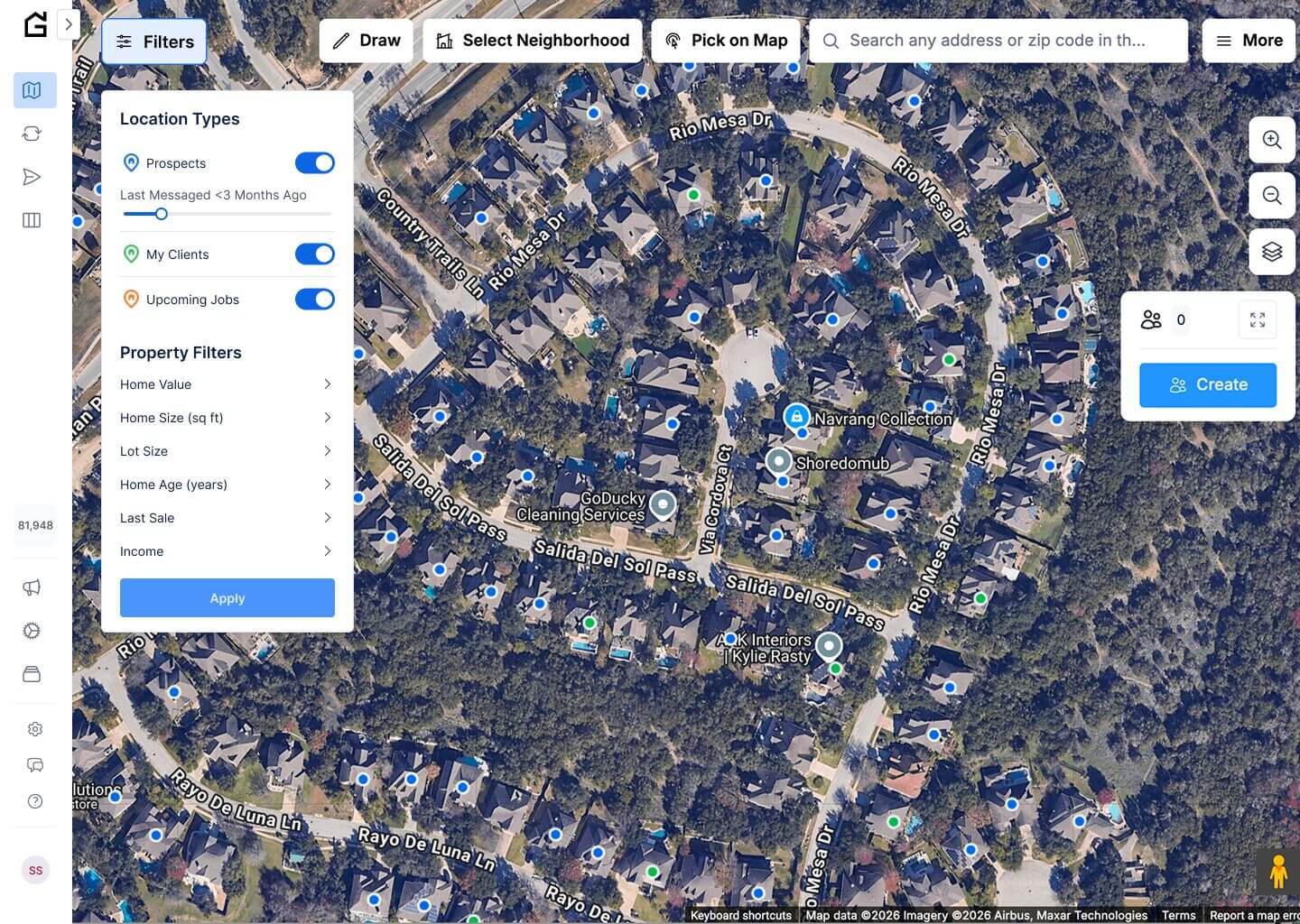
Use filters — home value, home size, lot size, home age, and last sale date — to narrow down the homeowners who are likely to be in the market for your services.
Click Reveal to see the properties that match your search criteria and pull those contacts into your campaign.
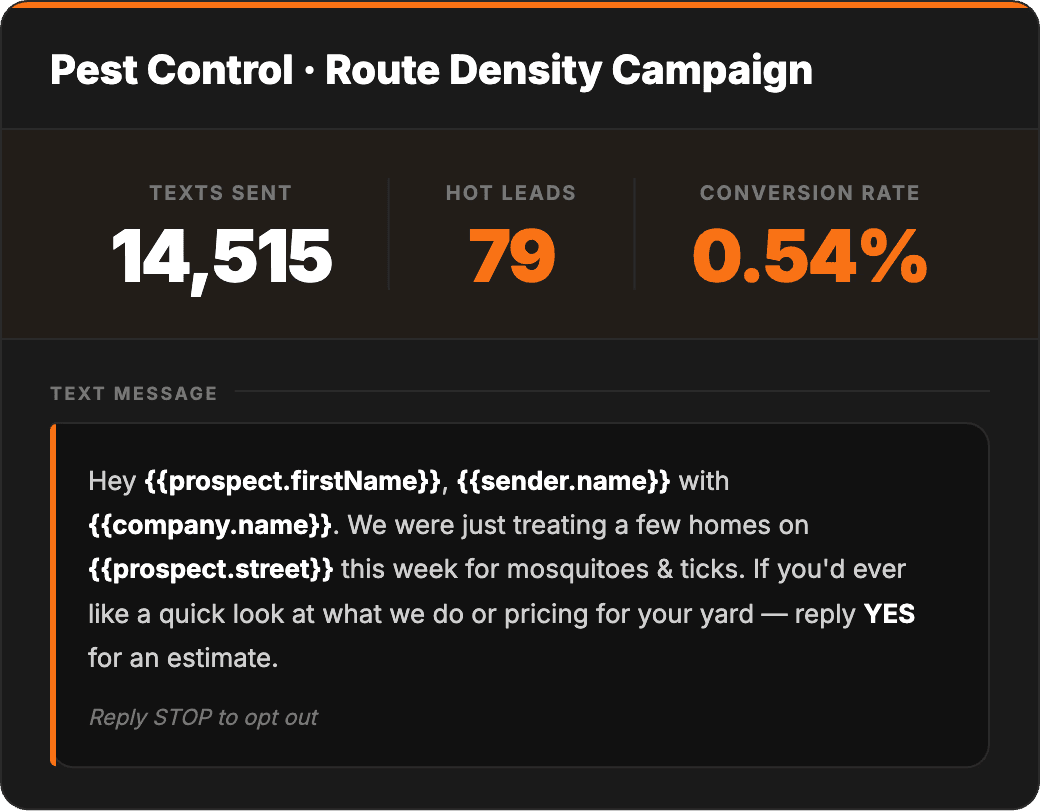
Grab a template to build out your campaign messaging. Again, our team helps you with this. Our system also comes preloaded with a variety of conversion-optimized templates for different industries and services. We’re always around to help hone this messaging. Check out an example of one of these templates below:
Schedule your messages to send. Our system enforces compliant sending hours so you’re never texting homeowners too early or super late in the day. And all your messages go out from a 10DLC number registered to your business.
Note: GlassHouse is built to meet all TCPA compliance requirements so you can do this outreach the right way. We scrub our contact database against TCPA litigator lists and state and national do-not-call registries, so those homeowners never show up in your contact lists. Every message includes an opt-out option, and anyone who does gets automatically removed from future outreach. And, as mentioned above, messages are only sent during compliant hours from a local number registered to your business.
Then you can manage all conversations in the Kanban-style sales dashboard. This displays all incoming (positive) replies and the status of every prospect. Our AI agent, Jackie, also helps here. This tool ensures everyone gets a quick response and handles all initial qualification and appointment scheduling for you, so every qualified lead ends up on the books. And our system pushes those leads over to your connected FSM or CRM.
Our team will walk you through this workflow, show you how to use the sales dashboard, and can talk more about the benefits of the GlassHouse<>FSM relationship during your demo.
Website optimization
You can turn your website into a lead engine by optimizing it for search engines and AI models. This helps you appear when people are looking up your services, anywhere they start their search.
The nice thing here is that many search engine optimization strategies lend themselves to AI visibility, as top-ranking posts in search engines are what AI tools search for and cite in their responses. Here’s what we recommend:
Your home page should include your business name and make it clear what you do. It also helps to link to review sites or testimonials that speak to your experience and quality of work.
Create dedicated pages for each service you offer, and include FAQs on those pages that cover the most common questions homeowners have about each service. These are what show up when people search for specific services.
Create a location page for every market you operate in. The same logic applies: these appear when people search "[service] in [city]." Each page should list the services available at that location and the service areas you cover. For franchises, that means one page per physical location — not one shared page for the whole brand — so each location shows up in its own local searches.
Publish blog content around the questions your customers are already asking. For example, a pest control company might write about how often to treat for mosquitoes in peak season. A roofing company might cover how to spot storm damage before it turns into a bigger repair. This is what helps you get in front of homeowners in early stages of research, before they’re looking to hire someone, so they know your name when they’re ready to make that call.
Most of all, every page should include simple ways to get in touch with you — click-to-call buttons, contact forms, or booking widgets that let people schedule appointments online.
After you have your site built out, you need to check usability to ensure people can easily toggle between pages and that pages load correctly. Make sure your site is both desktop- and mobile-friendly (the latter is especially important here, as most people search on their phones). And run your site through a page speed checker like Google’s PageSpeed Insights to make sure nothing is slowing it down. Slow-loading pages are an easy way to lose website visitors and their potential business.
Most of these strategies are straightforward enough for you to tackle on your own. That said, many home service businesses bring in a digital marketing agency to help with this. Any (good) agency will know the best ways to improve your website's performance so you can generate more direct leads. They can help determine the best keywords to target, ensure landing pages are formatted and optimized correctly, offer new content marketing ideas, and measure performance to identify areas for improvement.
Online directories like Google Business Profile & Yelp
Directory listings help you show up in local search and map results before anyone even reaches your website. For a franchise, they also do double duty: proving each individual location is real and active in its market.
Google Business Profile (GBP) is the priority. It's what shows up in Google's map pack and local search results, and it's usually the first thing a homeowner checks before calling.
Bing Places works the same way and is worth claiming too. For a franchise, it's actually easier to scale — you can bulk upload up to 10,000 locations from a single spreadsheet instead of setting up each one by hand.
Yelp is also worth claiming for the same visibility reasons. Yelp has a massive user base, and many homeowners search for local businesses here because it lets them easily see who’s nearby, compare star ratings, read details from other customers' reviews, and request quotes right through the platform.
Apple Business Connect gets you into Apple Maps and Siri responses. One thing to know here: Apple's bulk "Enterprise" tier excludes franchises regardless of how many locations you have. Most franchise networks end up verifying each location individually instead.
You can get set up by creating a master profile for the franchise. From there, add a dedicated listing for each location, with its own unique name, address, and phone number. (Google will merge or hide listings it sees as duplicates, so keeping each location distinct matters.) This structure lets corporate manage access across every location while each one still shows up on its own in local search.
The ongoing work here is collecting reviews. A quick, automated ask after every job — the same post-job follow-up covered earlier — is the easiest way to keep reviews coming in. We also suggest responding to every review, good or bad, to show customers you appreciate the feedback and improve your brand reputation.
Referrals & local partnerships
Referrals often carry some of the highest conversion rates of any channel, because the homeowner already trusts whoever sent them your way. Local partnerships work off the same logic — someone else vouches for you before you've said a word.
Building a network of people who can refer you is the best way to see more of these high-quality leads.
Start with your customer referral program. Offering dual-sided incentives works best here — a discount or credit for the customer who refers you, and one for the new customer they bring in, so both sides have a reason to follow through. Ask right after the job, while the experience is still fresh, either in person or in a quick follow-up text or email.
From there, build out local partnerships. Real estate agents, property managers, home inspectors, and insurance adjusters all regularly cross paths with homeowners, and a handful of relationships in these roles can turn into a steady lead source without any ad spend.
Staying visible in the community also helps build your brand presence and long-term brand recognition. Sponsoring a local event or showing up at an HOA meeting puts your name in front of the same homeowners you're trying to reach through referrals and partnerships — just through a different door.
Getting active on Nextdoor is another way to reach homeowners directly. Homeowners use Nextdoor to ask neighbors for recommendations, so creating a business profile and engaging in threads that make sense for your service types can generate leads directly from the platform.
You can also join your local BNI chapter or Chamber of Commerce. These are built specifically around businesses referring each other, so they're another reliable way to drive leads through your partner network.
For a franchise, the advantage is that the franchisor can systemize all of this across every location instead of leaving each one to improvise. Corporate can build a shared referral template and a standard partnership and community outreach approach once, then push it down to every location, rather than having fifty locations each figuring out their own version of the same program.
Social media marketing
Social media is where you build brand awareness and put a face to your business. The best home service accounts don't just post finished jobs — they show the process, the people, and the personality behind the work. A few content types worth building a rotation around:
Before-and-after transformations: Nothing sells a job better than the reveal. Cut straight from "before" to "after," keep it short, and let the work speak for itself.
Time-lapse installs or process videos: These show off both the finished result and the skill it took to get there — a homeowner watching a job come together gets it in a way a static photo can't deliver.
Behind-the-scenes crew content: Homeowners are letting your team onto their property. Getting to see who's showing up, how they work, and what a typical day looks like builds the kind of trust that gets you picked over a competitor with the same price.
Customer reaction videos: Film the homeowner seeing the finished result for the first time. A real reaction doubles as a testimonial but packs more of a punch than a written review.
Close-up detail shots: The kind of angle a homeowner can't get themselves — a clean edge, a tight seam, a perfectly finished corner. These are small proof points of craftsmanship that a wide shot misses.
"How we do it" content: A quick walkthrough of how your team plans a job, sizes up a property, or solves a tricky problem. This positions you as the expert and answers questions before homeowners even ask them.
Trending content: A relevant meme, a trending audio, a format that's getting attention right now — this is where a page gets to have a little fun instead of just posting job after job.
For a franchise, corporate can build out a shared content library, marketing materials, brand guidelines, and a posting cadence that every location can pull from, so individual franchisees aren't starting from scratch or guessing at what performs. Locations can still layer in their own local flavor — a specific neighborhood, a local event, a face from their own crew — on top of that shared foundation.
You can also run paid ads on social media, geotargeted to the neighborhoods you want to reach. More on that in the Paid Ads section below.
Paid ads
Most franchise operators already run some mix of paid search. Here's what's available and where the trade-offs come in.
Google Search Ads (PPC) let you bid on keywords and show up for high-intent searches — someone actively looking to hire, not just browsing. You can see nice conversion rates here, but you pay per click for search ads. CPCs vary too widely by vertical and market to give a solid number — you can end up paying hundreds of dollars per lead depending on what industry you're in and where you're operating.
Google Local Services Ads (LSAs) work differently. Instead of bidding on keywords, Google matches you to relevant searches based on your business profile and service area. You pay per lead instead of per click, so it’s a little easier on the budget, as you’re not wasting money on clicks that go nowhere. These tend to be the most popular among home services, especially for growing teams that want to be more careful with their ad spend. The downside is control — Google decides which searches you match to, so you can't fine-tune targeting the way you can with standard PPC, and not every service category even qualifies for the program.
Bing Ads uses the same bidding model as Google Search Ads, but on Microsoft's network. There is less competition here because Bing has fewer users and advertisers. The pro is that costs are lower for advertisers. The con is that you’re reaching a much smaller audience.
Social ads on Facebook and Instagram let you target homeowners by location and demographics rather than active search intent. These leads tend to be colder — people aren't actively looking yet — but the targeting can work well for brand awareness at the neighborhood level.
Nextdoor ads work off the same neighborhood-level targeting, but the platform's built around neighbor trust, so ads that read as a helpful heads-up perform better than a straightforward pitch. The catch is reach — Nextdoor's user base is smaller than Facebook or Instagram's, and availability can vary by market.
Paid ads are definitely worth investing in because they can bring in real business. But they get more expensive as you scale, and leads stop coming in as soon as you stop paying — so they work best as a supplement to your lead gen mix, not the main source carrying it.
Part three: Recruit the right franchisees & protect their territories
Once your operations are documented and your growth engine is producing real numbers, you have something worth selling to new owners: proof, not just a pitch.
The key thing here is to take your time on this recruitment, so you're pulling in just the right franchisees. Recruiting too quickly with the wrong ones recreates the same inconsistency problem you just spent Part 1 fixing. Here's our advice on how to do this:
Vet new potential franchisees the way you'd vet a hire. Look at whether they have the capital to fund the investment and get through a slower first year, and consider their relevant industry experience. It's also helpful to talk to your existing franchisees about what helps someone succeed or struggle in the system, so you know what to look for before signing someone new on. You can also bring in a franchise consultant to assist with this vetting.
Look for franchisees who'll run your system as documented. A franchise only works if every location operates the same way — someone determined to do things their own way is just going to create friction.
Handle the legal side properly. This includes a Franchise Disclosure Document (FDD) and state-level registration, not just a handshake and a territory map.
Protect territories with clear geographic boundaries, based on real household density and market demand data. Get this wrong, and you end up with two locations too close together, competing for the same customers (and an existing owner who feels burned).
Keep investing in the owners you already have. Coaching, marketing, and supply chain support help all your locations thrive.
Report on performance to catch problems & double down on what works
None of the three pieces above matter if leadership can't see how they're actually performing.
On the operational side, track whether locations are following documented workflows, if training is producing consistent results, and where service or quality gaps are showing up. The centralized software from Part 1 is what makes this possible. Comparing locations apples-to-apples requires one shared system feeding a single dashboard, not each location self-reporting in its own spreadsheet.
On the growth side, we suggest tracking:
Leads per channel: This shows the raw volume each channel produces, before you factor in cost or quality.
Cost per lead (CPL) by channel: This shows which channels return leads most cost-effectively and where you’re spending the most.
Lead-to-booked-job conversion rate by channel: This tells you what channels actually bring in new customers and if they’re worth the spend.
Customer acquisition cost (CAC) relative to average ticket size: This confirms the cost to land a customer doesn't outweigh what that customer pays.
Repeat and referral rate from existing customers: This shows how much of your growth comes from customers you already have. A location with high repeat and referral rates grows without constantly spending to win new business. A location with low rates has to keep investing in acquisition just to stay steady.
Territory performance: Compare results across locations to spot which ones are pulling ahead and which are struggling. That tells you where to dig in and find out why, before a struggling location falls further behind.
On the franchisee recruitment side, track how many new franchisees signed this year, how long territories stay unsold, and franchisee satisfaction and retention. A franchise adding units while losing franchisees isn't actually growing.
Use this data to fix operational wrinkles before they compound across locations, reallocate budget toward whatever's converting in each market, and keep recruiting the right franchisees based on performance data.
Getting started
Get your operations right. Build a growth engine with multiple marketing channels to keep every territory's pipeline full. Bring in the right franchisees once the first two are proven. Report on performance so you know what's actually working. That's how a home service franchise actually grows.
Outbound is the piece most franchise operators haven't built into their growth engine yet. It keeps you in control of your pipeline, helps you maintain a steady stream of leads, and builds more personal relationships with homeowners than an ad or a directory listing ever will.
See how GlassHouse can support your lead generation strategies and long-term, sustainable franchise growth by scheduling a free demo with our team.
Related reads: