10+ Best Lead Generation Strategies for Landscaping Companies
By Jackie Vaughn

Most landscaping leads aren't one-time jobs. They're long-term customers. Win one, and you win the mow, the fall cleanup, the spring planting, and the backyard renovation three years from now when the budget's finally there.
That changes what a bad lead actually costs you. It's not one lost job. It's every job that would've come after it.
This guide covers all the best strategies to win leads and keep them.
To learn more about how GlassHouse keeps your pipeline full, keep reading or schedule a free demo.
Digital door knocking with GlassHouse
Every landscaping business knows door knocking as a way to win new customers. GlassHouse is the new way to do it.
Instead of sending your crew door to door, you text homeowners directly. Choose your neighborhoods, filter down to the exact homeowners you want, and build text campaigns that reach them all at once. You can introduce yourself and your services, and ask if they have any landscaping work you can take off their to-do list.
Familiarity is landscaping's edge here, and most companies don't use it. Your crews are already on these blocks every week — mowing, trimming, running the same maintenance stops. The neighbor two doors down has watched your truck show up all season. By the time you text them, you're not a stranger. You're the company they've already seen working the street.
Multiply that across every block your crews touch, and you've got a list of warm homeowners you can convert into your next long-term customers. You already did the work to earn that. GlassHouse is just what starts the conversation.
Here’s how our system works.
How our system works
Campaign building starts on our map. It shows pins over your existing customers and upcoming jobs, so you can see the routes you're already running before you draw anything new.
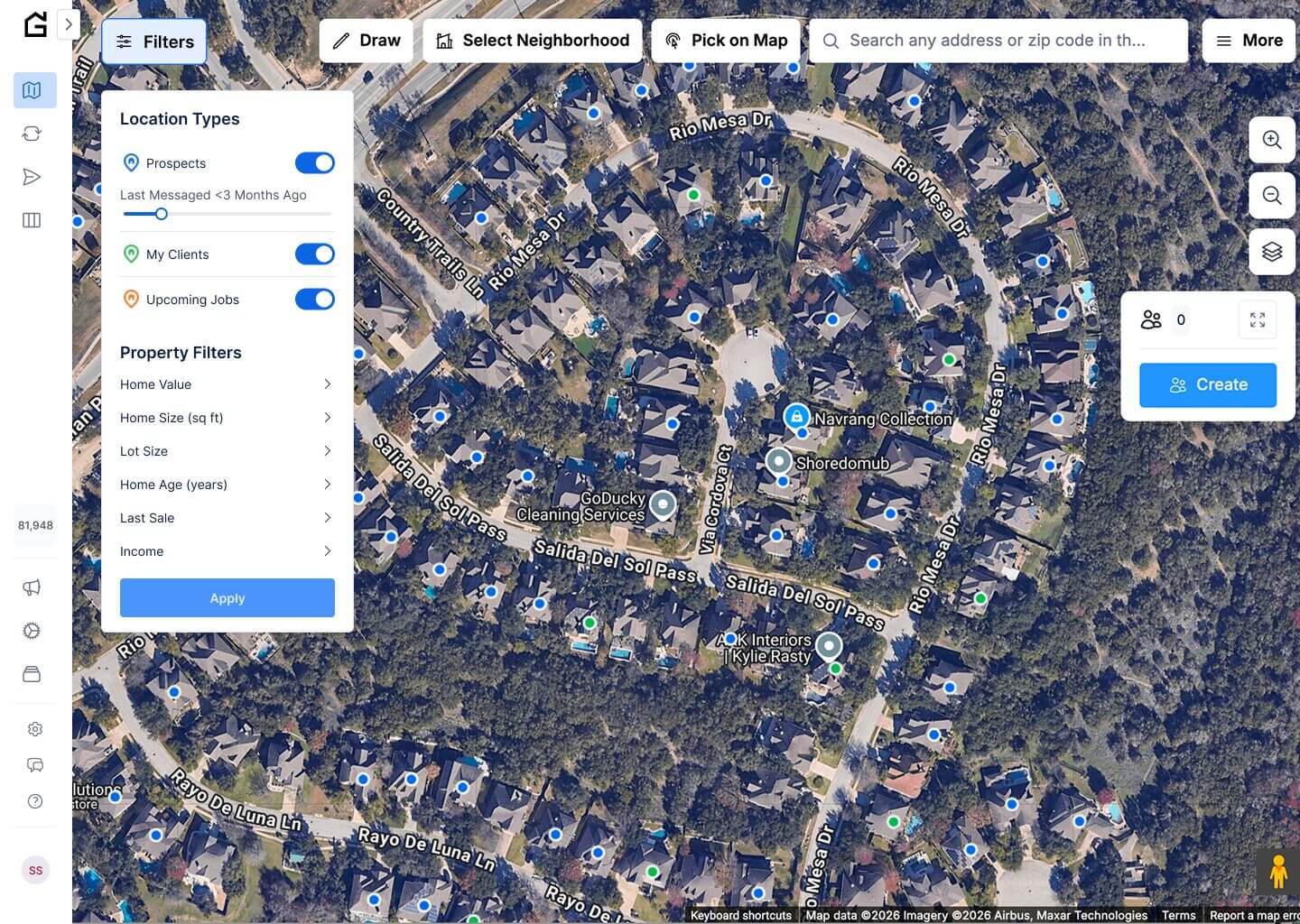
Open the map and draw your target territory — around a route you already run, or a neighborhood you want to break into.
Filter by home value, home and lot size, home age, and last sale to narrow down to the right homeowners. This matters more here than in most verticals: a bigger, higher-value lot isn't just a bigger budget; it's a different kind of lead. Larger lots and higher home values skew toward design-build work — patios, outdoor living, a full renovation. Mid-range, well-kept neighborhoods skew toward recurring lawn maintenance. Decide which one you're after before you filter, since your messaging and offer change depending on which you pick.
Click Reveal to pull the properties that match your search criteria.
Build out your text campaign. The system comes with a ton of preloaded campaigns for you to work with, all conversion-optimized with clear calls to action. Our team can also help refine your brand messaging and pitch, and create new templates around your initiatives. Some messaging ideas and tips for landscaping:
For maintenance, you might say: "Hey {{prospect.firstName}}, {{sender.name}} with {{company.name}}. We take care of lawns on {{prospect. street}} every week during the season. Want a free quote for weekly or biweekly service? Reply YES."
An outreach message for a landscape design-build might look like: "Hey {{prospect.firstName}}, {{sender.name}} here with {{company.name}}. We just finished a backyard patio install near {{prospect.street}} and thought you might want to see what's possible for your yard. Reply YES for a free design consultation." You can even include pictures of the completed project to show homeowners how they can transform their yards.
Lead with something real and current — a job you're already doing on that street, or one you just finished nearby. It performs better than a generic intro, and landscaping has an edge most verticals don't: the work you're pointing to is often recurring and visible week after week, not a one-time install.
Timing matters too. Spring is your highest-intent window — cleanup, mulching, planting — but don't wait for it. Send ahead of the season so you're booked before competitors start advertising. Fall cleanup and winterization are a smaller secondary push.
One more lever: offer a neighborhood-specific incentive tied to booking early in the season, not a blanket discount.
Schedule your campaigns to send. All messages are sent from a 10DLC number registered to your business, and the system automatically enforces compliant sending hours.
Note: We handle all the compliance to run these campaigns properly. Our system scrubs TCPA litigator lists and Do-Not-Call registries to exclude those homeowners from our contact database. All messages include an opt-out, and we automatically scan homeowner replies for that language to remove them from your contact list and future campaigns. You can learn more about these features in our guide on cold texting.
Once messages go out, replies show up in your sales dashboard. Jackie, our AI agent, can pick these up for you — she replies fast, answers basic questions, and schedules appointments. You can see the status of every prospect and review conversation threads to get up to speed or jump into conversations.
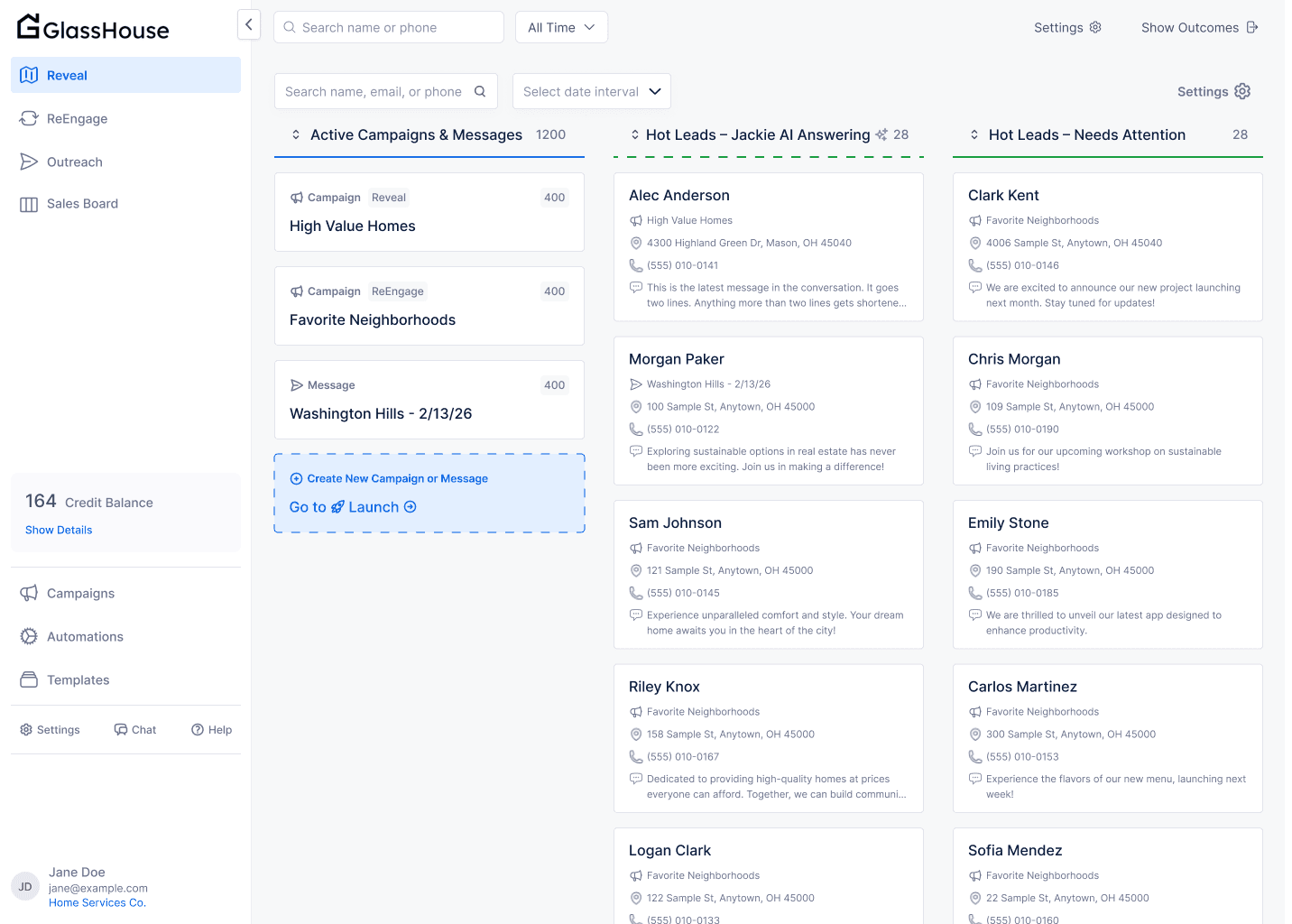
Every lead pushes to your CRM or FSM automatically, keeping your contact lists synced without anyone manually importing or exporting anything. This connection also works both ways:
You can import your existing customer base to power retargeting campaigns through GlassHouse. ReEngage uses that data to trigger upsell and cross-sell sequences — reaching maintenance customers with an upsell for irrigation systems or hardscape work, sending seasonal reactivation texts ahead of spring startup or fall winterization, or following up with a past design-build customer about a phase-two project like lighting or an outdoor kitchen.
It enriches your existing contact records with the property data from our system, so you have more context on each customer to hone your marketing messaging.
It maps your current customers so you can see where you already have a presence when building campaigns and exclude existing customers from new outreach.
Attribution is also a key piece here. Your sales dashboard lets you track replies and who you convert directly through those conversations. We can also help you identify leads that heard about you from a text you sent via GlassHouse, but contacted you through a different platform (like from your Google business page or your website).
How to get started with GlassHouse
Everyone starts with a free demo. Our team will pull real prospects in your market, walk you through the platform, and put together a package for you, complete with a custom ROI projection. (You can also check out the ROI calculator below to see just how much business GlassHouse can bring you.)
Pricing is straightforward after you get started. There's a $3,500/year platform fee, and you purchase credits on top of that — 3¢ each. Credits cover both revealing a property's contact info and sending a message. You can add credits any time you need, and they roll over for 12 months.
We offer flexible pricing and volume discounts for franchises. Our team can put together a custom package, complete with an ROI projection, based on your franchise's size and goals. You can schedule a demo to learn more.
Physical door knocking
This strategy is easy to implement because your crews are already working in neighborhoods. The simplest move is to knock on homes around a job while you're on-site: "We're already out here every week — want a quote for your yard too?"
That opener works on its own, but it lands even better with something specific to point to. Overgrown beds, a lawn that's clearly not getting regular care — anything that gives the homeowner a real reason to act. If nothing is obvious, the route angle still works.
The limit here isn't access; it's time and timing. You'll knock a lot of doors that never open — homeowners have to be home, available, and up for a conversation right then, and plenty aren't. Every minute spent on doors that don't answer is a minute off billable work, so this is best as an opportunistic add-on to routes you're already running, not something you build a dedicated push around.
Pairing it with GlassHouse gets around both limitations. Run digital outreach in a territory first, then send your crew to knock on the properties that replied but haven't booked yet — you're only spending time on homeowners who are already interested and expecting to hear from you.
Read more: Best Door Knocking Software for Home Service Teams
Yard signs, door hangers & mailers
A sharp, well-kept lawn next to an overgrown one is proof to anyone passing by. A few ways to put that work to use:
Yard signs: Place them wherever you're actively working — a maintenance stop, a completed design-build project — instead of buying blanket sign placement around town. A sign in a yard you just finished carries more weight than one with no job behind it.
Door hangers: Hit the 5 to 10 closest homes on either side of a job. And since your crews are back on the same streets every week, you can repeat this each visit instead of just once.
Direct mail: Works as a supplement, timed to seasonal triggers like spring cleanup or fall leaf removal offers. Rank it behind signs and hangers — it's slower and less targeted than either.
As an alternative to direct mailers, GlassHouse lets you send MMS messages. These are messages with pictures, like before-and-after photos of landscaping work you’ve done, seasonal offers, and more. This is cheaper than running a direct mail campaign and more immediate; i.e., texts can go out immediately, not a week or two after you’ve submitted the campaign.
Make all three trackable. A QR code linking to a quick quote form tells you how many leads came from a specific sign, hanger, or mailer and whether your investment is worthwhile.
Referrals & partnerships
Word of mouth carries weight no ad can match — a referral comes with a homeowner's trust already built in, and referrals convert at some of the highest rates in home services, typically 30% to 50%.
Winning these starts with what you do at the end of every job: Ask for a referral while the work is still fresh. Offering a dual-sided incentive through a structured referral program — a service credit for the customer who refers you, a discount for the new customer they send your way — helps you see more of these.
We also suggest asking for reviews in that same conversation. These serve a different purpose. They don't require a customer to hand your name to anyone directly, but anyone who searches you can see them, so they can win you business beyond your customers’ family and friends, and they keep working long after the job is done.
The only real downside with customer referrals alone is you don't control the pace. You might land one this month and then nothing for two more — there’s no way to know when the next one's coming or how many you'll see.
Establishing a broader referral network is one of the best ways to ramp these up.
Start by creating partnerships with other businesses and professionals. A few worth building for landscaping:
Property managers and HOAs are a natural fit for maintenance work — they manage multiple properties and need a reliable vendor for ongoing work. These relationships can win you bigger-ticket, long-term contracts where you run the landscaping for entire neighborhoods or apartment complexes. And since property managers often oversee commercial portfolios too, those relationships can lead to commercial clients like office parks, retail centers, and business or industrial complexes.
Real estate agents prepping a home for sale, pool installers, hardscape and patio contractors, and general contractors doing additions are natural fits for design-build work — anyone touching a property during a renovation is a potential referral source.
Local nurseries and garden centers are worth building relationships with too, since homeowners buying plants are often already looking for someone to install them.
You can also join your local BNI chapter or Chamber of Commerce, since these organizations are built specifically around businesses referring each other.
Building brand awareness in your community can also pay off. This may not generate referrals directly, but it builds the kind of name recognition that makes you the first call when someone does need a landscaper.
Show up at local events, like home and garden expos, farmers' markets, and community fairs.
Volunteer for a community project — a park cleanup, street planters, grounds work for a nonprofit. A yard sign at the site gives you something concrete to point to when talking about your involvement.
Sponsor something visible, like a local sports team or a charity 5K.
Another way to get your name out there and engage with homeowners is to join community social groups on sites like Nextdoor or Facebook. You can find groups or threads related to yard work, gardening, or patio projects and get active in those discussions — either offering advice or pitching your service, whatever makes sense for the conversation. Offering helpful insight here is what earns you the "local expert" reputation that can turn into a call later.
Website & local SEO
Every business needs a website — it's the first thing a homeowner checks before letting a landscaping crew onto their property. But how you build it determines whether it's just a credibility check or an actual lead engine. Optimizing your site for search engines helps people find you when they search for exactly what you do.
Your homepage needs to include your business name, logo, service areas, and a clear way to get in touch. An optional but helpful add: displaying your star rating and linking to your reviews and social profiles helps too, since it lets browsers click straight over and see the online presence you've built elsewhere.
Pair that with a contact page that lists your service areas and every way to reach you — your phone number and email address — plus a contact form or booking widget so homeowners can easily get in touch.
Build service pages individually for each type of work you offer: mowing, trimming, seasonal cleanups, hardscaping, patio installation, planting, and garden design. A homeowner looking for weekly mowing and one planning a $40K backyard renovation search completely differently — these pages help you rank for those specific searches. Each page should have unique messaging and FAQs to cover the gist of what homeowners should know about each service. The more detail you put into these, the harder they work for you — better odds of ranking, a stronger pitch before anyone calls, fewer questions once they do.
Create location pages for each service area you cover. These are pulled in local search results for queries like "landscaping company in [city].”
Write blog content that catches homeowners earlier in the research process, before they're searching for a specific landscaping service or company. At this stage, they're not looking to hire yet — they've got a question, like when to aerate or what to do about drought-resistant plants, and they're just looking for an answer. Building content around those questions gets you in front of them before your competitors even show up. That free advice also earns you points with Googlers. Some homeowners will remember your name and call when they're ready. Others will read what you wrote, realize the job's bigger than they thought, and call you right then, already knowing you can handle it. A few topic ideas for landscaping: drought-resistant plants for your region, when to aerate and overseed, spring cleanup checklists, hardscape design trend roundups, and cost breakdowns for backyard renovations.
One more addition worth making: a quick quote calculator or consultation form tied to project type — maintenance or design — instead of a static contact form. It captures the lead and routes it correctly from the moment someone submits, rather than you sorting it out after the fact.
Beyond content, make sure the site itself holds up: pages should load quickly and work cleanly on both desktop and mobile. Check this yourself by pulling up your site on a few different devices and clicking through the main pages, and use Google's PageSpeed Insights to measure load times and see where you stand.
Another thing to mention is GEO, a.k.a. generative engine optimization — optimizing for AI so you show up when homeowners ask AI tools like ChatGPT, Gemini, or Perplexity for recommendations.
This has become a huge topic of discussion in the last few years as more people use AI to research, and it can sound like a separate discipline you now have to learn on top of search engine optimization. But it isn't: these tools pull from top-ranking search results to build their answers, so a well-optimized site is already covering most of the GEO ground.
Social media
Often when landscaping companies are creating social media content, they’re focusing on creating a mix of proof content, audience content, and lifestyle content.
Proof content is showing your audience your landscaping results. This means before-and-after transformations, community makeover stories, etc.
Audience content tends to be more educational. This can mean showing your audience how to do basic maintenance or teaching your audience about different landscaping strategies and methods.
Lifestyle content is about showing the people behind your landscaping company. This can include day-in-the-life vlogs of a landscaper or “hot take” opinions from your team.
To help your social media content pick up traction, you can focus on using recurring characters (think of a spokesperson for the account), trending audios, and writing detailed captions with your posts.
For a lead gen tool, social media posts often cast a wide net, and you may get far more engagement than you do actual leads. However, a healthy social media account can lead to strong social proofing. That is, if someone hears about your landscaping company, looks you up, and finds your content, they may be more likely to hire your landscaping company based on how they resonate with your social media presence.
Online directories & map packs
Online directories put you in front of homeowners who are already looking to hire, often before they ever reach your website. And creating profiles on these directory sites is completely free.
Google Business Profile matters most here — these profiles show up in the map pack above organic search results, right where someone searching "landscaper near me" would see you first. Googlers can see your star rating, reviews, and hours, with quick links to your website or a call.
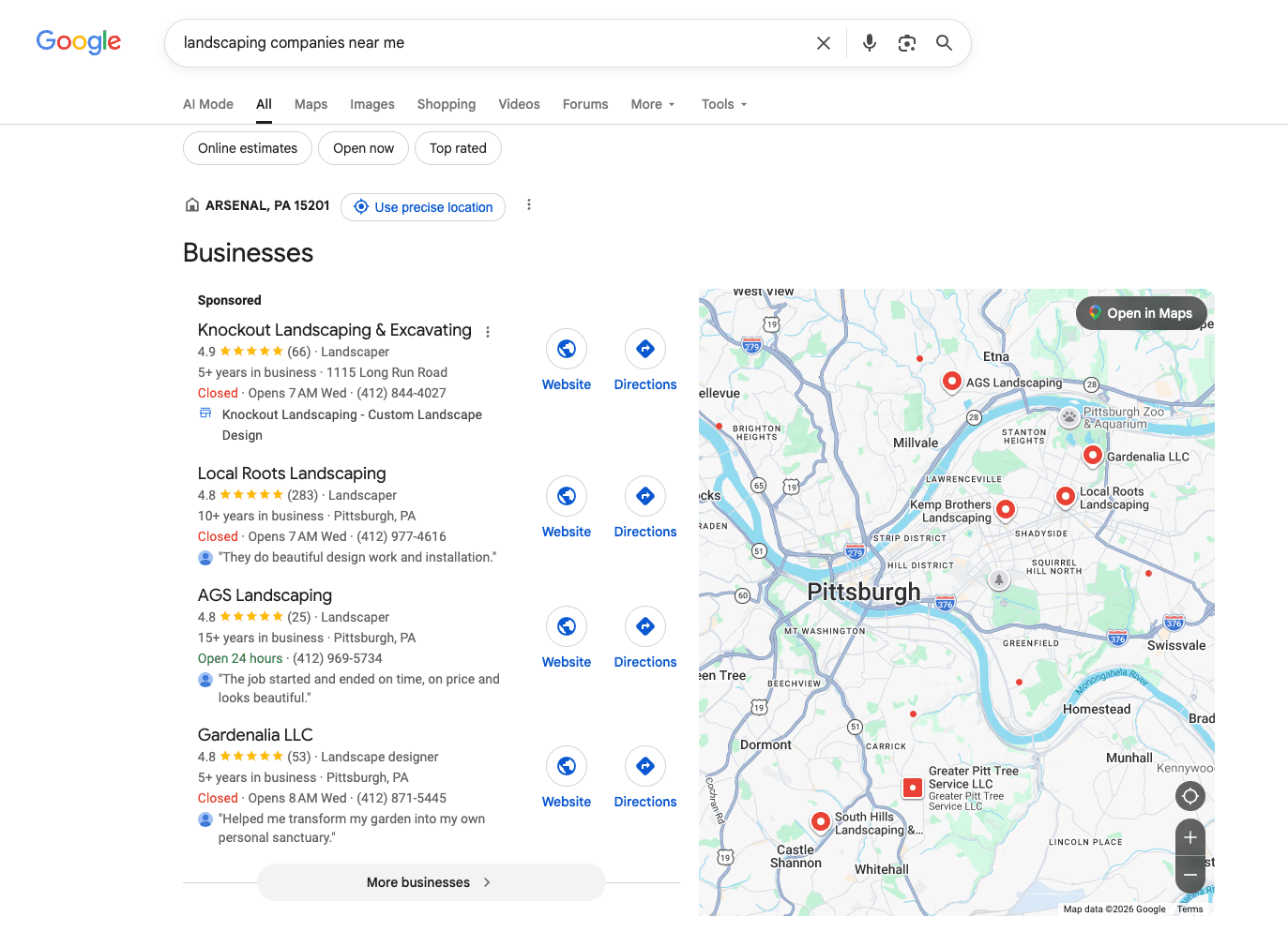
Beyond GBP, it's worth claiming profiles on Bing Places for Business, Apple Business Connect, and Yelp. These work the same way and give you visibility wherever homeowners start their search.
Setup is the same across all four: claim or create your profile, fill in your business details, and upload photos from past jobs.
One GBP setup tip that’s easy to skip: Use the service list to tag your specific offerings — mowing, hardscaping, patio installation — rather than leaving it as a generic "landscaping" category. It's a small detail, but it lets you show up when someone searches for a specific service instead of just the broad term (the same logic behind splitting your service pages by type of work).
After you create profiles, the focus is on reviews. Ask every customer for a review and respond to each one you get, good or bad. A higher star rating and staying active on your page helps your profile move up the map pack rankings, so you get listed above competitors.
Paid ads
Paid ads buy you improved visibility across search and social media, and work well as a complement to your existing strategies. They can get you listed in search results before your website or Google Business Profile ranks well on its own, or put you in front of homeowners on social media while your organic following is still building.
The tradeoff is cost. How well that cost pays off depends on intent. A homeowner searching "lawn care service near me" is ready to hire. Someone scrolling Facebook wasn't necessarily thinking about their yard.
Start with higher-intent channels, then use whatever budget you have left to test the lower-intent channels and see what they bring you.
Google Search Ads put you at the top of results for whatever keywords you bid on. Maintenance-intent searches tend to run cheaper — a few dollars per click — while design-build searches like "hardscape contractor" or "backyard renovation cost" cost more per click but represent a much bigger payoff per closed job, so a higher bid is easier to justify there.
Google Local Services Ads (LSAs) work differently: you pay per verified lead instead of per click, and Google matches you to relevant searches based on your business profile rather than you bidding on keywords yourself. This works well for any service type, but especially for design-build work, where a single high-CPC click that doesn't convert would otherwise cost you a chunk of change for nothing.
Microsoft/Bing Ads work the same way as Google Search Ads, but run on Microsoft's network — Bing, Yahoo, MSN, and AOL. These ads tend to have a lower CPC than Google Ads, which makes this a good place to start if you have a tight budget and want to get the hang of running search campaigns without the risk of blowing through spend. The downside — and why ads are so cheap — is that Microsoft’s network doesn’t get as much traffic as Google’s. It has fewer users, so lower search volumes, and fewer advertisers.
Facebook and Instagram ads generally cost less per lead than search, though the leads tend to be colder since nobody's actively searching when they see the ad. These work best for retargeting people who've already visited your site and building awareness.
Nextdoor ads are worth testing given how much of the platform's user base is homeowners. Targeting here works by drawing neighborhood boundaries rather than a broad radius, so you can put your ad in front of the specific streets your crews already work instead of paying to reach an entire zip code.
Whichever channels you run, build a landing page to match each ad — a maintenance ad should land on a maintenance page, a design-build ad on your portfolio or gallery page. Sending the click somewhere that matches what the person clicked on turns that traffic into a lead instead of a bounce.
Lead providers
The very last option on our list is to buy landscaping and lawn care leads from lead providers. This should be a fallback for filling gaps — it shouldn’t be a big part of your lead gen mix or a strategy to build around.
If you're going to spend money here, exclusive lead providers are the best way to go. They sell leads to just one company at a time, so you have a fair shot at converting and winning the business. Service Allies, 33 Mile Radius, and Minoya are some popular sites in this category.
Commission-based marketplaces are also an option, though they work differently than exclusive lead providers. Instead of charging per lead, they take a cut of each completed job. GreenPal and LawnStarter are the two names to know here. GreenPal runs a bidding model at roughly 5% per job, while LawnStarter sets pricing algorithmically and takes its share without bidding.
Shared marketplaces — Angi, HomeAdvisor, Thumbtack, Houzz — should be your last resort. Leads here are expensive and close rates are low, so many home service businesses spend hundreds of dollars just to win a single customer. That’s because the shared lead model doesn't work to your advantage or give you a decent chance of winning business. The same homeowner request gets sent to you and several competitors at once, so you're racing to respond and still competing on price after you win the race.
Again, none of these should be where your business lives. You should only buy leads to fill a slow stretch or a gap between jobs. Your pipeline should not depend on these channels.
Read more: How to Get Leads Without Paying for Angi & HomeAdvisor
Turn new customers into long-term accounts
Winning the job starts the relationship; it’s not the end of the transaction. What each relationship needs next depends on which kind of customer you just won.
For maintenance customers, a few practices make renewal more likely:
Make continuation the default, not something the customer has to opt back into. A seasonal contract needs them to actively come back next spring; an auto-renewing one just needs them not to cancel. Where you have the choice, build it the second way — the less action required to stay on, the less likely someone is to quietly drift off simply because they never got around to responding.
Stay visible around the decision point, whether that's a pre-season check-in or a heads-up ahead of an annual renewal date.
Walk the property yourself before that conversation happens, rather than waiting for the customer to bring up a problem. Catching a thinning patch of turf or an overgrown bed is a very different conversation than getting a complaint right when you're asking them to sign on for another year.
Flag things you notice between visits, even outside your scope — a broken sprinkler head, a drainage issue. That's what makes you someone who looks out for their property, not just someone who mows it.
Address price increases directly instead of letting them show up as a surprise. Customers generally accept an increase when you explain it with something specific behind it, and a price bump you raise ahead of time is far less likely to send them calling around than one that shows up on the invoice with no explanation.
Offer tiered plans — a basic mow-and-go vs. a full-property plan bundling mowing, bed care, and seasonal cleanups — so renewal can also be a chance to move someone up a tier, not just a repeat of the same contract.
A design-build project isn't necessarily finished just because the crew packed up. The yard you just built often needs maintenance. Pitch a contract before you leave the final walkthrough, while the new landscape is still top of mind. And a renovation today can turn into lighting, irrigation, or a phase-two expansion a year or two out. Send project photos and "here's what's possible next" messaging rather than assuming they'll think to call you again.
A few practices help you hold onto both kinds of customers, not just one or the other:
Upsell while you're already on-site. "Since we're already here for the mow, want us to handle that mulch bed too?" costs you nothing but the ask.
Deliver a five-star experience. That starts with doing the work well every time — a lawn that actually looks good, a job that's actually finished right. Layer reliable scheduling and clear communication on top of that, and you've got a crew customers trust enough to keep on the books indefinitely.
Request reviews right after a job, while the finished work is right in front of them and customer satisfaction is at its peak.
Use GlassHouse's ReEngage feature to bring past customers back into the mix — reaching out for seasonal reactivation or an upsell, rather than only using outreach to chase new leads.
Keep a CRM running underneath all of this, tracking service history, contract renewal dates, and follow-ups, so none of the above depends on someone remembering to do it manually.
How to build & optimize your lead gen mix
Getting your channel mix right isn't a one-time decision. It takes testing, some trial and error, and ongoing refinement as you see what actually works for your business. Here’s what we suggest: look at how much you want to increase your earnings and the metrics that help you figure out what you need to get to that goal.
For example, if you want to earn an extra $150,000, you can break that down to how many leads you need if you know your average annual value per customer and close rate.
If your average annual value per customer is $2,500 and your close rate is 30%, then you need 200 leads to get those 60 new customers that would bring in that extra $150k.
Layer your channels rather than betting on one.
Start with GlassHouse around your existing route density, since that's ground you already occupy. Add yard signs and door hangers on the jobs you're actively running, then add referrals and partnerships, split between maintenance and design-build. Build out your website so homeowners can find you on their own, and claim your online directories for fast, free visibility. Use social media to show off your work and connect with homeowners directly. Layer in intent-matched paid ads once everything above is running. Lead providers come last, and only to fill a gap — never as the foundation.
How you weight these channels should shift with the size of your operation:
Growing crews keep all of the above running while investing more in building out their website and social media platforms, since job volume is now high enough to make an ongoing content presence worthwhile.
Larger operations should layer in paid ads across search and social, since the volume and margin at this size can support the higher cost per lead.
Once your mix is running, measure performance across channels.
Track cost per lead, close rate, and lead source by channel. Also pay attention to which leads convert into recurring accounts vs. one-off jobs. A channel that produces one-time customers is worth less here than one that produces contract renewals, even at the same cost per lead.
Once you know which channels bring you the best ROI, you can double down on those channels and cut what isn’t working to fine-tune your mix.
Getting started
Every strategy in this guide works better with a full pipeline behind it, and GlassHouse is how you build one before the season even gets busy. Reach the homeowners on the same streets your crews already work, and turn those conversations into your next contracts.
Schedule a free demo to see how GlassHouse gives you greater control of your pipeline.