How to Increase ROI on Your D2D Solar Sales
By Makayla Schultheis

When solar companies come to us, they're typically relying on a mix of traditional door-to-door sales and various marketing strategies, like direct mailers and running ads, to get new customers.
While those strategies can work, these companies are often struggling to generate a strong ROI. They're paying more than they'd like in cost per lead, which makes it harder to grow their business. There are several reasons for this, including a shift in the solar industry.
In this post, we cover:
Why ROI is down for solar companies
How companies are adapting to shifts in the solar industry
How digital door knocking can help increase your ROI and lower your cost per lead
About us: GlassHouse helps your solar company increase your ROI by lowering your cost per lead. We do this by sending targeted, personalized text messages and emails to prospective customers. Schedule a demo to learn more.
Why ROI is down for solar companies
First, the solar industry is changing
On July 4, 2025, the One Big Beautiful Bill was signed into law, ending the Section 25D Residential Clean Energy Credit for expenditures made after December 31, 2025. Homeowners could claim 30% of the cost of qualifying solar systems installed by that date, but installations completed afterward are no longer eligible.
Without the credit, solar systems can cost homeowners more out of pocket, extending the payback period and weakening the savings pitch that closed deals a year ago.
Because of this, Wood Mackenzie — a global research firm specializing in energy, renewables, and natural resources — projects two significant effects:
A shrinking buyer pool. The residential solar market is projected to contract 19% in 2026.
Higher acquisition costs. Customer acquisition costs are projected to rise roughly 40% in 2026, from $0.60 per watt to $0.84 per watt, as installers compete for a smaller customer base.
Second, traditional door-to-door selling is an effective but costly way to find new customers
Door knocking still produces business. But it’s always been the most labor-intensive channel available.
This is because:
Door knocking requires a lot of manpower. Your coverage is capped by how many reps you can hire, train, and retain. Reps work on commission and take a share of the sales they close, so the cost scales with volume rather than dropping as you grow.
Door-to-door sales usually involve a lack of personalization. As reps canvass a neighborhood, they're often knocking blind. They don't know who lives behind the door, or whether the property is a good fit for solar.
There’s an inherent uphill battle with cold outreach. A rep first needs someone to be home and willing to open the door to a stranger. When that happens, the conversation usually starts with a homeowner who hasn't heard of your company. Those are difficult sales to close, which contributes to your high cost per lead: it takes a large number of doors to produce one.
Plus, if a neighborhood adopts anti-solicitation rules, then there are whole areas of a city you cannot reach out to.
But these challenges, which have always existed, are more of an issue now as the buyer market shrinks and acquisition costs rise.
How solar companies are addressing these issues
The changes above shifted what a productive sales strategy looks like. Three adjustments are common.
Targeting higher-end neighborhoods
Without the 30% credit, homeowners cover more of the system cost themselves. The ability to self-fund is now a bigger qualifier than it once was, and higher-value homes tend to fit that profile more often.
Larger homes also tend to carry higher electricity bills, and a bigger bill strengthens the return case for the system. Filtering a territory by home value, home size, lot size, home age, and last sale date narrows outreach to the homeowners most likely to buy, which matters more as the cost of reaching each one climbs.
This kind of filtering can be difficult for solar companies. For example, you can choose more affluent neighborhoods to canvass in, but that doesn’t give you insight into the individual homeowners you’re actually targeting. You can also find out about home size and home age, but it’s not efficient to do this house by house. When you use GlassHouse, you can choose who to reach out to and filter prospects by criteria such as income, home size, home age, etc.
Running a density strategy
A density strategy means picking one neighborhood, working the houses in it, finishing, and moving on — rather than spreading outreach thin across a metro.
Concentration pays off in three ways:
Installed systems are visible to the neighbors, so completed jobs create local proof for the next sale on that street.
You learn one jurisdiction's permit process and reuse it, which generally makes the second install in a town cheaper than the first.
Your pitch gains a local reference point, since "we just finished a system nearby" only carries weight when the work is close by.
Scattered outreach produces none of those compounding effects. With acquisition costs rising, the difference between the two approaches widens.
Framing the pitch against rate hikes
The standard solar pitch has been a savings number: here is what you'll save over the life of the system. That number depended on the federal credit covering part of the upfront cost, so solar became harder to sell once the credit expired.
Framing solar as a hedge works differently. Utility rates rise, homeowners have no control over them, and a solar system fixes a portion of that cost. The argument doesn't rest on an incentive, so the change to 25D doesn't weaken it.
Two related angles work on the same logic:
First, energy independence and backup power during outages, which is a stronger framing if you sell battery add-ons.
Second, the resale value of your customer’s home, since homes with owned systems generally sell for more. (Though there isn’t as much data around this since the energy credit was cut.)
Next, we discuss how to increase ROI with strategic, intentional, and personalized outbound marketing.
How GlassHouse helps you get new customers with a higher ROI
At GlassHouse, we offer a digital door knocking service that has helped our clients – solar companies as well as roofing companies and other home service businesses – get new customers while having a higher ROI.
Digital door knocking works the same way physical door knocking always has, with some key improvements. You pick a neighborhood, choose which doors to knock, and get right in front of homeowners with your pitch — except our "front door" is a phone screen.
Digital door knocking comes with unique benefits over traditional door knocking:
You can reach many qualified homeowners in a territory at once. Instead of sending a rep to knock 40 doors and hope five open, you can send texts to hundreds of eligible homeowners.
You can tailor every message and connect with homeowners on a more personal level. Create campaigns based on the homeowners you’re targeting and focus your messaging on what matters most to them.
Homeowners can respond on their own schedule, rather than needing to be home and ready for a face-to-face conversation when a rep shows up. Because people check their phones throughout the day, they can read and respond whenever it’s convenient for them.
Digital door knocking isn't affected by anti-solicitation laws, since you're not physically knocking on anyone's door. Further, because of how we remain compliant with federal laws and work to adhere to carrier requirements, our messages are much more likely to get seen by your customers. (We cover the compliance side of outbound texting below.)
Plus, with GlassHouse, you can more easily see the results of your efforts. You can track attribution from your dashboard and also use our software to re-engage with prospects down the line. We offer integrations with leading FSMs and CRMs, which let you track the life of a lead generated through GlassHouse.
Here are some results from actual GlassHouse customers:
Matt Bielawa of Mighty Dog Roofing shared: “In just one month of use, we've generated 28 booked appointments and closed just under $100k in revenue.” His cost per appointment landed at $197. He's since booked another $35,000 in revenue, with $126,000 in outstanding proposals.
Tasia Haygood, who runs PaintEZ in Grand Rapids, uses GlassHouse to text homeowners near every job site to ask if they've got painting work of their own. This wins her team 1 to 2 extra leads per job. It gets her in front of a ton of homeowners at once and lets her connect with them in a way her competitors aren’t. Watch her full story here.
You can schedule a demo to learn more, or keep reading for an overview of how to use GlassHouse’s software.
First, target the neighborhoods most likely to go solar
Start by drawing your target territory on a map. You can draw any shape, down to specific streets.
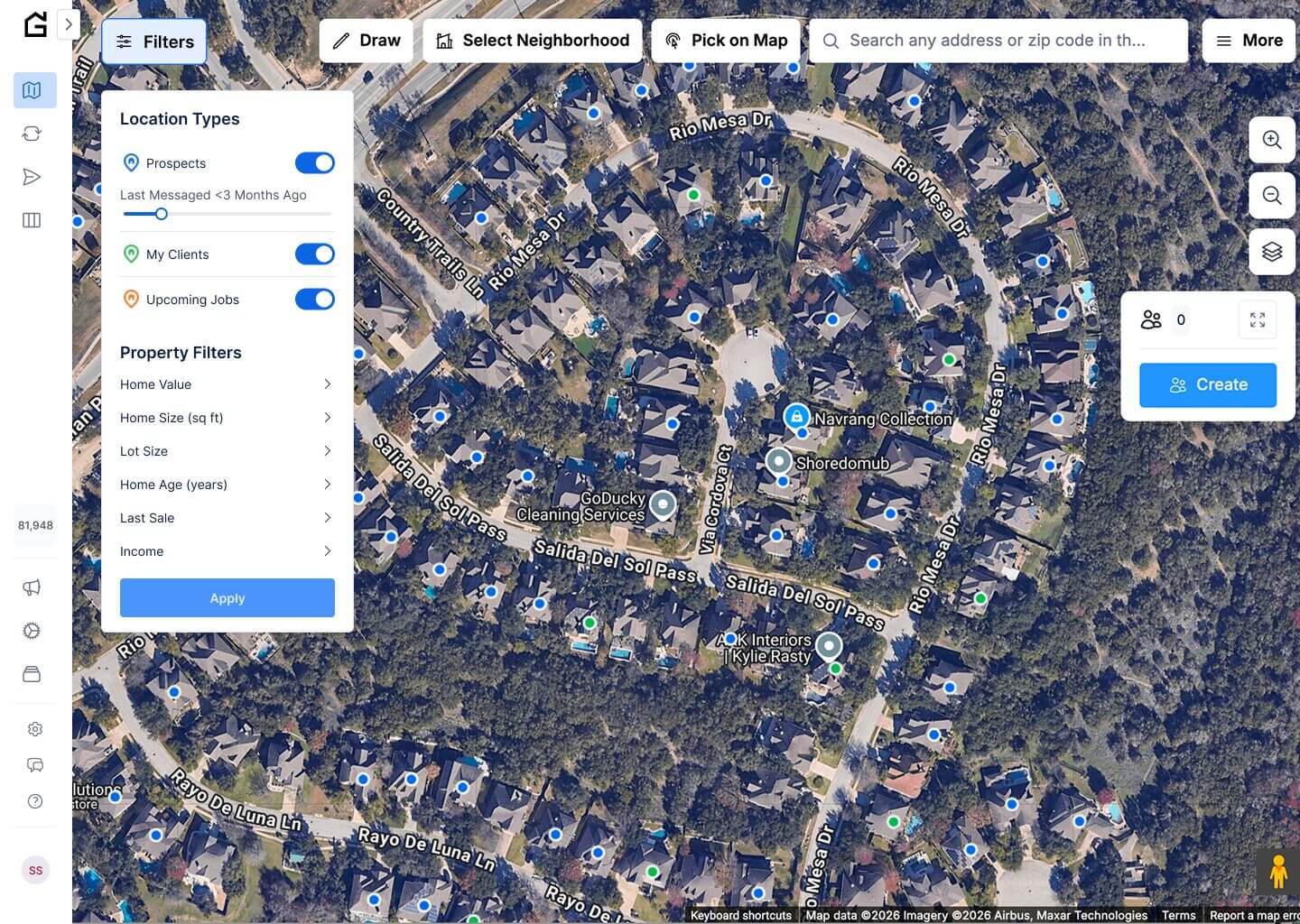
Your existing and upcoming jobs show up as pins: green for completed installs, orange for upcoming jobs. Use these to plan your next move.
For solar, the density strategy works best: pick a neighborhood, work every house in it, and move on once you've covered it.
Most teams start in neighborhoods where they've already installed solar panels. Those systems are visible proof to the neighbors, and you already know the permit process for that area, which makes the next install smoother.
Once you've drawn your territory, set your filters: home value, home size, lot size, home age, and last sale date.
We recommend prioritizing higher-end neighborhoods, where homeowners are more likely to have the means to invest in clean energy. With the federal residential credit no longer available, homeowners need to cover more of the cost themselves. Those larger homes typically have higher electricity bills, too, and a bigger bill means a stronger ROI case for your solar pitch.
Hit Reveal, and GlassHouse pulls all the properties that match your search criteria, giving you a list of contactable homeowners that fit your criteria.
While digital door knocking is exempt from door-to-door anti-solicitation laws, text message marketing comes with its own set of rules. You can’t reach out to homeowners on TCPA litigator lists or Do-Not-Call registries. You can only send messages at approved hours, and you have to honor opt-outs. Here’s how we built GlassHouse for compliance:
Read more: Is Outbound SMS Legal for Home Service Businesses? |
Second, build personalized campaigns that actually spark conversations
Once you've got your contact list, you can build your SMS campaign — a one-time blast or multi-step drip. As mentioned above, the system comes with preloaded templates to help with this. They all meet carrier requirements and are conversion-optimized, with clear calls to action that actually get homeowners texting back.
Here's an example:
Hi [Name], it's [Your Name] from [Company Name]. We just finished a solar installation on [Street] and wanted to reach out to neighbors. Happy to walk you through what a system like this could shave off your utility bill — interested? |
Our team can also help you hone your brand messaging and sales pitch, and create new templates to pull from. For example, you might also want to try:
Framing solar as a hedge against rising utility rates and unpredictable energy bills, instead of a one-time savings number.
Leading with energy independence and backup power during outages, especially if you offer battery add-ons.
Pointing to resale value — homes with owned solar systems tend to sell for more, which can appeal to homeowners who see this as a long-term investment, not just a bill reduction.
After you’ve got your messaging down, you can schedule texts to send.
Third, manage every conversation in one place
Now you’ve got replies coming in. This is where a lot of outbound strategies fall apart. Managing dozens (or hundreds) of homeowner conversations by hand isn't realistic, especially on top of everything else it takes to run a solar business.
GlassHouse comes with a couple of tools to help:
An AI Sales Assistant that manages replies and initial conversations. It ensures every homeowner gets a quick response, qualifies the lead, and sets up times for estimates or consultations.
The Sales Board displays all positive replies and each lead’s status. (Remember, we manage opt-outs for you so those replies don’t land on your sales board.) This Kanban-style board makes it easy to visualize every lead stage so you can see who’s still awaiting a reply, who the AI agent is responding to, and who needs human attention.
Connections with your CRM or FSM automatically push new GlassHouse leads to your existing system. This improves lead management, and lets you track direct revenue from GlassHouse as well as cross-reference customers against your outbound campaigns, so you see the homeowner who got your text, Googled you, and called you weeks later.
The connection with your CRM or FSM also works both ways. You can push your customer list into GlassHouse to power ReEngage, and run SMS campaigns to past customers around battery add-ons, system upgrades, referrals, you name it.
Importing your contact list is also what enables our system to display pins over existing customers, so you can plan outreach around those neighborhoods and exclude homeowners you've already worked with from new outreach campaigns.
With these tools at your disposal, you're not manually tracking who replied “interested,” who ghosted, or who asked to be texted next month. It's all sitting in one place, updated in real time.
Plus, see what your outreach actually generated
Below you can see an example of your Performance Dashboard.
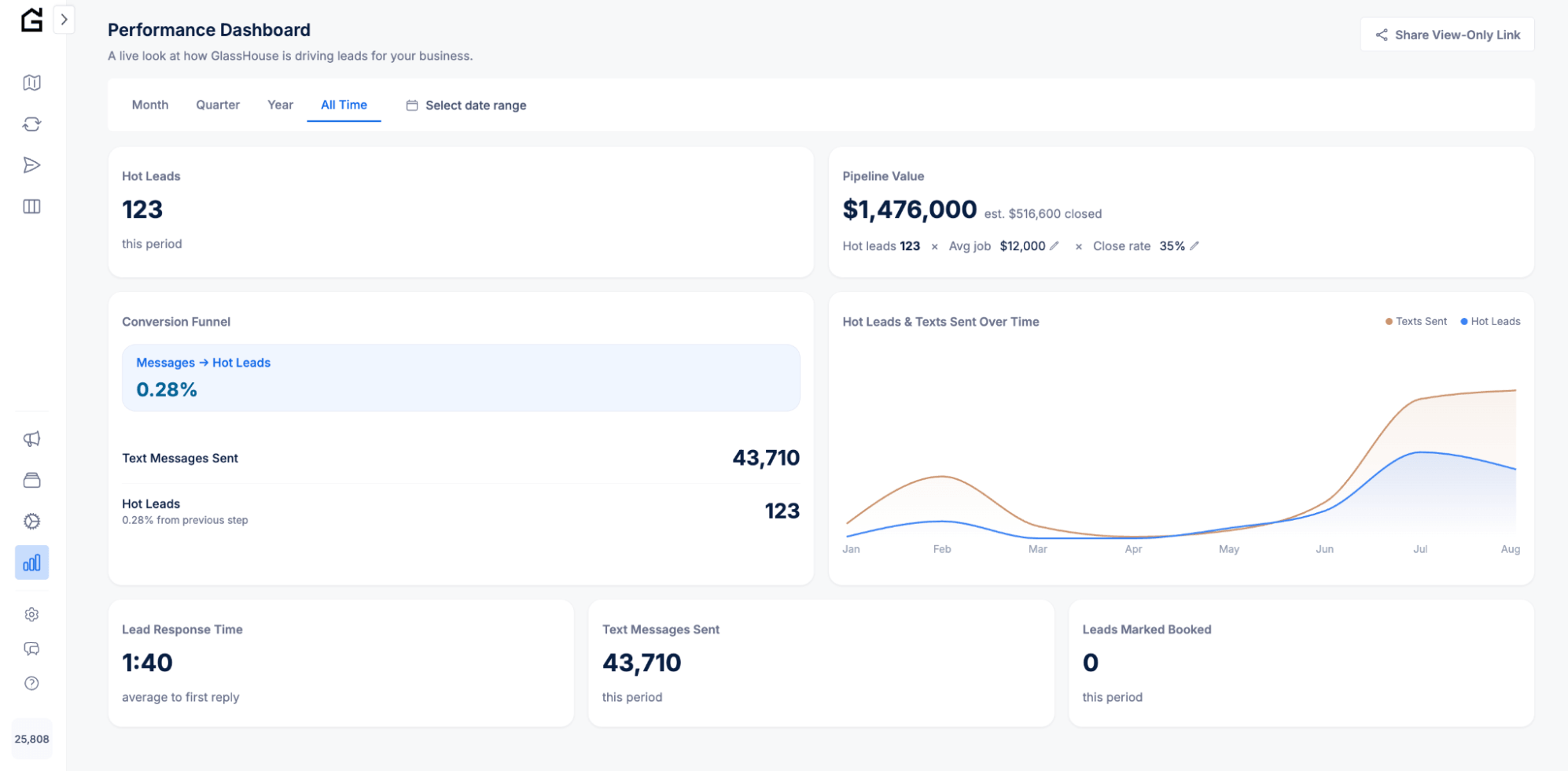
This shows you key metrics such as:
Number of hot leads
Pipeline value
Average job value
We can report on both direct revenue and revenue influence. This helps you see the total value of your outreach campaigns run through GlassHouse and get an accurate picture of your cost per lead.
Getting started
If you want to learn more about how GlassHouse lets you level up your solar sales strategy, schedule a free demo with our team. We'll pull real prospects from your area, walk you through the platform live, and build a strategy around your business, complete with a custom ROI projection.
Related reads: